
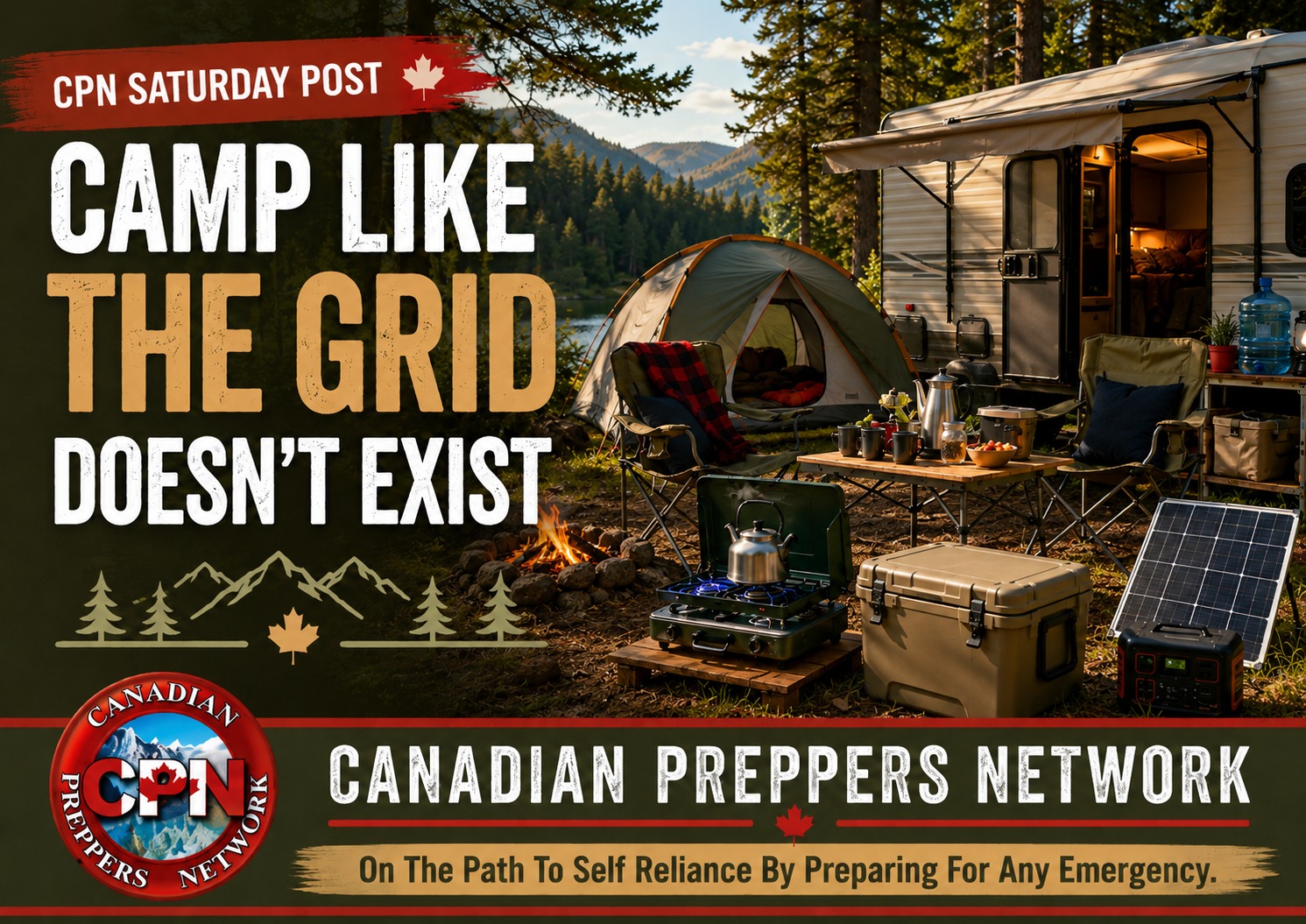
A comfortable weekend outdoors begins with your own food, power and routine—not campground services.
A campsite should be treated as a patch of ground, not a hotel room surrounded by trees.
Anything beyond that patch of ground—electricity, prepared meals, refrigeration, internet access or other conveniences—is a bonus. When campers arrive expecting to provide those things for themselves, the quality of the campground matters less and the quality of the weekend improves considerably.
This does not mean spending several uncomfortable days eating cold beans beside a dead cellphone. Self-contained camping can be comfortable, well-fed and surprisingly easy. It simply requires thinking through a few ordinary household functions before leaving home.
For preppers, this is more than a camping strategy. It is an opportunity to practise living well without depending upon a building, an electrical outlet or somebody else’s kitchen.
Begin With the Right Assumption
The easiest way to become frustrated at a campsite is to arrive without knowing which services you expect to use.
Instead, begin with a simple assumption:
The site provides space. You provide everything else.
That one decision eliminates much of the uncertainty. You are no longer wondering where you will charge a telephone, what will be available for breakfast or whether you can find a hot meal late in the evening.
Your campsite becomes a small, temporary household containing its own kitchen, lighting, power, water, sleeping area and sanitation supplies.
You do not need an expensive recreational vehicle to accomplish this. A tent, vehicle or small trailer can all support a highly functional camp when the systems around them have been planned properly.
Build a Camp Kitchen, Not a Pile of Snacks
Many campers bring plenty of food but no real meal plan.
The result is a cooler full of ingredients that require too much preparation, a collection of snacks that never becomes a satisfying meal, or repeated trips away from the campground in search of food.
A better system begins by planning each meal before packing.
For a three-day stay, write down three breakfasts, three lunches and three suppers. Add coffee, drinks and one or two evening snacks. Then pack only what those meals require, with a modest reserve for delays or unexpected guests.
Good camp meals use few ingredients, require little preparation, create minimal washing, do not depend entirely upon refrigeration and can be cooked with one burner or eaten without cooking.
Breakfast can be oatmeal, eggs, breakfast wraps, bannock or granola. Lunch can be sandwiches, canned fish, cured meat, cheese, crackers, soup or leftovers. Suppers can include chili, stew, pasta, foil-packet meals, sausages, rice dishes or food prepared at home and reheated at camp.
Preparing some meals before departure dramatically reduces work. Chili, stew, pulled meat, pasta sauce and cooked breakfast fillings can be portioned at home and reheated when needed.
This is also a useful preparedness exercise. A real emergency kitchen will not have unlimited water, counter space, refrigeration or cooking fuel. Camping exposes the weaknesses in a meal plan while the consequences are still minor.
Freeze-Dried Meals Simplify Camp Cooking
Freeze-dried meals are particularly useful for self-contained camping because most require nothing more than measured hot water and a short waiting period.
They eliminate much of the chopping, refrigeration, cooking and dishwashing associated with conventional meals. In many cases, the meal can be reconstituted directly inside its pouch, leaving only a spoon to clean.
Commercial freeze-dried meals are convenient, compact and easy to portion. Home freeze-dried meals can offer greater control over ingredients, serving size and cost, especially for households that already own a freeze dryer.
They are useful for late arrivals, rainy evenings, quick lunches and those times when nobody wants to build a complete camp kitchen after a full day of activities. Keeping a few extra pouches also provides a simple reserve meal if the trip lasts longer than expected or another camper arrives without enough food.
However, freeze-dried food is not entirely resource-free. It still requires potable water and usually requires fuel to heat that water. Include the reconstitution water in the camp’s overall water calculation and make sure the stove fuel supply reflects the number of meals being prepared.
For groups, a large kettle can heat enough water for several meals at once, reducing fuel use and shortening the time spent cooking.
Freeze-dried meals should not necessarily replace every camp meal. They work best as one component of a broader food plan that includes fresh meals, preserved foods and items that can be eaten without cooking.
Use a Simple Cooking System
A camp kitchen does not need six appliances.
For most short trips, a reliable outdoor stove, appropriate fuel, a covered pot, a frying pan and a kettle will handle nearly everything. Add basic utensils, a cutting board, a sharp kitchen knife, a can opener and heat-resistant gloves.
The stove should be tested before leaving home. Verify that it lights properly, the fuel connections are sound and enough fuel has been packed for the entire stay.
A second cooking method is worthwhile, but it does not have to be elaborate. Depending upon the location and applicable fire restrictions, that backup might be another small burner, a charcoal grill, a suitable campfire setup or meals that require only hot water.
Outdoor fuel-burning appliances must remain outdoors and be used according to their instructions. Tents, enclosed shelters and vehicles are not safe cooking areas.
Hot water deserves special attention. It is required for coffee, tea, freeze-dried meals, washing dishes and some sanitation tasks. A kettle or covered pot heats water faster and uses less fuel than an uncovered cooking vessel.
For more ideas, see Boiling Water Without Power and Rehydrating Freeze-Dried Food Off Grid.
Control the Cooler Instead of Constantly Opening It
The cooler often becomes the weakest part of the camp kitchen.
People open it repeatedly for drinks, leave it exposed to the sun and fill it with loose bags of melting ice. By the second day, food may be floating in questionable water while the remaining ice disappears quickly.
Use separate coolers for food and drinks when possible. The drink cooler will be opened frequently, while the food cooler can remain closed for longer periods.
Pack food inside sealed Tupperware-style containers before placing it in the cooler. Even when food is already wrapped or packaged, a rigid container provides another barrier against melted ice, leaking packages and water contaminated by raw meat juices or dirty hands.
Sealed containers also prevent bread, cheese, leftovers and prepared meals from becoming waterlogged as the ice melts.
Organizing foods into separate containers makes the cooler easier to manage. One container might hold breakfast ingredients, another lunch supplies and another prepared supper items. Instead of rummaging through loose packages with the lid open, the required container can be removed quickly and the cooler closed again.
Frozen water bottles and reusable ice packs create less mess than loose ice. They can also provide drinking water as they thaw. Pre-chilled food lasts longer than groceries placed into a warm cooler immediately before departure.
Keep coolers in shade, cover them with an insulating blanket and return food promptly after each meal.
Not every meal needs cold ingredients. Canned foods, dry staples, freeze-dried meals, shelf-stable milk, bread, tortillas, oatmeal, peanut butter and properly stored preserved foods reduce the burden on the cooler.
The goal is not to recreate the household refrigerator. It is to reserve limited cold storage for foods that genuinely require it while keeping those foods clean, dry and organized.
Reduce Electrical Demand Before Producing Power
The first step in off-grid power is not buying a larger battery.
It is deciding what actually needs electricity.
For many campers, the essential list is fairly short: mobile telephones, two-way radios, headlamps, camp lanterns, cameras, small fans and necessary personal equipment.
Begin the trip with every device fully charged. Download maps, schedules, tickets and reference information before leaving home so they remain available without internet service.
Place telephones in battery-saving mode and reduce screen brightness. Turn off Bluetooth, Wi-Fi and unnecessary background applications when they are not being used. A telephone that is checked periodically can last considerably longer than one that is constantly searching for a signal.
Small power banks are often sufficient for individual telephones, headlamps and other USB-powered equipment. One power bank per person also prevents everyone from depending upon a single shared battery.
Small solar-chargeable power banks can be particularly useful at an unserviced campsite. They can be placed in direct sunlight during the day and used to top up a telephone or another small device in the evening. Models with an integrated light can also serve as a backup lantern.
The small solar panel built into most pocket-sized power banks charges slowly. It should be considered a way to extend the battery or recover a small amount of power over time, not a rapid replacement for charging from an electrical outlet.
Charge the power bank fully at home before leaving and use its solar panel to maintain or supplement that stored energy.
A larger folding solar panel connected to a compatible power bank or portable power station will generally collect more energy than the small panel attached to a pocket-sized unit. This can be worthwhile when several people are sharing power or when the campsite will be occupied for multiple days.
Larger portable power stations become useful when equipment has greater electrical demands, but they also add weight, cost and complexity. For a short camping trip, several small power banks may be more practical than transporting a large battery system.
Vehicle charging provides another option while the vehicle is already being operated. Avoid repeatedly running accessories or drawing power from the starting battery while parked. The ability to start the vehicle and leave the campground is more important than squeezing out one more telephone charge.
More off-grid power options can be found in the Energy Production in Canada Preparedness Hub.
Lighting Should Be Personal and Shared
Every person should have a headlamp or flashlight.
A shared lantern may illuminate a table, but it does not help somebody walking back to a tent, searching inside a vehicle or making a nighttime trip across the campground.
Headlamps leave both hands free for cooking, carrying supplies and setting up equipment. Keep one in the same accessible location every time rather than burying it in a tent after dark.
Rechargeable lights work well when a power bank or solar charging system is available. Battery-operated lights remain useful as a backup. Whatever system is chosen, standardizing battery sizes and charging connections makes replacements easier.
Low-level lighting is usually better than flooding the entire campsite with bright light. It preserves night vision, uses less power and avoids shining into neighbouring sites.
Bring Water for More Than Drinking
Camp water planning often accounts for drinking but forgets cooking, coffee, washing and cleaning.
Freeze-dried meals increase the need for potable water, even though they reduce cooking and washing. Read the preparation instructions before packing so the required water can be included in the total.
Separate water into two categories.
Potable water is reserved for drinking, food preparation, reconstituting meals, brushing teeth and other uses where clean water is required. Utility water can be used for washing equipment and certain cleaning tasks where potable water is unnecessary.
Use containers that can be lifted and poured safely. A massive container may hold plenty of water but become awkward once full. Several manageable containers are usually easier to transport and distribute around camp.
A water container with a spigot creates a simple handwashing station when placed at the edge of a table. Add soap, a catch basin and a towel, and the campsite immediately becomes easier to manage.
For more information on stored and treated water, visit the Water Collection and Purification in Canada Preparedness Hub.
Comfort Comes From Small Systems
Comfort is not created by bringing every household convenience outdoors.
It comes from solving predictable problems before they become irritating.
Bring a chair that remains comfortable for more than ten minutes. Use an insulated sleeping pad instead of relying only upon a sleeping bag. Pack clothing for colder evenings, even when the daytime forecast looks warm.
Create shade before it is needed. Keep rain gear accessible rather than buried beneath other supplies. Place frequently used items in labelled bins so the campsite does not have to be dismantled every time somebody needs a lighter, utensil or charging cable.
A small entrance mat helps keep mud and grass out of tents and trailers. A folding table provides a clean food-preparation surface. A clothesline creates a place for wet towels and clothing.
None of these items is particularly exciting, but together they determine whether the campsite remains organized or gradually turns into a damp pile of equipment.
Plan for Waste and Cleanup
A self-contained campsite also manages its own waste.
Bring strong garbage bags and separate food waste from recyclables where practical. Keep garbage secured from animals and remove it according to the campground’s rules.
Use a small wash basin rather than running water continuously. Scrape dishes thoroughly before washing them. Meals that use one pot, require only hot water or allow people to eat directly from the cooking container reduce both water use and cleanup.
Freeze-dried meal pouches create relatively little food waste, but the empty packaging still needs to be packed out and disposed of properly.
Paper plates may reduce washing, but reusable dishes create less garbage. The right balance depends upon the water available, length of the trip and number of campers.
A clean camp is easier to operate, less attractive to animals and more pleasant for everyone nearby.
Conduct a Short Practice Run
The best time to discover that a stove connector is missing is not at supper.
Set up the core camp system at home before departure. Cook one meal using only the equipment that will be packed. Prepare a freeze-dried meal and note how much water and fuel it actually requires.
Charge a telephone, headlamp and radio from the planned power banks. Place a solar-chargeable power bank outside for a day and see how much energy it realistically collects under local conditions.
Spend an evening using only the lighting that will be taken to camp.
This simple rehearsal reveals missing utensils, insufficient fuel, incompatible charging cables, uncomfortable bedding and equipment that has not been used in years.
It also prevents overpacking. Many people discover that they need fewer gadgets but more organization.
Build a Self-Contained Campsite
As an Amazon Associate, Canadian Preppers Network earns from qualifying purchases.
Solar-Chargeable Power Banks
Keep telephones, USB lights and small electronics running without depending entirely upon campground electricity.
Freeze-Dried Camping Meals
Compact meals that generally require only measured hot water and a few minutes to reconstitute.
Portable Camping Stoves
A dependable outdoor cooking method for boiling water, heating prepared meals and cooking basic camp food.
Camping Kettles
A covered kettle makes heating water for coffee, freeze-dried meals and cleanup faster and more fuel-efficient.
Airtight Food Storage Containers
Keep food organized and protected from cooler meltwater, leaking packages and cross-contamination.
Camping Water Containers With Spigots
Useful for storing potable water and creating a simple handwashing station at the campsite.
Self-Contained Camping Is Preparedness in Practice
Camping without depending upon built-in services is not hardship camping.
It is a temporary demonstration that food, light, power, water and comfort can be created with systems you control.
Once those systems are established, the campsite becomes a base rather than a problem to solve. Meals are available when you want them. Devices remain charged. Lighting is ready after dark. The cooler stays organized. The weekend is spent participating, learning and visiting instead of leaving the property in search of supplies.
That is exactly what a preparedness gathering should encourage.
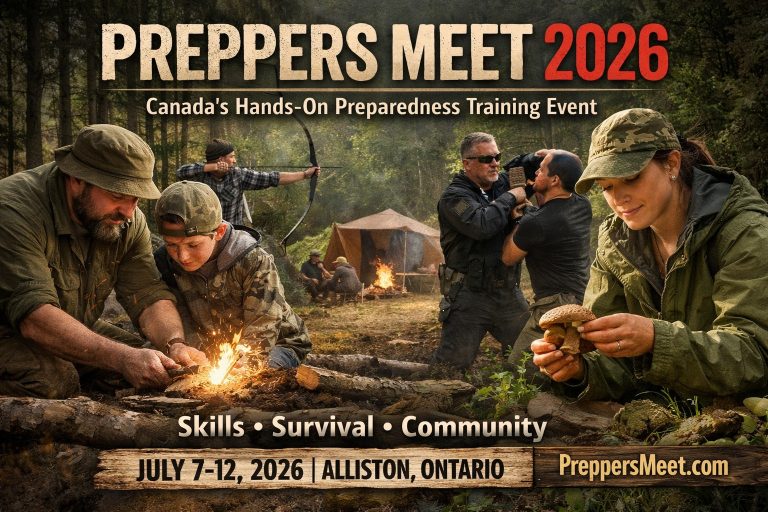
Preppers Meet 2026 runs July 7–12 at Primrose Park in Mono, Ontario, with the core festival taking place July 9–12. Arrive prepared to operate a comfortable, self-contained campsite and use the weekend for what matters: skills, training and the preparedness community.
One Comment