
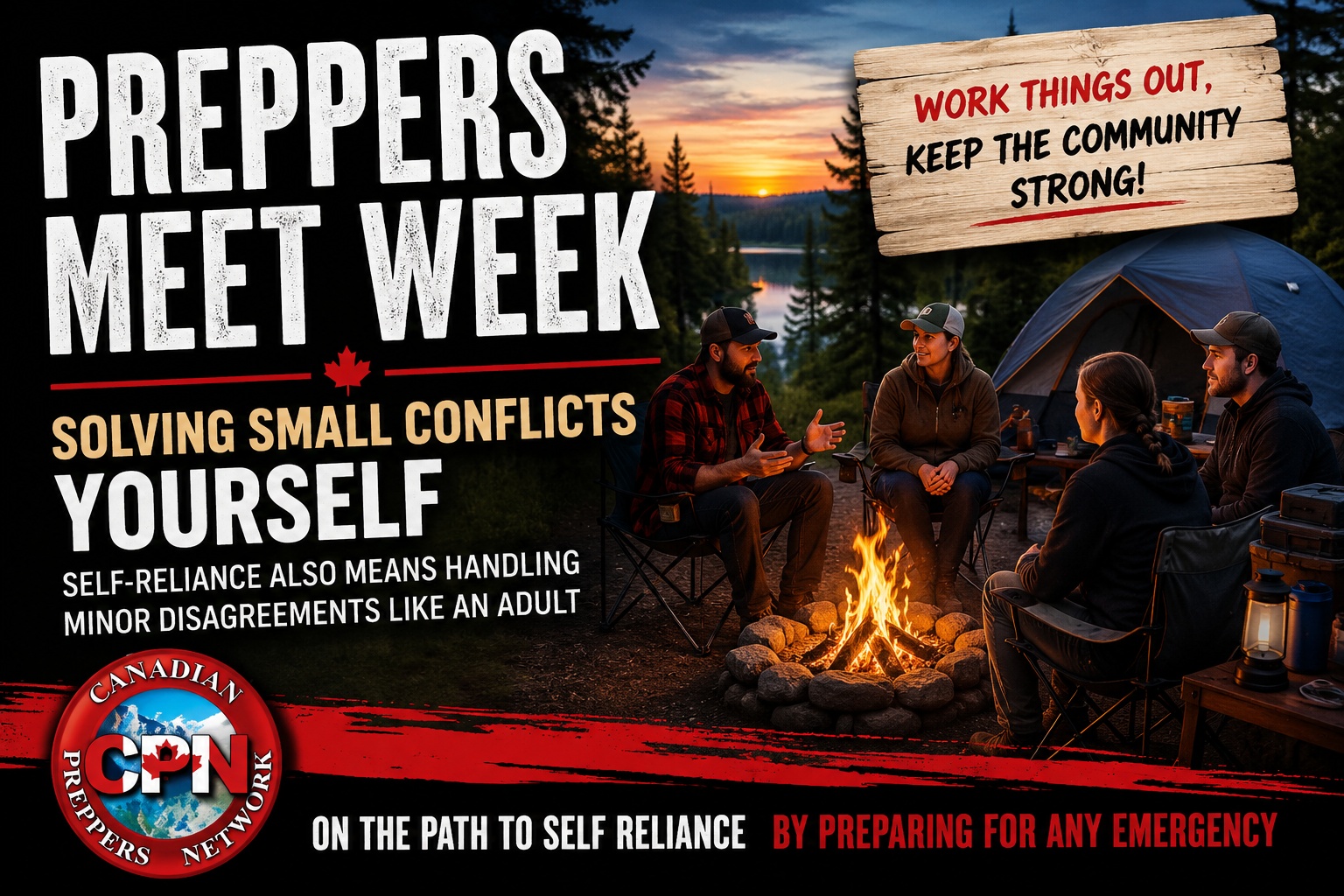
Self-Reliance Also Means Handling Minor Disagreements Like An Adult
Preparedness attracts independent people. That is one of its strengths. We value self-reliance, personal responsibility, practical skills, and the ability to solve problems without waiting for someone else to step in.
That same mindset should apply to minor disagreements.
Whether you are camping with friends, travelling in a convoy, working with neighbours, attending a preparedness event, or building a trusted group, small conflicts are going to happen. People have different habits, different expectations, different stress levels, and different ways of doing things.
Someone may be too loud. Someone may park awkwardly. Smoke may drift into another camp. A lantern may shine into a tent. A dog may wander too close. A generator may run longer than expected. Someone may borrow a tool and forget to return it. Someone may misunderstand where gear should be placed or who was supposed to do what.
Most of these issues do not require outside involvement. They require calm, direct, adult communication.
If we believe in self-reliance, then we should also believe in resolving small problems ourselves whenever possible.
Not Every Disagreement Needs To Become A Group Issue
One of the fastest ways to damage trust in any community is to turn every minor irritation into a larger matter.
A small problem between two people can quickly become gossip. Gossip becomes sides. Sides become resentment. Resentment weakens the group far more than the original disagreement ever would have.
This is especially true in preparedness circles, where people often have strong personalities and firm opinions. If every small issue gets carried around instead of addressed directly, the group atmosphere can sour fast.
Self-resolution means dealing with the person involved before talking about the person involved.
That does not mean ignoring problems. It means handling them at the lowest reasonable level. If the issue is minor, practical, and fixable, start with a conversation.
Most people would rather be spoken to directly than hear later that several others have been discussing them behind their back.
Start With The Assumption That It Can Be Fixed
Not every inconvenience is disrespect.
Someone may not realize how loud they are. They may not know smoke is drifting into your area. They may not notice that their gear is blocking a path. They may not understand that their light is bothering someone trying to sleep.
If you begin by assuming bad motives, the conversation will probably go badly. If you begin by assuming the problem is fixable, you give the other person a chance to respond well.
A useful mindset is simple: this is probably a small problem that can be solved with a small conversation.
That approach keeps the issue in proportion. It also prevents you from walking into the discussion already angry.
Most minor conflicts are not battles. They are adjustments.
Speak Early, Before You Are Angry
Small problems become bigger when people wait too long.
Instead of saying something calmly at the beginning, they let frustration build. They replay the issue in their mind. They complain to someone else. They assume the other person should already know better.
By the time they finally speak, they are no longer dealing with the original issue. They are unloading accumulated irritation.
That rarely helps.
If something is bothering you and it is reasonable to address it, speak early. Keep your tone calm. Keep the issue specific. Do not wait until you are at the point of snapping.
There is a huge difference between saying, “Hey, just so you know, that light is shining right into our tent. Could you angle it a bit?” and saying, “Are you seriously going to leave that thing shining on us all night?”
The first invites cooperation. The second invites defensiveness.
Timing matters. Tone matters. Starting small keeps the problem small.
Deal With The Person, Not The Audience
Minor disagreements should usually be handled privately and directly.
There is no need to perform the conflict for everyone nearby. There is no need to make a speech. There is no need to collect witnesses for a simple conversation. Public correction often embarrasses people, and embarrassed people are more likely to push back.
A quiet word works better.
Pulling someone aside, speaking at a normal volume, and keeping the conversation between the people involved shows respect. It gives the other person room to correct the issue without losing face.
That matters if you want the relationship to continue.
Preparedness groups, camp communities, convoys, neighbourhoods, and mutual assistance networks all depend on relationships. Winning a minor disagreement while damaging the relationship is not much of a victory.
For more on building trust before trouble starts, read Establishing Relationships With Other Survival Groups and Building a 5-Family Mutual Aid Circle.
Describe The Problem, Not The Person
The way you describe the issue will often decide how the conversation goes.
Talk about the specific problem. Do not attack the person’s character.
Say, “The generator is carrying pretty far over here.” Not, “You’re being inconsiderate.”
Say, “Your dog is getting a little too close to our food area.” Not, “You need to control your animal.”
Say, “This path is getting blocked.” Not, “You people always leave your stuff everywhere.”
The first version gives the other person something to fix. The second version gives them something to defend against.
If the goal is resolution, keep the focus on the issue: noise, smoke, light, parking, space, pets, timing, chores, tools, or expectations.
Do not turn a practical issue into a personal accusation.
Ask For A Solution, Do Not Just Demand One
Self-resolution works best when both sides are involved in the answer.
A demand may get short-term compliance, but it often leaves resentment behind. A mutual solution is more likely to hold.
Instead of only saying what you want, ask what would work.
“Can we figure out a better spot for this?”
“What would be a reasonable time to shut that down?”
“Could we keep this area open so people can get through?”
“Would you mind turning that away from the tents?”
These questions leave room for the other person to cooperate without feeling ordered around.
Sometimes there is information you do not have. The generator may be charging a battery. The vehicle may be parked there because the ground is soft elsewhere. The person may have thought the path was still clear. The dog owner may not realize others are uncomfortable.
A mutual solution allows both sides to explain what they need and find a workable middle ground.
That is much stronger than one person simply trying to win.
Be Ready To Give A Little
Conflict resolution is not just about getting the other person to change. Sometimes you may need to adjust too.
That does not mean tolerating unsafe behaviour or letting people walk over you. It means being honest about what is actually necessary and what is merely annoying.
Maybe the other person can lower the volume, and you can accept that people will still talk around a campfire before quiet time. Maybe they can move their gear, and you can shift your route slightly. Maybe they can angle the light away, and you can reposition your chair. Maybe both sides need to make a small change.
A good self-resolution mindset sounds like this:
“If you can do that, I can do this.”
That is how adults solve minor friction. Not everything has to be perfect. It only has to be workable and fair.
Handle Correction With Maturity
Self-resolution also means responding well when someone brings a concern to you.
That can be harder than raising the issue yourself.
Nobody enjoys being told they are causing a problem. It is natural to feel defensive, especially if you did not mean any harm. But intent is not the whole story. Your actions may affect someone else even when you had no bad intention.
If someone approaches you respectfully, try not to treat it as an attack.
A simple answer can go a long way:
“Thanks for letting me know.”
Then look at the issue honestly.
If your light is bothering someone, turn it. If your smoke is drifting into another area, adjust what you can. If your group is louder than you realized, bring it down. If your dog is too close, give people more room. If you borrowed something, return it.
You do not have to grovel. You do not have to agree with every complaint. But you should be willing to correct reasonable issues without making it a battle.
That is part of being dependable.
Do Not Feed The Drama Loop
Minor conflict often grows because people feed it.
They retell the story. They exaggerate the tone. They recruit agreement. They keep score. They bring up old issues. They turn one problem into a pattern and one person into a villain.
That is not preparedness. That is drama.
If the problem can be solved directly, solve it directly. Once it is solved, let it be solved.
Do not keep punishing the person after they corrected the issue. Do not keep telling the story to everyone else. Do not treat every future action as proof of bad character.
Groups become stronger when people can correct course and move on.
Holding grudges over small issues is a poor use of energy, especially in any environment where cooperation matters.
Know The Difference Between Minor And Serious
Self-resolution is for minor, practical disagreements.
Noise, lights, smoke, campsite boundaries, shared chores, borrowed tools, parking, pets, misunderstandings, and everyday friction usually belong in this category.
Serious issues are different. Threats, violence, theft, serious safety risks, medical emergencies, intoxicated dangerous behaviour, or repeated deliberate harassment are not ordinary disagreements. Those situations require a different response.
But most day-to-day friction is not in that category. Most of it can be handled by the people involved if they are willing to speak calmly, listen fairly, and make reasonable adjustments.
Knowing the difference is part of good judgement.
The goal is not to avoid all conflict. The goal is to keep small conflict from becoming unnecessary conflict.
This Is Practice For Harder Times
In a real emergency, there may be no convenient authority to settle every dispute. A convoy may have to make decisions on the move. A neighbourhood may have to coordinate during a power outage. Several families may have to share space, supplies, tools, heat, water, or chores.
Under stress, small disagreements can become serious if people do not know how to handle them.
That is why self-resolution matters.
If a group cannot calmly sort out noise, smoke, parking, lights, chores, or borrowed gear during normal times, it should not assume it will handle fuel shortages, security concerns, fatigue, hunger, or fear any better.
The habits we practise now become the habits we fall back on later.
Speak directly. Stay calm. Be specific. Listen. Offer options. Give a little. Correct yourself when needed. Move on when the issue is settled.
Those are preparedness skills.
Practical Camp Courtesy Gear
Some conflict prevention is simple: reduce light spill, noise, clutter, and confusion before they bother anyone else. A few small items can make shared spaces easier to manage.
Strong Communities Are Built By Adults Who Can Work Things Out
Community is not built by pretending disagreements will never happen. It is built by handling them well when they do.
People who can resolve small problems directly are easier to trust. They do not run every irritation through the rumour mill. They do not turn every inconvenience into a loyalty test. They do not need an audience for every disagreement.
They speak plainly. They listen. They adjust. They move forward.
That kind of person is valuable in any preparedness group.
Self-reliance is not only about food storage, tools, radios, firewood, or water filters. It is also about conduct. It is about being steady enough to handle ordinary friction without creating unnecessary division.
For a broader look at the people side of preparedness, visit the Mental Resilience & Community Building in Canada hub.
Minor disagreements will always happen. The real question is whether we use them as an excuse for drama or as practice for stronger community.
Solve what you can directly. Give others the chance to do the same. Keep small problems small.
That is how trust is built before the real pressure begins.
