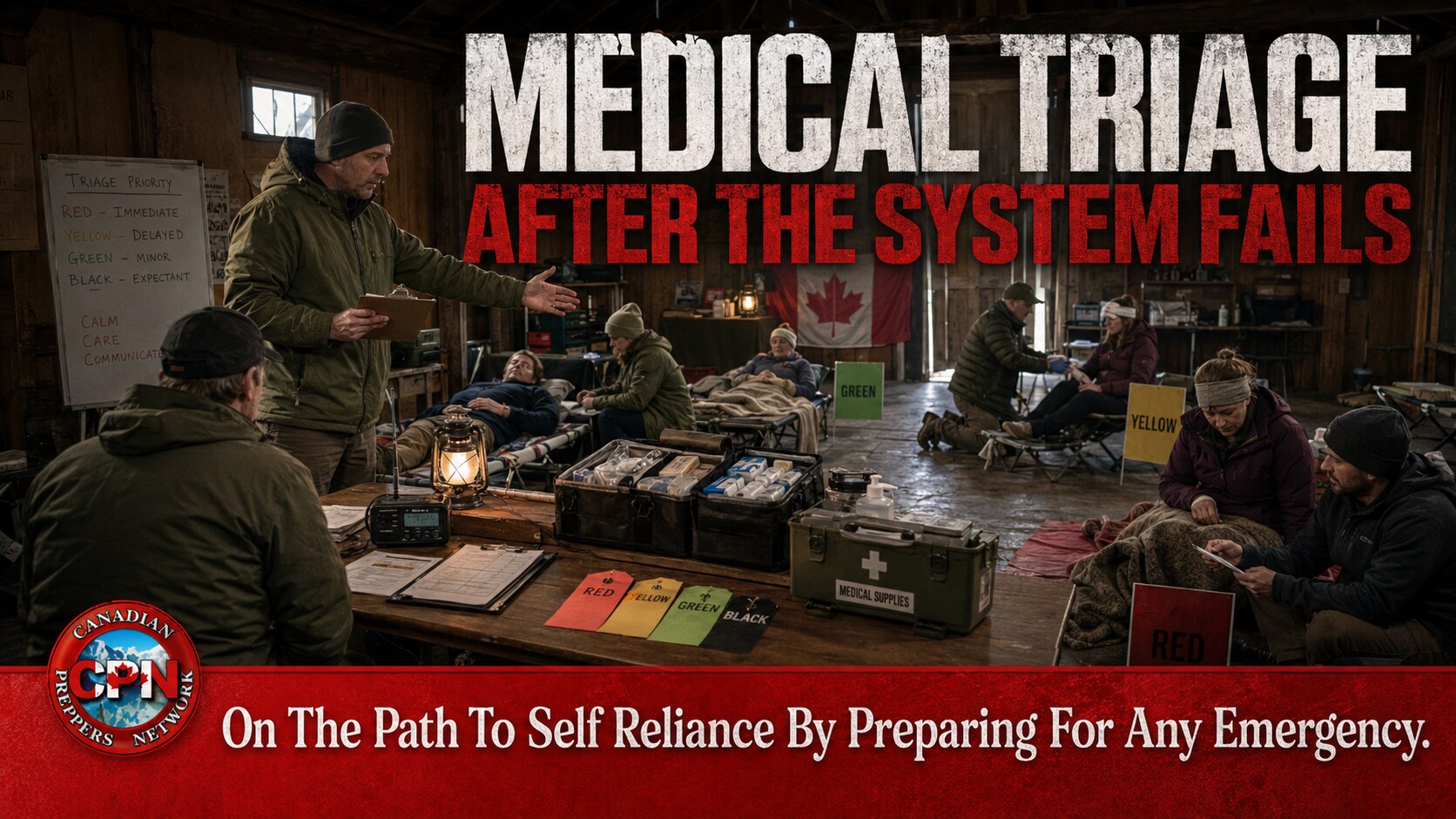
When injuries outnumber capable hands, good intentions must give way to organized priorities.
Most first-aid training assumes that professional help is coming. You assess the patient, provide immediate care, call 911 and keep the situation from getting worse until paramedics arrive.
After a major collapse, that final step may disappear.
Hospitals may be inaccessible. Ambulances may not be operating. Roads may be blocked, fuel scarce and communications unreliable. A household, neighbourhood or retreat could suddenly have several injured or ill people—but only one trained responder, a few helpers and a limited supply of medical equipment.
That is when first aid becomes triage.
Triage is not about deciding who deserves care. It is a structured way of deciding who must be treated first, who can safely wait and how limited people and supplies can accomplish the most good. The objective is to prevent a loud, chaotic scene from consuming resources while quieter but more urgent patients are overlooked.
The Loudest Patient May Not Be the Priority
Human instinct naturally pulls us toward the person shouting for help. Noise attracts attention, visible distress creates urgency and relatives may demand that their person be treated first.
None of those things reliably identifies the most urgent patient.
Someone who can speak clearly is breathing and maintaining an airway. Meanwhile, a quiet person elsewhere may be deteriorating without attracting attention. Effective triage therefore begins with a rapid assessment of everyone—not a prolonged examination of the first person encountered.
Before providing extended care, determine:
- How many patients are involved?
- What hazards remain at the scene?
- How many capable responders are available?
- What supplies, shelter and transportation exist?
- Can additional help be contacted by radio, telephone or messenger?
- Is this a short emergency or the beginning of extended care?
Without that overview, responders risk using most of their time and supplies on one person while several others receive nothing.
Scene Safety Still Comes First
A collapsed structure, active fire, contaminated water, damaged electrical system, leaking fuel or ongoing violence can produce additional casualties.
Before entering, stop and look.
Identify the danger, establish a safer treatment area and prevent untrained helpers from rushing blindly into the scene. If the location remains hazardous, people who can move should be directed toward a designated collection point.
The strongest available person should take scene control. That does not necessarily mean the most medically trained person. A competent organizer can manage helpers, collect supplies, record patient information and maintain communications while the trained responder concentrates on assessment and care.
Begin With the People Who Can Walk
A useful first step is to call for everyone who can safely walk to move to a clearly identified location. These patients still require assessment, but separating them immediately accomplishes several things.
It clears the treatment area, identifies people with at least some ability to move and gives responders a smaller number of non-ambulatory patients to assess first.
Do not assume that everyone who walks is uninjured. Stress can temporarily conceal symptoms, and a person’s condition can worsen later. Walking patients still need to be checked, recorded and reassessed.
Those who are genuinely capable can become valuable helpers. Under direction, they may retrieve supplies, maintain warmth, write information, watch for changes, carry messages or comfort other patients.
Use Simple Priority Groups
Professional triage systems use standardized categories and coloured tags. A preparedness group can adopt the same general structure without pretending that an untrained person has become a paramedic.
Immediate Priority
These patients have an urgent, potentially survivable problem requiring attention now. They receive the first available lifesaving interventions and the highest transportation priority if evacuation becomes possible.
Delayed Priority
These patients require medical attention but can wait briefly without an obvious immediate threat. Waiting does not mean being ignored. They should be protected from the environment, observed and reassessed regularly.
Minor Priority
These patients can generally walk and may be able to assist themselves or others. Their injuries still require cleaning, protection, documentation and follow-up.
Beyond Available Capability
In a truly overwhelming event, some patients may require care far beyond the group’s training, equipment or remaining resources. This is the most difficult category and should never be assigned casually by an unqualified person.
Provide comfort, protection and continued reassessment. Conditions, resources and evacuation possibilities can change. A priority assigned during the first chaotic minutes must never become a permanent verdict.
Perform Only Rapid Interventions During the First Pass
The purpose of the initial triage pass is to locate urgent problems and sort the entire group. It is not the time for lengthy treatment, detailed histories or elaborate procedures.
Respond within the limits of your training. Immediate first-aid priorities may include maintaining an airway, controlling severe external bleeding, positioning an unresponsive but breathing patient appropriately and protecting people from dangerous environmental exposure.
Once every patient has been assessed, responders can return in priority order for more complete care.
This discipline is emotionally difficult. Remaining with one patient feels compassionate, but doing so before checking the others may leave another urgent patient undiscovered.
Build a Treatment Area, Not a Pile of Casualties
If the location is safe enough, establish a basic casualty collection point. It should be sheltered from wind, rain, snow and direct sun, while remaining accessible to transportation.
Separate the priority groups so responders can immediately see where attention is needed. Allow enough space to work around patients and keep walking routes clear.
Create one controlled supply point instead of scattering medical equipment across the scene. Assign someone to distribute and record supplies. In a long emergency, losing equipment through confusion can be almost as damaging as never owning it.
Basic areas may include:
- Immediate treatment
- Delayed treatment
- Minor injuries
- Isolation for potentially contagious illness
- Supply and record station
- Transportation or evacuation staging
Good organization makes a small number of trained people far more effective.
Label and Record Every Patient
Memory becomes unreliable during exhaustion and stress. Every patient should have a written record that remains with them.
At minimum, record:
- Name or identifying description
- Approximate age
- Time first assessed
- Main complaint or apparent problem
- Initial priority
- Significant changes
- Care provided
- Relevant allergies, medications or conditions if known
- Destination and departure time if moved
Waterproof cards, masking tape, luggage tags or paper sealed inside transparent bags can serve as improvised patient records. Write clearly and avoid unexplained abbreviations.
A numbered patient system can help when identities are unknown. Use the same number on the patient record, treatment notes and transportation list.
Triage Never Ends
A person categorized as delayed can become immediate. A walking patient can deteriorate. Someone who initially appeared critical may improve after basic first aid.
Reassess patients regularly and whenever their condition changes. Canadian Red Cross multiple-casualty training and modern mass-casualty guidance both emphasize that triage is a continuing process rather than a single decision.
Keep observers with the delayed and minor groups. Their job is not to diagnose. They should report changes such as increasing confusion, difficulty breathing, loss of responsiveness, worsening discomfort or unusual behaviour to the trained responder.
Control the Supplies
Post-collapse medicine introduces a brutal logistical reality: using everything on the first day may leave nothing for the following week.
That does not mean withholding necessary first aid. It means eliminating waste.
Open only what is required. Protect clean supplies from rain, dirt and unnecessary handling. Keep contaminated items separate. Track what is used and maintain an updated inventory.
Ordinary items should handle ordinary tasks whenever safe and appropriate. Medical-grade supplies should be preserved for situations in which their cleanliness, design or reliability matters.
Reusable equipment requires a written cleaning routine. If nobody is responsible for cleaning, drying, inspecting and returning equipment, the medical supply will steadily disappear into contaminated piles and half-empty bags.
Establish Authority Before the Emergency
Triage becomes much harder when nobody knows who is in charge.
A prepared group should identify its medical lead, alternates and support roles in advance. The person with the highest appropriate training should direct medical assessment and treatment. Another person should manage the overall scene.
Useful support roles include:
- Medical lead
- Scene coordinator
- Recorder
- Supply manager
- Communications operator
- Patient observer
- Transportation coordinator
- Sanitation worker
These roles should be practised during exercises. A laminated plan buried in a binder will not create an organized response unless people have rehearsed using it.
Training Matters More Than Equipment
Triage tags, trauma bags and folding stretchers look impressive, but equipment cannot replace judgement.
At least two members of a serious preparedness group should obtain recognized first-aid training, with remote or advanced training where appropriate. Skills must be refreshed because rarely used procedures are easily forgotten.
Exercises can remain simple and safe. Give participants fictional patient descriptions, limited supplies and changing conditions. Practise scene organization, communication, record keeping, reassessment and transportation decisions without performing invasive procedures or creating graphic simulations.
The goal is not to play battlefield medic. It is to discover weaknesses before a real emergency exposes them.
Download the Canadian Grid-Down Starter Kit
Triage is only one part of functioning when normal systems fail. Download the free Canadian Grid-Down Starter Kit for a practical starting point covering the essential systems every household should examine before a serious disruption.
Medical Preparedness Buying Box
Equipment should support trained responders and organized care—not encourage procedures beyond the user’s qualifications.
- Preassembled first-aid kits
- Nitrile examination gloves
- CPR face shields
- Commercial tourniquets from established manufacturers
- Pressure dressings and compressed gauze
- Trauma shears
- Non-digital thermometers
- Waterproof patient tags
- Permanent markers and medical logbooks
- Headlamps and rechargeable lanterns
- Emergency blankets
- Folding cots
- Patient transfer sheets
- Emergency carry sheets or portable stretchers
- Plastic storage bins for controlled medical supplies
The Hardest Part Is Maintaining Order
A mass-casualty event will never feel fair or orderly. People will be frightened. Relatives will demand attention. Supplies will seem inadequate, and the person making decisions may question every choice.
The answer is not emotional detachment. It is disciplined compassion.
Assess everyone. Address immediate threats within your training. Record what was done. Reassess continuously. Preserve supplies, delegate work and change priorities when the situation changes.
When the medical system is no longer behind you, organization becomes a medical resource of its own.
Related Reading
- Medical and First Aid Buying Guide
- When Help Is Hours Away
- Building a Five-Family Mutual Aid Circle
- The Shelf Life of Medications
This article provides preparedness education, not medical certification or individual medical advice. During an actual emergency, contact professional emergency services whenever they remain available and work within your training.