Canada’s preparedness community must confront defensive force.
The Canadian preparedness community is comfortable discussing stored food, backup heat, water purification, generators, radios and medical supplies. We talk about storms, blackouts, supply failures and the slow erosion of public services.
Then the conversation reaches defensive force—and suddenly becomes either silent or ridiculous.
One side pretends that responsible citizens will never face a threat they cannot escape, negotiate with or report to the police. The other jumps immediately to fantasies about armed compounds, roaming looters and unrestricted violence.
Neither position is serious preparedness.
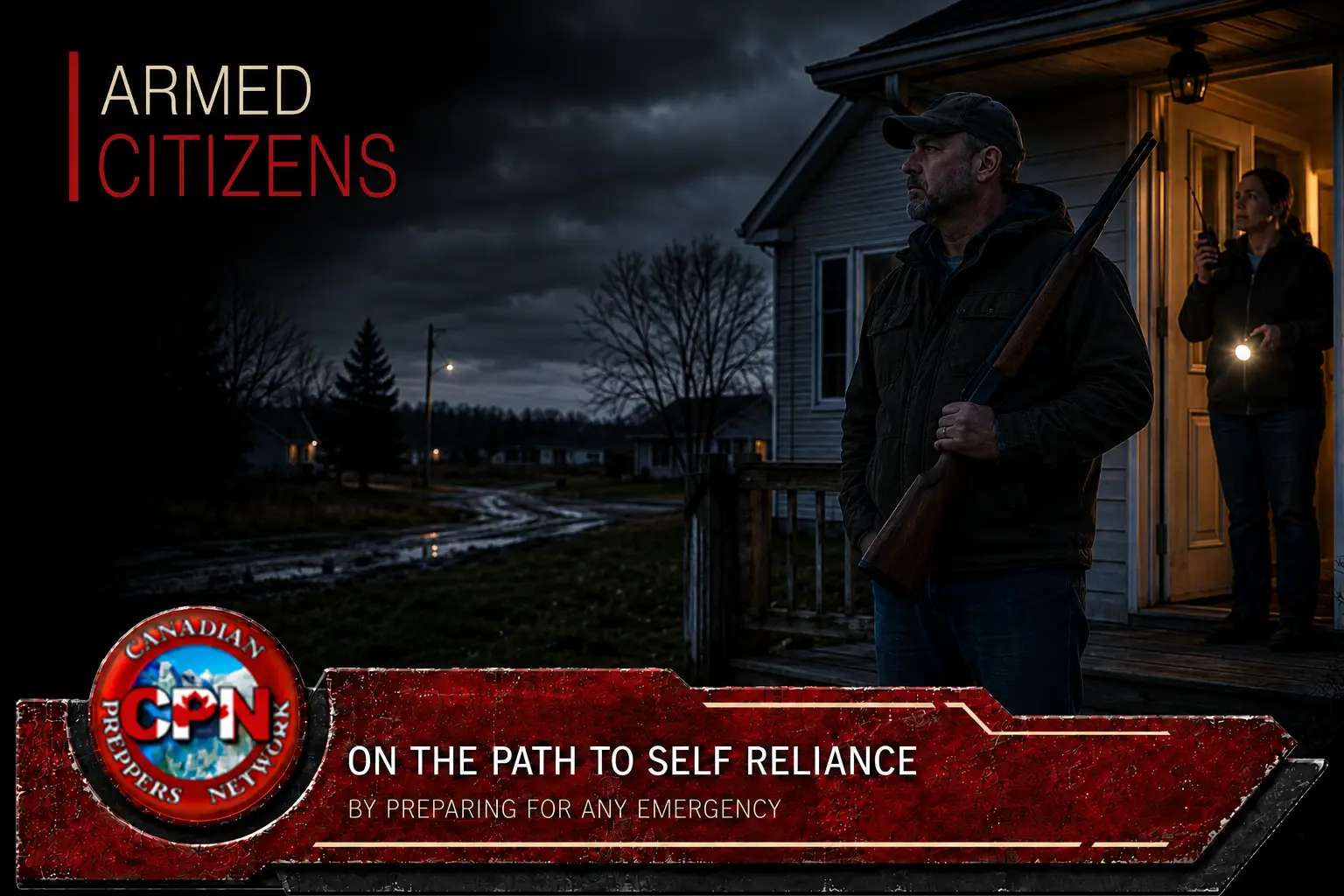
Canada needs a more mature discussion about armed citizens: not as vigilantes, substitute police officers or self-appointed authorities, but as ordinary people who may one day be forced to protect themselves, their families or others when immediate help is unavailable.
That conversation will be uncomfortable. It is still necessary.
Free Canadian Preparedness Download
Canadian Grid-Down Starter Kit
Use this printable first-72-hours checklist to test your household’s security, communications, food, water, power, sanitation and operating routines before a short emergency becomes a prolonged breakdown.
Firearms Are Already Part of Canada
Armed citizens are not an imported American concept. Firearms have long been part of Canadian rural life, hunting, farming, sport shooting, predator control and northern survival.
At the end of 2025, Canada had approximately 2.46 million valid Possession and Acquisition Licences. Those licence holders are subject to safety training, screening and continuing eligibility requirements. The figures are available in the RCMP’s 2025 Commissioner of Firearms Report.
That does not mean every licence holder owns a firearm for protection. It does mean that millions of Canadians already possess the equipment, training and legal authorization associated with firearm ownership.
Pretending those people have no place in a broader preparedness discussion is unrealistic. So is assuming that firearm ownership automatically makes someone capable of protecting a household or community.
Possession is not preparedness.
The Response Gap Is Real
Canadian emergency planning is built on shared responsibility. Governments, first responders, private organizations, communities and individual citizens are all expected to contribute to resilience. That principle is reflected in the federal government’s Federal Policy for Emergency Management.
That responsibility becomes important when an emergency exceeds normal capacity.
Most incidents are resolved without armed resistance. Doors can be locked. People can leave. Neighbours can help. Police can be called. A confrontation can often be avoided.
Preparedness, however, is specifically concerned with the times when ordinary systems do not perform normally.
A wildfire can isolate a rural community. An ice storm can make roads impassable. A communications failure can prevent calls for help. Civil disorder can overwhelm available officers. A regional disaster can force police, fire and medical resources to concentrate on the largest threats while individual households wait.
The question is not whether police and emergency services remain legitimate. They do.
The question is what a household does during the gap between recognizing an immediate threat and receiving outside help.
That gap may last minutes in a city, considerably longer in the countryside and indefinitely during a sufficiently severe breakdown.
Statistics Canada reported that the 2024 police-reported crime rate in rural areas was 42 per cent higher than the urban rate. Rural communities vary enormously, and that figure should not be used to portray every country property as dangerous. It does demonstrate that distance and isolation do not make security concerns disappear. Readers can review the complete Statistics Canada rural and urban crime analysis.
Limited-Space Outdoor Event
PLINKIN’ IN THE WOODS
Practical Rimfire Marksmanship With Frugal Gunnie
Develop practical outdoor shooting skills from prone, standing, seated and kneeling positions. Learn to use slings, bipods, tripods and shooting bags more effectively while receiving individual instruction on fundamentals, ergonomics and technique.
Saturday, September 12, 2026
8:00 a.m.–5:00 p.m.
Great Ape Empire
267 Highway 6, Wiarton, Ontario
Event admission: $250 CAD
Weekend camping: $20 per person
Private event. Space is strictly limited.
Presented in collaboration with Off-Grid School, Preppers Meet, Canadian Preppers Network and Great Ape Empire.
Armed Does Not Mean Prepared
A firearm can provide defensive capability. It can also magnify poor judgement, fear, anger, confusion and inadequate training.
That is why the preparedness community must stop treating the firearm as the end of the security discussion. It is only one possible layer in a much larger system.
A responsible defensive plan begins with awareness, controlled access, strong doors, communication, early warning, safe rooms, exterior visibility and routes that allow people to avoid unnecessary confrontation. It includes neighbours who can recognize unusual activity and household members who know what to do when something goes wrong.
The firearm, where one is legally owned and competently handled, belongs near the end of that system—not at the beginning.
Anyone who imagines reaching for a firearm before turning on a light, identifying the threat, securing vulnerable family members, calling for help or attempting safe withdrawal has built a dangerous plan.
Defensive force is not a substitute for poor security.
Protection Is Not Punishment
The most important distinction in this debate is the difference between stopping a threat and punishing an offender.
An armed citizen is not a police officer, judge or executioner. Seeing someone trespassing, stealing supplies or behaving suspiciously does not create unlimited authority to threaten, shoot or detain them.
Canada’s Criminal Code provisions on defence of a person consider whether someone reasonably believed force or a threat of force was being used, whether the action was taken for a protective purpose and whether the response was reasonable in the circumstances.
The law considers factors including imminence, available alternatives, weapons and the proportionality of the response. Defence of property is also governed by a reasonableness requirement.
This is not a legal article, and anyone facing a specific question should obtain qualified Canadian legal advice. The broader preparedness principle is simpler:
The purpose of defensive force is to preserve life—not to avenge loss, defend pride or impose punishment.
That principle should remain intact even during a serious emergency.
A generator can be replaced. Fuel can be rationed. Property can sometimes be abandoned. A human life cannot be restored after someone mistakes fear, anger or possession for necessity.
Collapse Does Not Eliminate Consequences
Some collapse scenarios assume that law simply disappears and every household becomes an independent authority.
Real emergencies are rarely that clean.
Services may become inconsistent without vanishing. Police may be delayed rather than gone. Courts may resume after the crisis. Communications may return. Witnesses will remember. Cameras may still record. Injuries and deaths will still require explanations.
Even if formal accountability weakens temporarily, moral accountability remains.
The decisions made during the worst night of an emergency will still exist the following morning. They will affect families, neighbours and whatever community survives the disruption.
That reality should encourage restraint rather than paralysis. A person facing an immediate threat should be able to act decisively. But decisive action must be connected to a defensible purpose: protecting life from a threat that cannot safely be avoided.
Build Your Offline Preparedness Library
CPN Gold Membership
For only $5 per year, Gold members receive unlimited access to the CD3WD collection and hundreds of practical manuals covering food production, water, energy, repairs, health, agriculture, security and self-reliance.
Gold members also receive the monthly Canadian Preparedness Intelligence Briefing.
The Debate Must Include Standards
If Canadian preppers are going to discuss armed defence seriously, the conversation needs standards.
First, firearm ownership must remain tied to competence. Passing a basic course is the beginning, not the completion, of responsible training. Safe handling, storage, maintenance and judgement deteriorate when they are never practised.
Second, armed members of a household or preparedness group must understand their roles. A firearm does not grant command authority. The loudest, most heavily armed person should not automatically make decisions for everyone else.
Third, households need agreed boundaries. Who has access to firearms? Who does not? What happens if a member is exhausted, intoxicated, emotionally unstable or showing dangerously poor judgement? Who secures the firearms during a medical or mental-health crisis?
Fourth, the plan must include people who are not armed. Observation, communications, first aid, fire suppression, caregiving, documentation and evacuation are all essential security roles. A capable community is not divided into armed protectors and helpless dependants.
Finally, every plan needs a way to disengage. Leaving, locking down, creating distance or surrendering replaceable property may prevent a confrontation from becoming a fatal event.
These are not signs of weakness. They are signs that the objective is survival.
Community Defence Can Become Community Danger
Groups introduce another risk: people behave differently when surrounded by others who reinforce their fear.
A rumour becomes intelligence. A stranger becomes a scout. A hungry neighbour becomes a looter. An unfamiliar vehicle becomes an attack.
Once that thinking takes hold, an armed preparedness group can become more dangerous to its community than the threat it was organized to resist.
Any group discussing defensive force therefore needs discipline around identification, communication and authority. One frightened person should not be able to trigger a chain reaction. Reports must be verified. Firearms must never be used to intimidate neighbours, settle personal disputes or enforce a group leader’s preferences.
There must also be a clear distinction between protecting a location and controlling the surrounding population.
Prepared citizens may defend themselves. They do not acquire authority over a road, neighbourhood or town simply because official services are strained.
Special September Training Event
ARCHERY INTENSIVE WITH WOLF STARCHILD
Learn the Bow. Understand the Shot.
Improve stance, grip, drawing, anchoring, release, follow-through and arrow control through concentrated hands-on instruction. Equipment is available.
Sunday, September 13, 2026
Great Ape Empire
267 Highway 6, Wiarton, Ontario
Admission: $120 per person
Weekend camping: $20 per person
Instruction is provided by Wolf Starchild of Barefoot Bushcraft. Space is limited, and a minimum of eight registered participants is required.
Presented by Barefoot Bushcraft in partnership with Canadian Preppers Network, Preppers Meet, Great Ape Empire and Off-Grid School.
Questions We Should Be Asking Now
The preparedness community does not need identical answers, but it should be willing to discuss the questions:
- Under what circumstances would defensive force genuinely protect life?
- What alternatives should be attempted when time and circumstances permit?
- How do we prevent an armed household member from acting out of panic, anger or exhaustion?
- Who makes decisions within a family or group?
- How will an approaching person be identified before being treated as a threat?
- What happens when neighbours arrive asking for help rather than intending harm?
- How are firearms secured when unfamiliar people, evacuees or distressed relatives are inside the home?
- Can every armed member render first aid after a violent incident?
- What records, communications or witness accounts should be preserved?
- How does the group return control to legitimate authorities when emergency services recover?
These questions are harder than discussing calibres, magazine capacity or accessories. They are also far more important.
Practical Security-Support Equipment
A responsible defensive plan begins with identification, communication, early warning, medical readiness and stronger physical security. These supplies support those layers without replacing training or sound judgement.
- Rechargeable LED flashlights
- Wireless driveway alarms
- Licence-free two-way radios
- Door-reinforcement kits
- Trauma-oriented first-aid kits
- Waterproof notebooks for incident records
- Lockable storage cabinets
- Fire-resistant document bags
As an Amazon Associate, Canadian Preppers Network earns from qualifying purchases. This does not change the price paid.
Silence Is Not a Security Plan
Canada’s preparedness community cannot claim to prepare for system failure while refusing to discuss what happens when personal safety is threatened during that failure.
Nor should it allow the conversation to be dominated by people who seem eager for violence.
Armed citizens may have a legitimate role in protecting life during the most serious emergencies. That role must be narrow, disciplined, accountable and built around avoidance whenever avoidance remains possible.
The firearm owner who understands restraint may be an asset. The firearm owner who believes possession grants authority is a liability. The unarmed person who refuses to acknowledge any possible need for defensive force may also leave a dangerous gap in the plan.
This debate is not about encouraging confrontation.
It is about ensuring that if Canadians ever face a moment when they must protect themselves without immediate help, their decisions are guided by preparation rather than panic, responsibility rather than fantasy, and the preservation of life rather than the desire to use force.