A communications plan for approaching your retreat
Reaching your retreat does not necessarily mean you have reached safety.
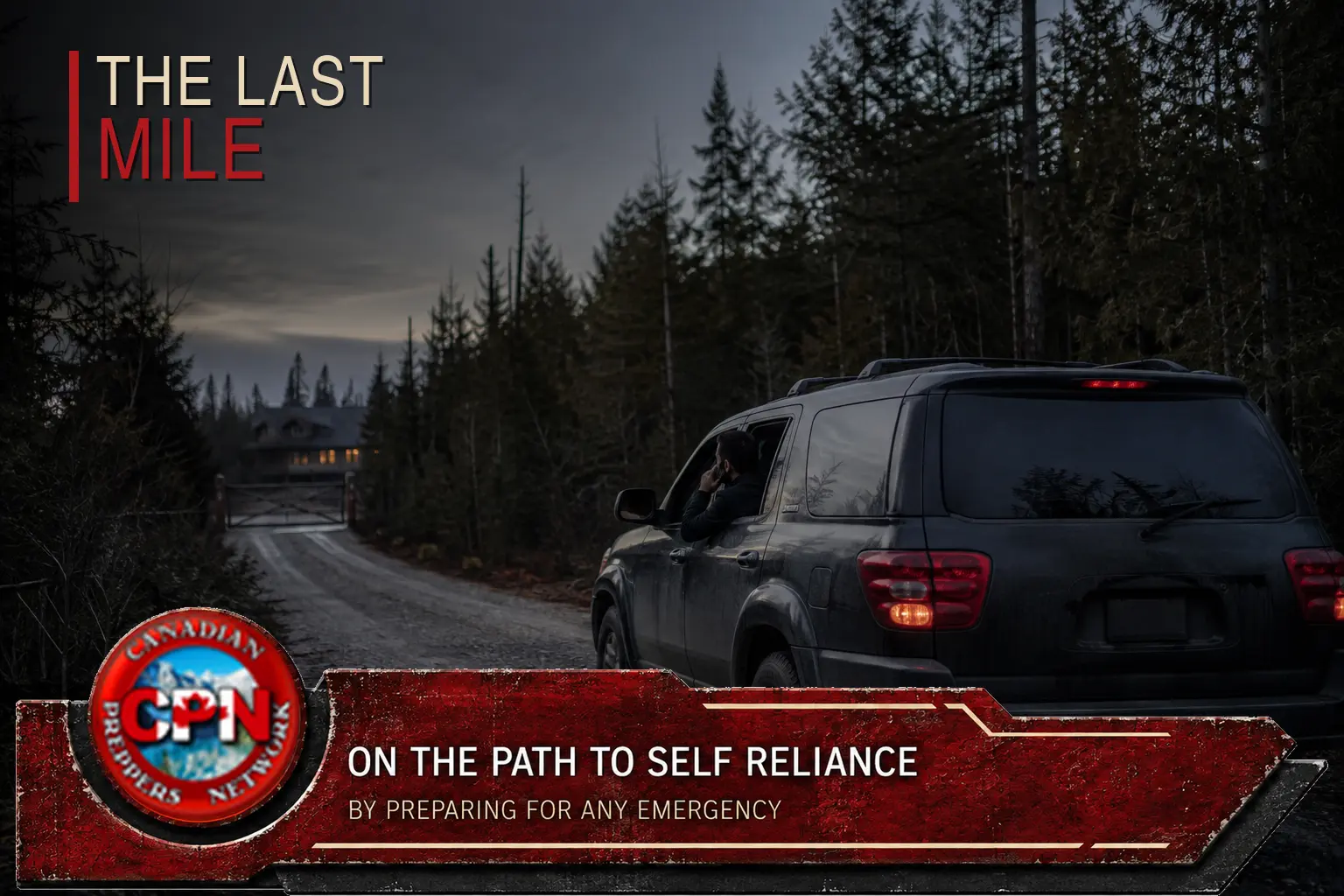
The final kilometres may be the most dangerous part of the journey. Roads could be blocked, unfamiliar vehicles may be nearby, communications may be unreliable and the people already at the property may be operating under considerable pressure. An unexpected vehicle driving directly toward the entrance could easily be mistaken for a threat—even if everyone inside it belongs there.
There is another possibility. The expected vehicle may arrive, but the people inside may no longer be travelling alone. They could have picked up a stranded person, be under observation or have someone aboard who forced them to continue toward the retreat.
From a distance, all these situations look the same.
A retreat communications plan allows the approaching party to identify itself, report its condition and quietly warn the receiving group when something is wrong. It also gives the retreat time to observe the surrounding area, prepare for the arrival and redirect the vehicle if the normal approach is no longer safe.
The entire procedure must be decided, written and practised before anyone needs it.
Free Canadian Preparedness Download
Canadian Grid-Down Starter Kit
Use this printable first-72-hours checklist to test your household’s water, food, sanitation, power, communications and operating routines before a short outage becomes a prolonged emergency.
The Retreat Controls the Final Approach
Under normal conditions, people announce that they are coming and drive directly onto the property. During a serious emergency, that assumption must disappear.
The approaching party should never interpret silence as permission to continue. The retreat radio may have failed. The operator may be occupied with another problem. The property could have been evacuated, placed under observation or compromised.
The retreat must explicitly authorize the final approach.
Until authorization is received, the arriving group remains at a predetermined holding point outside the immediate property. That location should provide enough distance to observe the surrounding area, turn the vehicle around and leave without revealing the retreat entrance.
No contact means no final approach.
There may be extreme circumstances in which that rule must be reconsidered, but those circumstances should be defined in advance—not invented by an exhausted driver at the end of a difficult trip.
What the Retreat Needs to Know
Every approach report should answer four questions:
- Who is calling?
- Where are they?
- What is their current condition?
- Are they free to speak honestly?
The first three questions can be answered directly. The fourth requires a code system.
A calm voice does not prove that everything is normal. Someone inside the vehicle may be listening. The caller may have been instructed to make the usual radio contact and avoid saying anything suspicious.
The communications plan must allow the caller to report trouble without announcing that a warning has been sent.
Establish Communications Checkpoints
The travelling party should not wait until it can see the retreat before making contact. The plan should establish several reporting points along the expected route.
A basic arrangement might include:
- A departure report
- A report after clearing the urban area
- A report at a known highway junction or landmark
- A contact point several kilometres from the retreat
- A final holding point used while awaiting instructions
These do not always need to be places where the vehicle stops. They can be geographic areas in which the party attempts contact while continuing to travel.
The departure report should include the number of people travelling, the vehicle being used, the intended route, the estimated arrival window and any significant mechanical or medical problem. Later reports update that information and warn the retreat about roadblocks, suspicious activity or delays.
Sensitive details should not be transmitted unnecessarily. There is rarely a good reason to announce the retreat’s precise location, population, supplies or defensive condition over an open channel.
Build a Real PACE Plan
A dependable plan requires several communications methods that do not all rely on the same infrastructure. The PACE model organizes them as:
- Primary: The normal and preferred method
- Alternate: The first backup
- Contingency: A separate method used when both earlier options fail
- Emergency: The final procedure when electronic communications are unavailable
Calling, texting and using a messaging application may appear to provide three different options, but all three may depend on the same telephone, battery and cellular network. One failure could eliminate all of them.
| Level | Method | Purpose |
|---|---|---|
| Primary | Cellular text message | Routine travel and arrival updates |
| Alternate | Amateur-radio voice or digital message | Contact beyond functioning cellular coverage |
| Contingency | Short-range radio from the final contact area | Coordinate the controlled approach |
| Emergency | Holding point and visual recognition procedure | Await instructions without transmitting |
The exact technologies will depend on distance, terrain, equipment and operator qualifications. The important point is that each level must provide a genuinely different communications path.
Saturday, September 12 · Wiarton, Ontario
Plinkin’ in the Woods with Frugal Gunnie
A full day of practical rimfire marksmanship at Great Ape Empire.
8:00 a.m.–5:00 p.m. · $250 CAD · Weekend camping $20 per person
Space is strictly limited.
Use Scheduled Radio Windows
Leaving a retreat radio operating around the clock wastes power and requires someone to monitor it continuously. Scheduled communications windows are more practical.
For example, the retreat might monitor the primary frequency for ten minutes at the top of each hour when a group is expected. The travelling party knows when to call, how many attempts to make and when to move to the alternate method.
Every communications window should define:
- The frequency or channel
- The starting time and duration
- Who initiates contact
- How many calls are attempted
- When to change methods
- What happens after a missed window
Everyone must use the same time reference. Unsynchronized watches or an unnoticed time-zone change can cause both parties to miss every scheduled contact while believing they followed the plan.
Radio checks should be conducted from the actual checkpoint locations. A frequency that works from the retreat yard may fail completely from a road hidden behind a ridge.
Authenticate the Caller
Recognizing a familiar voice is not adequate authentication. Stress, weak signals and interference can make voices difficult to identify. A radio may also have been lost, stolen or taken from one of the travellers.
The plan should include a simple challenge-and-response procedure. The retreat provides a challenge and the approaching party gives the corresponding reply. This might use a rotating word pair, a numbered list or another method understood by the group.
The challenge confirms identity. It does not report the party’s condition.
Authentication information should change periodically and immediately after a radio, plan card or group member is compromised. Permanent passwords eventually become useless passwords.
Amateur-radio communications must never be treated as private. Anyone with suitable receiving equipment may hear the exchange. Authentication can help confirm who is transmitting, but it does not make the channel secret.
Use Code Words to Report Status
Each routine report should contain a status word or phrase. It tells the retreat whether the approaching party is operating normally or whether the spoken message is being influenced by someone else.
The code must sound natural when inserted into an ordinary travel report. Obvious warnings such as “Code Red” or “we have a problem” defeat the purpose.
The group should establish separate codes for:
- Everything is normal
- A manageable problem exists
- The vehicle is being followed or observed
- An unexpected but cooperative passenger is aboard
- An unauthorized or potentially hostile person is in the vehicle
- The caller is speaking under coercion
The following examples illustrate the method and should not be adopted as permanent codes:
| Spoken phrase | Concealed meaning |
|---|---|
| “The cargo is secure.” | Everything is normal |
| “One container shifted.” | A problem exists, but we can continue |
| “We picked up an extra parcel.” | An unexpected passenger is aboard |
| “The rear door won’t latch.” | An unauthorized person is in the vehicle |
| “We will need the blue tools.” | We are being watched or coerced |
Each phrase must have one exact meaning. If “extra parcel” sometimes means a friendly passenger and sometimes means an armed stranger, it communicates nothing useful.
The caller should include the status phrase in every scheduled report. Its absence can itself be treated as a warning that the caller has forgotten the procedure, is under stress or is unable to speak freely.
For a broader system of short, prearranged messages, read The One-Off Code System.
Knowledge and Intelligence for Only $5 Per Year
CPN Gold Membership
Gold members receive unlimited access to the CD3WD collection and hundreds of practical manuals covering food production, water, energy, repairs, health, agriculture and self-reliance.
Membership also includes the monthly Canadian Preparedness Intelligence Briefing, examining global geopolitics, domestic economic pressures, employment, food and energy security, civil-defence developments and other emerging risks affecting Canadian households.
Never Acknowledge the Warning
The retreat operator must never repeat or explain the concealed message.
If the caller says, “The rear door won’t latch,” the response must not be, “Understood—you have an unauthorized passenger.”
Instead, the operator replies in an ordinary tone and provides a coded instruction. That instruction might direct the party to continue by the normal route, use the alternate approach, remain at the holding point, proceed to a secondary meeting location or abort the approach.
The retreat therefore needs its own short list of coded directions.
If a duress phrase is received, the operator should avoid suspicious questions, a sudden change in tone or an abrupt end to the conversation. The caller may not be alone. The retreat follows its predetermined response while allowing the exchange to sound routine.
The objective is to communicate one critical fact without alerting the unauthorized person: this is not a normal arrival.
Use a Standard Reporting Order
People communicate badly when tired, frightened or hurried. A standard reporting format reduces forgotten details and long, confused transmissions.
- Identity: Who is calling
- Location: The predetermined checkpoint
- Condition: People, vehicle and fuel status
- Observation: Roadblocks, suspicious activity or other problems
- Intention: Continue, hold, divert or request assistance
- Status phrase: The coded condition inside the vehicle
- Request: Instructions from the retreat
A routine report might sound like this:
“Base, Mobile Two at Checkpoint Three. Four people, no injuries, vehicle operational. Debris on the north road but still passable. The cargo is secure. Holding for instructions.”
A warning report could sound almost identical:
“Base, Mobile Two at Checkpoint Three. Four people, no injuries, vehicle operational. Debris on the north road but still passable. The rear door won’t latch. Holding for instructions.”
Anyone unfamiliar with the plan hears an ordinary mechanical detail. The retreat hears a warning that an unauthorized person is aboard and knows not to permit a direct approach.
Avoid building a complicated library of obscure codes. A few well-defined phrases are useful. An elaborate secret language will be forgotten or misused under pressure.
Keep the Final Approach Controlled
Once the party has been authenticated and its status confirmed, the retreat provides final instructions. Those instructions should specify:
- Which road or trail to use
- Where the vehicle must stop
- Whether the occupants remain in the vehicle
- Which radio channel will be monitored
- What signal authorizes further movement
- What to do if another vehicle appears
The receiving group should already know the vehicle description, expected occupants and approximate arrival time. Any important difference requires the approach to stop until it can be explained.
The vehicle should never proceed from the holding point merely because the retreat looks quiet. Silence could indicate safety, communications failure or compromise. There is no reliable way to distinguish among them from the driver’s seat.
Arrival control is only one part of keeping a property functional. You Can’t Guard a Retreat Alone examines the staffing, fatigue and work demands behind a sustainable retreat watch.
Plan for Additional Passengers
A travelling party may encounter an injured neighbour, stranded relative or desperate stranger. The decision to bring that person cannot be resolved safely at the retreat entrance.
The group needs an agreed policy covering:
- Who may be brought toward the retreat
- Which status code reports an additional passenger
- Where the vehicle waits
- Whether the passenger leaves the vehicle
- Who has authority to approve entry
- What happens when entry is refused
An unexpected but cooperative passenger is not the same as an unauthorized person who has forced or manipulated their way into the vehicle. The code system must distinguish between those conditions.
Compassion and security both suffer when these decisions are postponed until the vehicle is already at the gate.
Decide What Silence Means
Every communications plan must address the possibility that nothing works. The approaching group needs exact instructions for that situation.
- Repeat the call once.
- Change to the alternate communications method.
- Attempt contact during the next scheduled window.
- Proceed only as far as the designated holding point.
- Observe without moving closer.
- Use the emergency recognition signal at the scheduled time.
- Withdraw to the fallback location if no response is received.
The fallback location should provide room to turn around, more than one route away and enough distance that waiting there does not reveal the retreat.
The plan must also establish a maximum waiting time. “Stay there until someone answers” is not adequate when the retreat may have lost its radio, evacuated or been compromised.
Build the Skill Behind the Radio
Canadian Basic Amateur Radio Course for Preppers
Learn Canadian amateur-radio fundamentals, operating practice, equipment and emergency communications through a self-paced course built specifically for preparedness-minded Canadians.
Carry the Plan on Paper
A communications plan stored only on a telephone may disappear with a dead battery or damaged device.
Each authorized vehicle should carry a compact paper card containing:
- Scheduled contact windows
- Radio frequencies or channels
- The order of alternate methods
- Checkpoint identifiers
- Current authentication instructions
- Status and duress codes
- Coded approach directions
- Holding and fallback procedures
- Maximum waiting times
- Essential contact numbers
The card should contain enough information to execute the plan without openly identifying the retreat or describing everything stored there.
Radios should be programmed and labelled in advance. Spare batteries, charging cables, an appropriate external antenna, a paper map and writing materials belong with the communications equipment.
Equipment that has never been tested from the intended route is only an assumption.
Practise the Arrival
The first complete test should not take place during an evacuation.
Drive the planned route. Attempt contact from every checkpoint. Confirm which systems work in poor terrain. Have someone unfamiliar with the plan follow the written instructions and identify anything that is unclear.
Then introduce failures:
- The cellular network is unavailable.
- The primary radio cannot reach the retreat.
- The group misses its scheduled window.
- The expected approach road is blocked.
- An unfamiliar vehicle follows the group.
- An unexpected passenger is aboard.
- The caller uses the duress phrase.
- The retreat deliberately gives an abort instruction.
The exercise should test the people as much as the equipment. Everyone must recognize the current codes, respond without revealing them and know when to stop moving toward the property.
Retreat Communications Buying Box
Build the physical layer that supports the plan, then test every item from the routes and checkpoints where it will actually be used.
FRS Two-Way Radios
Useful for short-range coordination between vehicles, checkpoints and people working around the property.
Dual-Band Mobile Amateur Radios
A vehicle-mounted radio and suitable antenna can provide substantially better performance than a handheld when used by a qualified operator.
Vehicle-Mount Dual-Band Antennas
An external antenna can improve vehicle communications, but it must be compatible with the radio and tested before an emergency.
Waterproof Notebooks
Keep contact windows, checkpoint reports, radio logs and changing instructions usable in the vehicle and at the retreat.
Laminating Pouches
Protect current code sheets, approach cards, contact lists and route instructions from moisture and repeated handling.
Power Banks and Vehicle Chargers
Separate charging options help keep phones and small communications equipment available during a prolonged movement.
Waterproof Map Cases
Protect paper routes, alternate approaches and fallback instructions when navigation apps are unavailable.
For a broader equipment overview, see the Emergency Communications Buying Guide.
This article contains Amazon affiliate links. As an Amazon Associate, Canadian Preppers Network may earn from qualifying purchases.
The Last Kilometre Is Part of the Plan
A retreat can be well stocked, well hidden and well defended, yet still be endangered by an unplanned arrival. The final kilometres need the same preparation as food, water, heat and security.
Your people should know how to announce themselves, prove who they are, quietly report who is inside the vehicle and wait for authorization.
They should never have to improvise at the gate.
How would your group signal that an unauthorized person was inside the vehicle without revealing the warning to that person?