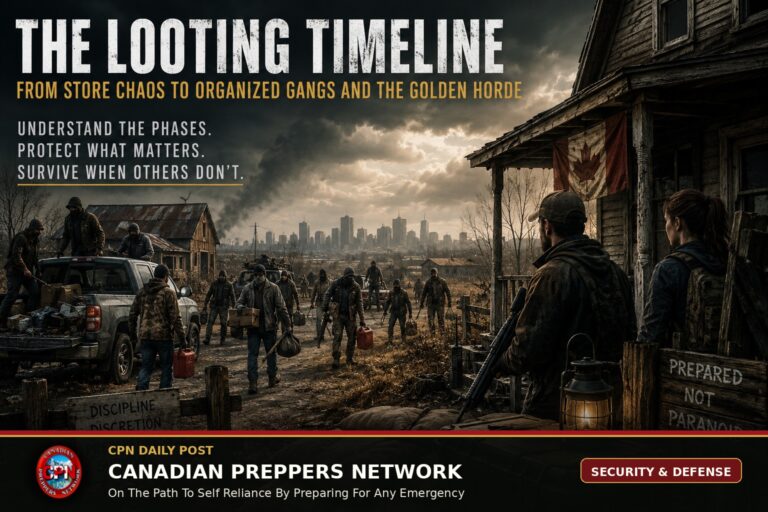
As winter tightens its grip across much of Canada, most people focus on staying warm and keeping the lights on. For preppers, however, winter introduces a quieter but equally important concern: security. Long nights, reduced visibility, fewer people outdoors, and weather-related distractions create ideal conditions for theft and opportunistic crime, especially during power disruptions or storms.
This is the season when weaknesses become obvious. Cameras fail in extreme cold, locks freeze, lighting becomes inconsistent, and routines become predictable. Addressing those issues now is far easier than trying to correct them during a prolonged outage or emergency.
Darkness Is Neutral — Until You Ignore It
Winter darkness isn’t inherently a threat; it’s only a problem when it works against you. In many Canadian neighbourhoods and rural properties, the only consistent light source at night comes from inside the home. That creates silhouettes, blind spots, and clearly defined approaches that anyone watching can exploit.
A simple nighttime walk around your property can be revealing. Pay attention to where shadows gather, where someone could move unseen, and where entrances are concealed from view. Effective winter security balances constant low-level lighting near doors with motion-activated lights along approach routes. The goal isn’t to flood your property with light, but to make movement visible and unpredictable.
Cold Weather Exposes Weak Technology
Security cameras and motion sensors often perform well in mild conditions but struggle in real Canadian winter weather. Batteries drain faster in the cold, lenses fog or ice over, and snow glare can overwhelm poorly positioned cameras. Devices that worked fine in October may become unreliable by January.
Cold-weather reliability comes down to placement and maintenance. Sheltered mounting locations, downward camera angles, and regular checks after snowfall make a significant difference. Motion sensors should be adjusted to ignore wind-driven branches and drifting snow while remaining sensitive to human-sized movement. Technology should support awareness, not create a false sense of security.
A Lock That Fails Is Worse Than No Lock at All
Winter reveals which doors and locks were never properly installed or maintained. Doors swell, frames shift, and cheap hardware begins to fail just when reliability matters most. If a lock freezes or a latch doesn’t seat properly, people tend to stop using it consistently — and that’s when security breaks down.
Before winter is fully set in, every exterior door should close smoothly, latch solidly, and lock without resistance. Proper lubrication, reinforced strike plates, and basic weatherproofing improve both security and heat retention. In cold climates, dependability is the foundation of protection.
Predictability Is the Real Vulnerability
One of the biggest security risks during winter isn’t equipment failure — it’s routine. Long nights encourage habits: the same lights on every evening, the same parking spot, the same visible patterns during storms. Those patterns are easy to observe.
Small variations matter. Changing which rooms are lit, using timers backed by battery power, and varying arrival or departure routines make a home harder to read from the outside. Even in rural areas, consistency signals opportunity. The objective isn’t secrecy, but uncertainty.
Secure Gear Before You Need It
Winter security isn’t only about protecting your home; it’s about protecting your preparedness. Fuel, tools, generators, and power equipment are most vulnerable before a crisis, not during one. Theft before an emergency effectively transfers your preparation to someone else.
Fuel storage should be discreet and locked. Tools that could be used for forced entry should not be easily accessible. Expensive equipment should remain out of sight whenever possible, with serial numbers documented and stored securely. Winter is the ideal time to audit what you’ve staged and how visible it is.
Security Is a Process, Not a Switch
Many people treat security as something to “turn on” when conditions worsen. In reality, security works best when it’s layered, habitual, and boring. The more normal your precautions feel, the more consistently they’re used.
Winter gives you fewer distractions and clearer feedback. If something is inconvenient now, it will fail under stress later. Fixing those weaknesses today puts you ahead of the curve long before conditions deteriorate.
Acres of Preparedness
Long-term security isn’t just about cameras and locks — it’s about land layout, infrastructure, food systems, power, water, and community design that work together under stress. Acres of Preparedness lays out a practical, Canadian-focused blueprint for building a resilient homestead or retreat where security is built in from the ground up.