Rising Costs, Slowing Systems, and the Squeeze on Everyday Resilience
There’s a pattern forming across Canada right now—and it’s not the kind that makes headlines in a dramatic way. Nothing is collapsing. Nothing is failing outright.
But everything is getting tighter.
Food costs are climbing. Fuel is unstable. Weather is disrupting systems more often. And the margin for error—the buffer that keeps daily life running smoothly—is shrinking.
This week’s developments don’t point to a single crisis. They point to something more important:
A system that still works—but no longer works well under pressure.
Food Prices Continue to Climb—And the Pressure Isn’t Over
Recent economic reporting shows that while headline inflation in Canada has cooled, food prices remain stubbornly high.
Grocery costs are still rising at a pace well above overall inflation, and over the past five years, Canadians have seen food prices increase dramatically. For a typical family of four, annual food costs are now pushing toward the $17,000+ range.
This isn’t being driven by a single factor. It’s a combination of:
- transportation costs
- global instability
- weather impacts on agriculture
- ongoing supply chain friction
What matters is not just the price—but the trajectory.
Food is not becoming scarce. It’s becoming harder to stock in meaningful quantities.
If you’re still buying week-to-week, you’re absorbing every price increase in real time.
A simple hedge is to start building depth in shelf-stable foods now:
- Rice, flour, and oats remain among the most cost-effective calories
https://www.amazon.ca/s?k=white+rice&tag=canadianprep-20 - Long-term storage solutions like food-grade buckets and Mylar bags
https://www.amazon.ca/s?k=mylar+bags+food+storage&tag=canadianprep-20
For more on long-term food planning, see:
https://canadianpreppersnetwork.com/category/food/
Fuel Volatility Signals Another Cost Wave Coming
Oil markets have shown sharp swings in recent weeks, driven largely by geopolitical instability. Analysts are already warning that Canada could be facing another energy-driven price spike.
Historically, fuel increases don’t stay isolated.
Within a few months, they show up in:
- grocery prices
- delivery costs
- heating expenses
And we are entering the part of the cycle where those downstream effects begin to hit.
There are no shortages being reported—but that’s not the risk.
The risk is cost escalation across every essential system.
For preppers, this changes how fuel should be viewed. It’s no longer just about mobility—it’s about resilience.
Practical steps include:
- keeping vehicles consistently above half a tank
- maintaining stabilized fuel reserves for generators
- preparing for higher heating costs next winter
Recommended basics:
- Fuel stabilizer for long-term storage
https://www.amazon.ca/s?k=fuel+stabilizer&tag=canadianprep-20 - Approved fuel storage containers
https://www.amazon.ca/s?k=jerry+can+fuel&tag=canadianprep-20
Explore more energy preparedness here:
https://canadianpreppersnetwork.com/category/energy/
Severe Weather Is Causing Real Disruptions—Not Just Inconvenience
A major winter storm in February dropped over 60 cm of snow in parts of Canada, shutting down highways, grounding flights, and leaving hundreds of thousands without power.
This isn’t unusual anymore.
What is changing is:
- the frequency of severe events
- the duration of outages
- the strain on recovery crews
In practical terms, outages are lasting longer—and affecting more people at once.
And when roads close, it’s not just travel that stops.
Deliveries stop too.
That’s when:
- grocery shelves don’t get restocked
- fuel stations miss deliveries
- rural areas become temporarily isolated
Preparedness here is straightforward—but often underestimated.
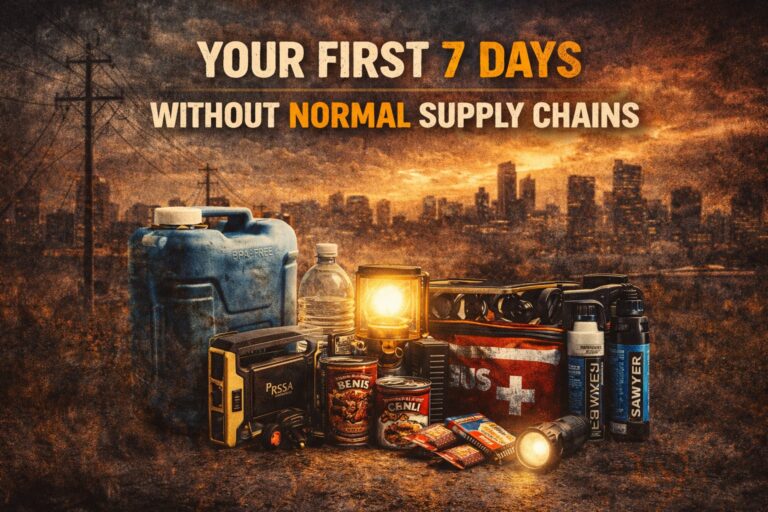
Every household should be able to function independently for at least 72 hours, ideally longer.
Core items include:
- Portable backup power
https://www.amazon.ca/s?k=portable+power+station&tag=canadianprep-20 - Emergency lighting and battery systems
https://www.amazon.ca/s?k=led+lantern+rechargeable&tag=canadianprep-20 - Alternative cooking methods
https://www.amazon.ca/s?k=camp+stove+propane&tag=canadianprep-20
More on shelter and resilience:
https://canadianpreppersnetwork.com/category/shelter/
Global Conflict Is Already Affecting Canada—Indirectly
A recent missile strike in Kuwait impacted a base hosting Canadian personnel. While no casualties were reported, the event highlights something many Canadians overlook:
Canada is not isolated from global conflict.
Even when events happen overseas, the effects show up at home through:
- fuel markets
- supply chains
- cybersecurity risks
We are already seeing shipping disruptions and cost increases tied to global instability.
This is not about immediate danger—it’s about system pressure building over time.
The Real Story This Week
There is no single headline that defines the moment.
Instead, there is a pattern:
- Food is getting more expensive
- Fuel is becoming more volatile
- Weather is causing real-world disruptions
- Global instability is adding pressure behind the scenes
Nothing has broken.
But everything is under strain.
And that’s where preparedness matters most—not after failure, but before it.
What You Should Be Doing Right Now
Based on current conditions—not theory:
- Build at least a one-month food buffer
- Treat fuel as a critical supply, not a convenience
- Prepare for multi-day outages without assistance
- Reduce reliance on just-in-time systems
If you wait for clear warning signs, you’ll be competing with everyone else.
Right now, you still have time to move quietly and deliberately.
Final Thought
Preparedness isn’t about reacting to disaster.
It’s about recognizing when systems are becoming less reliable—and adjusting before they fail you.
That’s where we are today.