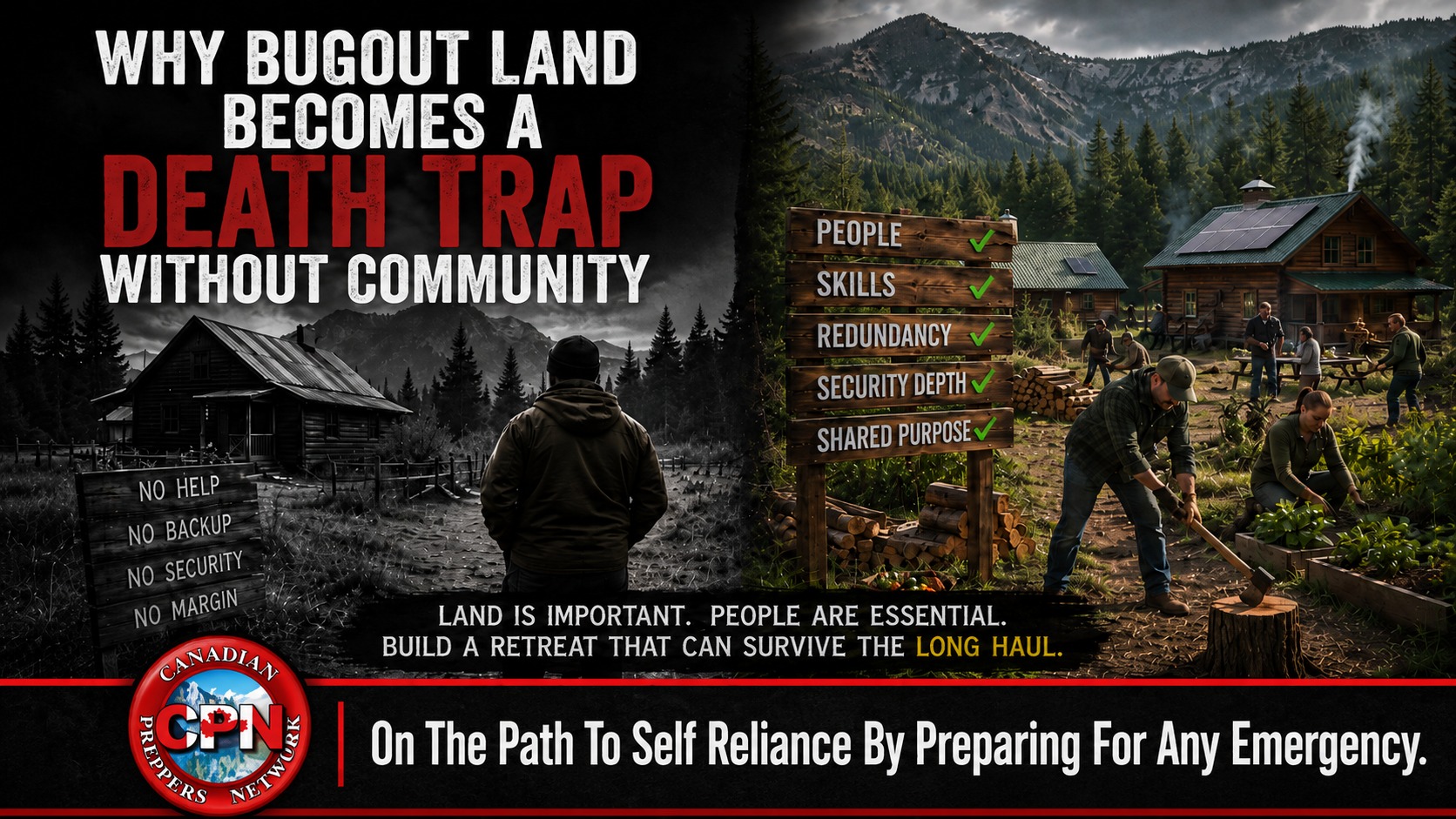
Remote land sounds safe until you realize isolation means no security depth, no redundancy, and no backup.
There is a dangerous fantasy in the preparedness world that goes something like this: buy a patch of land, stash some food, build a cabin, and when everything falls apart, disappear into the trees.
It sounds clean. It sounds simple. It sounds independent.
It is also one of the fastest ways to turn a retreat property into a private trap.
A remote bugout property can absolutely be part of a serious preparedness plan. Land matters. Water matters. Distance from dense urban centres matters. But land by itself is not a survival strategy. A cabin is not a community. A stocked shed is not a security plan. A woodstove is not a labour force. A few acres and a locked gate do not magically solve the problems that arrive when fuel is scarce, roads are unreliable, medical help is distant, and every mistake has consequences.
The hard truth is this: isolation feels safe before the collapse. Afterward, isolation becomes a liability.
A lone family on remote land has very little margin for failure. Someone gets sick, injured, exhausted, or overwhelmed, and the entire system weakens. Firewood still needs to be cut. Water still needs to be hauled or pumped. Food still needs to be cooked, rationed, grown, preserved, protected, and cleaned up after. Tools break. Animals get loose. Weather turns ugly. Children need attention. Elderly relatives need care. Someone has to stay awake when others sleep.
That is where the lone bugout fantasy begins to fall apart.
Most people underestimate the amount of labour required to keep even a modest off-grid retreat functioning. A normal household survives today because thousands of invisible systems support it. Grocery stores replace gardens. Hydro replaces wood piles. Pharmacies replace stored medical supplies. Fuel stations replace manual hauling. Police, fire, hospitals, contractors, road crews, plumbers, electricians, and delivery drivers all quietly hold modern life together.
When those systems are gone or badly weakened, the workload does not disappear. It lands directly on the people at the retreat.
And if there are only two or three capable adults, the math gets ugly fast.
This is why the multi-family retreat is not just a nice idea. It is the more realistic model for long-term grid-down survival. A serious retreat needs manpower, skills, redundancy, and internal structure. It needs people who can take over when others are tired, hurt, sick, or unavailable. It needs enough trusted adults to divide labour without burning everyone out in the first few weeks.
A retreat group can rotate watch, split chores, maintain tools, tend livestock, process firewood, handle repairs, care for children, manage sanitation, grow food, and keep morale from collapsing. One person may know small engines. Another may understand medical basics. Another may be strong with food preservation. Another may be good with radios, gardening, construction, animal care, or conflict resolution.
That mix matters more than most people want to admit.
Too many preppers build plans around supplies instead of systems. They imagine shelves of food, stacks of gear, and a retreat location far from trouble. But supplies run down. Gear breaks. Food gets eaten. Fuel gets used. Batteries die. What remains is the human system.
Can the group work together under stress?
Can they make decisions without falling apart?
Can they enforce standards without becoming tyrants?
Can they deal with fear, fatigue, jealousy, resentment, and grief?
Can they keep producing after the easy stored supplies are gone?
That is the difference between a retreat and a campsite with delusions of permanence.
Remote land without community also creates a security problem. This does not mean turning a retreat into some cartoon fortress. It means recognizing that awareness, presence, and routine matter. A lone household cannot watch every approach, manage every chore, and stay rested at the same time. They cannot be everywhere. They cannot respond to every problem. They cannot keep eyes open day and night without eventually making mistakes.
A larger, trusted group creates depth. Not just in security, but in decision-making, observation, labour, and emotional stability. There is someone to notice the smoke, the missing tool, the sick animal, the change in weather, the weak fence, the low woodpile, or the person who is quietly falling apart.
That is what community buys you: margin.
Of course, not every group is an asset. A badly chosen retreat group can be worse than being alone. Freeloaders, hotheads, addicts, chronic complainers, fantasy warriors, and people who refuse responsibility will destroy a retreat from the inside long before outside threats matter. This is why retreat planning must happen before the crisis, not during it.
The people matter. The standards matter. The expectations matter.
Who owns the land?
Who contributes what?
Who makes decisions?
Who is allowed to bring relatives?
What happens when someone refuses work?
How are supplies tracked?
How are disputes handled?
What skills are missing?
What rules are non-negotiable?
These are not comfortable questions, but they are necessary ones. A retreat that avoids them is not being peaceful. It is postponing conflict until the worst possible moment.
A real retreat is not just a place to run to. It is a working social and physical system. It needs planning, trust, leadership, redundancy, and shared purpose. It needs practical people who understand that survival is not a weekend aesthetic. It is not just bushcraft, firearms, freeze-dried food, or a cabin in the woods. It is governance, maintenance, food production, sanitation, morale, discipline, and daily labour.
The lone bugout property appeals to the part of us that wants to escape people. The group retreat recognizes that in a long-term crisis, the right people are exactly what you need.
That does not mean inviting everyone. It does not mean building a commune. It does not mean lowering standards in the name of kindness. It means finding a small number of capable, trustworthy households and building something functional before the pressure hits.
Because when the roads are uncertain, the grid is down, the stores are empty, and winter is coming, the question will not be whether your retreat looked good on paper.
The question will be whether it can keep working after everyone is tired.
A lonely piece of land may get you away from the crowd.
A properly planned retreat community may keep you alive after that.
Land Is Not A Retreat Until People Can Operate It
Bugout land sounds safe until the work begins.
A remote property without trained people, tools, water systems, food production, communications, medical supplies, security routines, and written agreements is not a retreat. It is a campsite with liabilities.
The land may give you distance, but distance alone does not feed anyone, repair anything, treat injuries, defend boundaries, split firewood, manage conflict, preserve food, or keep people from burning out under stress.
A real retreat needs systems.
Mental Resilience and Community Building Buying Guide
Wilderness Skills Buying Guide
Medical and First Aid Buying Guide
The hard truth is simple: a retreat is not land. A retreat is people, tools, rules, skills, food, water, heat, communications, medical capability, and the ability to work together when nobody feels like cooperating.
Recommended Reading
For a deeper look at building a long-term retreat plan instead of relying on the lone bugout fantasy, check out:
Acres of Preparedness: Planning the Last Safe Place
https://amzn.to/4mRu7b5
This book digs into the practical realities of retreat planning, land use, group structure, and why long-term preparedness requires more than simply owning rural property.