
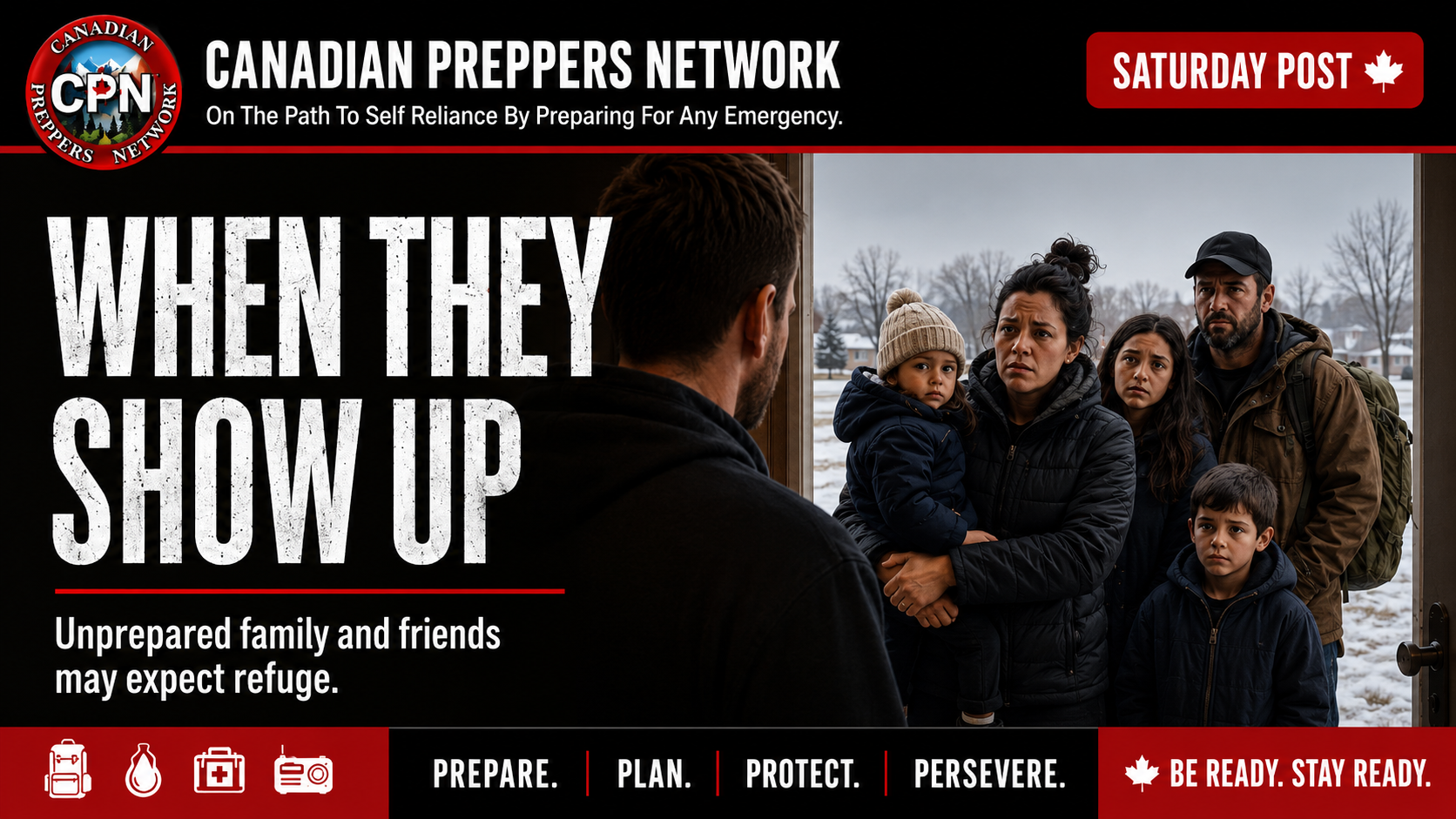
The hardest prep may not be feeding your own household. It may be dealing with the unprepared family and friends who ignored every warning and still expect refuge when the shelves go bare.
Most preppers have imagined shortages, blackouts, storms, fuel interruptions, broken supply chains, public disorder, and long emergencies. They have thought about food storage, water filtration, heat, security, communications, medical supplies, backup power, and the thousand small details that keep a household functioning when normal systems fail.
Fewer have seriously thought about the knock on the door.
Not the stranger. Not the looter. Not the dramatic Hollywood threat.
The cousin who laughed at your pantry.
The neighbour who said prepping was paranoid.
The adult child who assumed “Mom and Dad always figure it out.”
The friend who spent every spare dollar on entertainment, vacations, new toys, and takeout while rolling their eyes at anyone who stored rice, beans, candles, filters, fuel, tools, or medicine.
Then the emergency hits.
The power stays out. The grocery store does not reopen. The pharmacy shelves are empty. Fuel becomes uncertain. Public services slow down or disappear. Suddenly, the same people who mocked preparedness remember exactly where you live.
This is one of the most uncomfortable subjects in preparedness because it cuts straight through fantasy. Most people do not live alone on an isolated retreat with a hand-picked group of disciplined adults. Most people have families, friends, neighbours, old obligations, emotional baggage, and people they care about who are not prepared.
That means your emergency plan is not only about supplies. It is about boundaries. It is about responsibility. It is about deciding, in advance, what help looks like before desperation makes every decision harder.
A Full Pantry Is Not A Community Welfare System
There is a dangerous assumption among unprepared people. They believe that someone else’s preparedness is a shared resource.
They may not say it directly in normal times, but the attitude is there.
“You have lots.”
“You’re ready for this stuff.”
“You knew this was coming.”
“You can help us for a while.”
“You wouldn’t turn away family.”
That last one is the emotional hook.
Most prepared people are not heartless. Many store extra because they know real emergencies hurt real people. They understand that children, elderly relatives, sick neighbours, and good people caught off guard may need help.
But there is a hard line between charity and being consumed.
A family that has carefully stored six months of food for four people does not have six months of food if eight people arrive. It has three months, and probably less once stress, waste, sanitation problems, medical needs, and poor discipline enter the picture.
A household that can heat one living space may not be able to heat sleeping space for ten. A water plan built around four people becomes fragile when relatives arrive with laundry, pets, dishes, and no understanding of conservation. A medical kit built for your own household disappears quickly when every visitor needs cold medicine, bandages, pain relievers, stomach medication, gloves, masks, or prescription help.
Preparedness math is brutal because it does not care about feelings.
If people arrive empty-handed, they are not just guests. They are a load on every system you built.
The Real Problem Is Not Food. It Is Expectations.
Most unprepared friends and relatives will not arrive thinking of themselves as a burden. They will arrive thinking they are scared. They will arrive thinking you are the safe place. They will arrive assuming normal family rules still apply.
That is where the trouble starts.
In normal life, feeding guests is hospitality. In a long emergency, feeding guests is ration planning.
In normal life, letting someone sleep on the couch is kindness. In a grid-down winter, every extra body changes heat, space, sanitation, and security.
In normal life, someone who does not help clean up is annoying. In a collapse scenario, someone who refuses work is a liability.
In normal life, you can tolerate bad habits for a weekend. In a long-term disruption, laziness, entitlement, addiction, carelessness, gossip, panic, and drama can damage the entire household.
This is why the conversation has to happen before the emergency. Not after.
After the emergency, everyone is emotional. People are cold, hungry, afraid, and ashamed. They will hear boundaries as rejection. They will hear rationing as cruelty. They will hear rules as control.
Before the emergency, you can still speak plainly.
You can say: “We are preparing for our household. If you expect to come here during an emergency, then you need to contribute now.”
That sentence will offend some people.
Good.
Better to find out now than when they are standing in your driveway with three bags, two kids, a dog, and nothing useful.
There Are Only Three Real Categories
When planning for unprepared family and friends, it helps to stop thinking in vague emotional terms. “Family” is not a plan. “Friends” is not a plan. “We’ll figure it out” is not a plan.
In a serious emergency, people generally fall into three categories.
The first category is people you are fully responsible for. This may include your children, spouse, dependent parents, or someone already living under your roof. These people are part of the core plan. Their food, water, heat, medical needs, and sleeping space must be calculated honestly.
The second category is people you are willing to help, but not absorb unconditionally. These may be siblings, adult children, close friends, neighbours, or extended family. They may be welcome under certain terms, but they are not automatically entitled to unlimited access.
The third category is people you cannot take in. This is the category many preppers refuse to name. But it exists. Some people are too unstable, too entitled, too reckless, too disruptive, or simply too numerous for your household to support.
Naming these categories does not mean you hate anyone. It means you understand limits.
The worst plan is pretending everyone can come, then discovering too late that nobody can survive that way.
The Refuge Conversation
Every serious prepper with unprepared relatives should have some version of a refuge conversation.
It does not need to be dramatic. It does not need to sound like a bunker speech. It can be simple, direct, and practical.
Try this:
“If things ever get bad enough that you think you may need to come here, we need to talk about that now. I am not running a hotel, and I cannot feed unlimited people. If you want this place to be part of your emergency plan, then you need to keep supplies here, learn the rules, and understand that everyone works.”
That conversation does three important things.
First, it tells people your home is not an unlimited fallback.
Second, it gives serious people a path to become useful.
Third, it exposes the people who only want rescue without responsibility.
Some will laugh. Some will avoid the subject. Some will get offended. Some will say, “Don’t worry, I’ll just come to your place.”
That last response should be treated as a warning, not a joke. Because under stress, jokes become plans.
No One Arrives Empty-Handed
One of the clearest boundaries is this: no one planning to use your home as a refuge gets to arrive empty-handed.
That does not mean everyone needs to be wealthy. It does not mean everyone needs a basement full of gear. It means they need to take responsibility before the crisis.
At minimum, anyone expecting refuge should be told to store food, water containers, personal hygiene supplies, medications, warm clothing, bedding, batteries, flashlights, work gloves, basic tools, and pet supplies if they have animals.
They should also bring copies of important documents, cash, sturdy footwear, seasonal clothing, and anything specific to children, elderly dependents, or medical needs.
This is not about greed. It is about survival discipline.
If someone cannot be bothered to prepare even a small personal kit now, what makes you think they will suddenly become disciplined under pressure?
The answer is simple. They probably will not.
And if they do arrive, they will expect your household to cover every gap they refused to handle.
Refuge Comes With Rules
If people come to your home during a long emergency, they are not casual guests. They are temporary members of a stressed household.
That requires rules.
Rules for food. Rules for water. Rules for sanitation. Rules for noise. Rules for chores. Rules for visitors. Rules for pets. Rules for firewood, fuel, lighting, laundry, waste, privacy, and conflict.
Rules should not be invented during a shouting match. They should be written down now.
A serious refuge plan should make it clear that everyone works according to ability. Children can carry small items, sort supplies, help with dishes, collect kindling, or assist with simple chores. Elderly relatives may be able to mend clothing, watch children, prepare food, organize supplies, or provide calm leadership. People with injuries or limitations may still contribute in some way.
The point is not punishment. The point is that nobody gets to consume while others carry the household.
In a long emergency, resentment is poison. Nothing destroys morale faster than one person eating the same ration as everyone else while refusing to help.
The Friend Problem
Family is complicated, but friends can be worse.
Friends often assume emotional closeness equals access. They may know you prep. They may have seen your storage. They may know you own tools, filters, generators, radios, food, or a rural property.
Some may be loyal, useful, and worth including.
Others may be people you enjoy in normal life but would never trust in a crisis.
That difference matters.
A drinking buddy is not automatically a retreat member. A hunting friend is not automatically welcome with his entire extended family. A neighbour you chat with over the fence is not automatically entitled to your supplies.
A friend who cannot keep private information private is a risk. A friend with constant drama will bring drama. A friend who always borrows and never returns will not become more reliable when resources are scarce.
This sounds harsh only because normal life lets us pretend character does not matter. In an emergency, character becomes a survival resource.
So ask the hard questions now.
Who keeps their word? Who stays calm? Who works without being asked? Who respects privacy? Who brings skills? Who brings supplies? Who brings problems?
That list may change how you see people.
Good.
The Doorstep Decision
The most painful moment is the doorstep decision.
Someone arrives. They are scared. They have children. They have no plan. Maybe they are family. Maybe they are a friend. Maybe you warned them for years.
What then?
This is where preppers often split into two fantasy camps.
One fantasy says, “I’ll turn everyone away.”
The other says, “I could never turn away someone I care about.”
Both are too simple.
Reality may require a middle path.
You may decide to provide a meal, water, information, and a limited rest period, but not permanent refuge. You may keep a small charity cache separate from your core household supplies. You may help people reach another destination. You may offer work-for-rations arrangements.
You may accept specific people but not their entire network. You may take in children or vulnerable dependents under certain conditions while refusing disruptive adults. You may decide that some people cannot come in at all.
The key is deciding these principles now.
Because if you wait until the doorstep moment, guilt will do the planning for you.
And guilt is a terrible quartermaster.
The Charity Cache
One practical solution is to separate household survival supplies from charity supplies.
Your core storage is for your household and approved group.
A charity cache is separate. It can include basic rice, beans, oats, pasta, canned goods, water treatment options, hygiene items, candles, matches, and simple printed instructions.
That way, helping someone does not immediately compromise your main plan.
The charity cache also creates a psychological boundary. You are not opening the pantry and letting someone see everything. You are handing out a controlled amount from a separate supply.
This matters.
In desperate times, visibility creates expectation. If people see shelves full of food, they may not understand that every item is already counted. They see abundance. You see a ration calendar.
Keep those two worlds separate.
The Hardest Word Is No
Preparedness attracts people who want solutions. Food storage solves hunger. Filters solve unsafe water. Firewood solves heat. Radios solve communication. Training solves ignorance.
But some problems are not solved by gear.
Some are solved by saying no early enough.
No, you cannot assume you are coming here.
No, I cannot feed your household unless you prepare too.
No, your adult decisions do not become my emergency.
No, I will not risk my household because you refused every warning.
No, this house has rules.
No, you do not get to bring extra people without discussion.
No, pets require their own food.
No, stored supplies are not community property.
No, kindness does not mean unlimited access.
That word will feel ugly the first few times you say it.
Say it anyway.
A boundary stated before disaster is far kinder than a collapse of the entire household during one.
Build The Lifeboat Before The Ship Sinks
The best time to deal with unprepared family and friends is while stores are open, roads are clear, emotions are calm, and everyone still has choices.
Tell people what you are willing to do.
Tell them what you are not willing to do.
Give them a basic supply list.
Invite the serious ones to store extra food.
Ask who has useful tools.
Find out who has medical needs.
Discuss pets.
Discuss transportation.
Discuss where they would sleep.
Discuss what work they can do.
Discuss what happens if they bring someone else.
Most people will avoid the conversation because it forces them to admit they have done nothing.
That is their problem.
Your job is not to maintain their illusion.
Your job is to protect the people already depending on you.
Final Thought
The unprepared relative problem is not really about food. It is about responsibility.
In good times, people are free to ignore warnings, mock preparedness, spend carelessly, refuse to learn, and assume the systems will always work.
In bad times, those choices come due.
A prepper can be generous. A prepper can be compassionate. A prepper can help others.
But a prepper cannot allow guilt, entitlement, or family pressure to destroy the very lifeboat they spent years building.
So have the conversation now.
Draw the line now.
Make the rules now.
Because when they show up cold, scared, hungry, and empty-handed, it will be too late to pretend this was never part of the plan.


One Comment