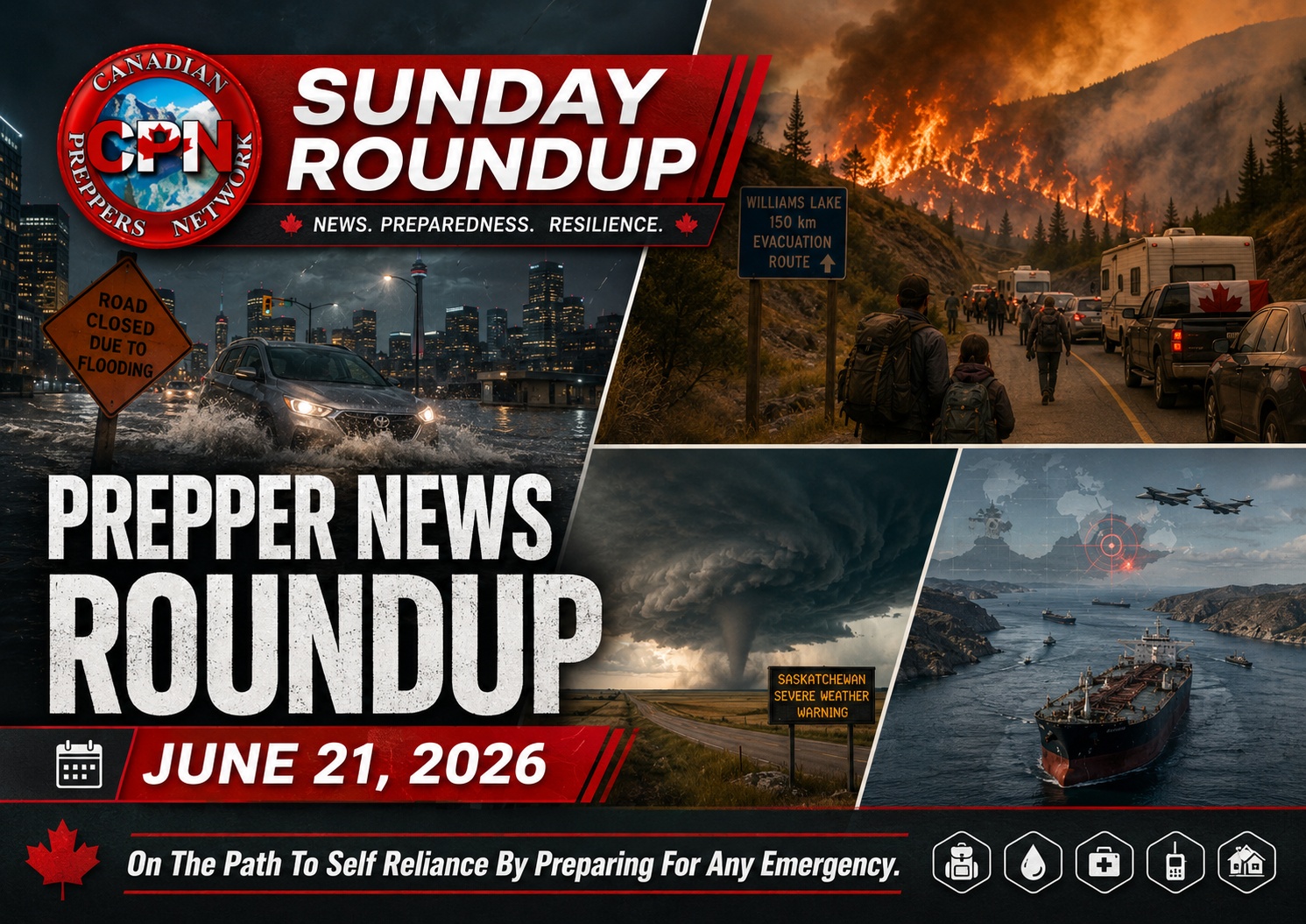
Flooding in Montréal, wildfire evacuations in B.C., tornado warnings across Canada, war pressure on fuel routes, and civil defence systems under strain.
This week’s roundup is a reminder that preparedness rarely comes from one big, cinematic disaster. More often, it arrives as a cluster of smaller pressure points: flooded streets in one city, wildfire evacuations in another province, tornado warnings in farm country, war risk around a fuel chokepoint, and government alert systems that may or may not work exactly when people need them.
For Canadian preppers, the lesson is not panic. The lesson is pattern recognition. The same practical themes keep repeating: water, fuel, communications, evacuation timing, documents, cash, medical supplies, and the ability to function when the official system is overloaded, delayed, or temporarily unreliable.
Montréal Flooding Shows How Fast Urban Rain Becomes an Emergency
Environment Canada reported that near-stationary thunderstorms dumped 100 to 150 millimetres of rain in just a few hours over the western part of Montréal Island and several South Shore communities on Saturday, June 20. Flooding was reported, along with property damage, cars trapped in floodwaters, flooded homes, airport delays, small hail, and some power outages.
That is not just “bad weather.” That is a practical urban preparedness problem.
Heavy rain in a city does not need to wash away a bridge to become dangerous. It can overwhelm storm drains, push water into basements, strand vehicles, contaminate stored items, damage electrical panels, and make parts of a city temporarily impassable. For apartment dwellers, it can mean elevators going down, underground parking flooding, and power interruptions. For homeowners, it can mean sump pump failure, sewage backup, ruined supplies, and the sudden need to move valuables or equipment to higher ground.
The prepper takeaway is simple: flood planning belongs in cities, not just along rivers. A proper plan should include sump pump backup power, stored drinking water, sealed storage bins for important documents and gear, a way to shut off utilities if needed, and a firm rule against driving into flooded roads. A vehicle does not need deep water to stall, float, or trap its occupants.
Lytton Faces Wildfire Evacuations and a Boil-Water Notice
In British Columbia, the Saw Creek wildfire situation near Lytton escalated rapidly along the Highway 1 corridor. EmergencyInfoBC listed expanded evacuation orders for the Village of Lytton and Electoral Area “I,” along with evacuation orders for Klahkamich IR 17 and Kitzowitz IR 20. The Village of Lytton also reported that a boil-water notice was in effect for the Village of Lytton, IR 17, and IR 18 due to the fire.
That combination matters. Wildfire is not only a flame-front problem. It becomes a water problem, a road problem, a shelter problem, and a communications problem. A person may be able to leave the smoke and flames, but still have to deal with unsafe water, road closures, limited accommodations, displaced pets, separated family members, and uncertainty over when home access will be restored.
For preppers, Lytton remains one of the clearest Canadian examples of why “wait and see” is a weak evacuation strategy. When an evacuation order comes, the time for building a go-bag has already passed. The bag, fuel, medication list, pet carrier, insurance papers, backup phone charger, cash, and destination plan should already exist.
It is also worth noting the water angle. A boil-water notice during a wildfire means evacuees and residents cannot assume municipal systems will remain safe just because the taps still run. Stored water, portable filtration, a way to boil water during a power outage, and sanitation planning are not optional extras in wildfire country.
Canada’s Wildfire Season Is Already Displacing Communities
Public Safety Canada’s June wildfire update placed the national situation in context. As of June 10, Canada had already seen 1,747 wildfires in 2026, with 95 active fires and 44 listed as out of control. Indigenous Services Canada reported that, since April 1, wildland fires had affected multiple First Nations on reserve or EMAP-eligible communities and had led to 2,169 evacuees.
The numbers matter because they show that evacuation is not an abstract possibility. It is already happening.
Remote and northern communities face added complications. Evacuation may involve aircraft, long-distance travel, unfamiliar host communities, medical continuity problems, and delays in returning home. Even in less remote areas, hotel space, fuel, animal care, and road access can become immediate problems once more than one community is under pressure at the same time.
The household lesson is not to assume government response is absent. It is to understand its limits. Fire crews, aircraft, emergency managers, and reception centres may all be active and still not be able to make your household comfortable, organized, and supplied in the first hours of displacement.
A practical wildfire plan should include pre-packed evacuation bins, scanned documents, printed contact information, N95 or better smoke masks, vehicle fuel discipline, a trailer or tote plan for pets and livestock, and a realistic destination beyond “we’ll figure it out.”
Prairie Tornadoes Prove Canadian Severe Weather Deserves Respect
The Northern Tornadoes Project confirmed details from the June 9 tornado outbreak in Saskatchewan and Manitoba, including an EF3 tornado near Oxbow, Saskatchewan. The tornado was assessed with estimated maximum winds of 245 km/h, a track length of roughly 32 kilometres, and a maximum path width of about 560 metres. Survey teams documented damage including snapped power poles, pump jack damage, tree damage, and minor structural damage.
That is a serious Canadian tornado.
There were also confirmed Manitoba tornadoes during the same outbreak, and Alert Ready noted that Environment and Climate Change Canada issued tornado and severe thunderstorm warnings through the national public alerting system on June 9.
The Ontario angle deserves mention as well. Earlier this season, Environment Canada issued red-level tornado warnings in parts of southern Ontario, including areas such as Brantford, County of Brant, Simcoe-Delhi-Norfolk, Woodstock-Tillsonburg-Oxford County, and London. That matters because too many Canadians still treat tornadoes as a Prairie-only problem. They are not. Southern Ontario, southern Quebec, the Prairies, and parts of Atlantic Canada all need severe-weather plans.
The prepper takeaway is to build the plan before the alert. Know the safest room in the house. Keep shoes, gloves, a flashlight, a whistle, and a small first-aid kit where you shelter. Make sure phones are charged during severe-weather watches. Have more than one alert method, especially if your phone is in another room, on silent, dead, or outside cell coverage.
An alert is not the plan. It is the trigger for a plan that should already exist.
Hormuz Tensions Put Fuel and Shipping Back in the Spotlight
Reuters reported that Iran’s Islamic Revolutionary Guard Corps claimed on June 20 that the Strait of Hormuz had been closed, while U.S. Central Command denied that claim and said traffic continued to flow. U.S. forces were reportedly monitoring the situation to ensure the waterway remained open.
That distinction is important. The story is not that Hormuz was confirmed closed. The story is that a critical oil chokepoint became unstable enough for competing claims, military monitoring, and market uncertainty.
For Canadian households, that does not mean panic-buying fuel. It does mean understanding how quickly distant war can reach ordinary life. Fuel prices, diesel supply, heating costs, fertilizer, shipping rates, and the cost of moving goods across Canada are all tied into global energy and transport systems. A disruption does not need to stop every tanker to raise costs or shake confidence.
A reasonable prepper response is boring and practical: keep vehicles above half a tank when possible, rotate stored generator fuel safely, avoid letting heating backup plans sit empty, and keep enough household supplies on hand that every price jump or supply rumour does not become a personal emergency.
Fuel is not just about driving. It is food distribution, farm inputs, heating, trucking, emergency services, backup power, and the cost of everything that moves.
Lebanon Ceasefire Shows Why Headlines Are Not Stability
Reuters reported that Israel and Hezbollah had agreed to a ceasefire set to begin Friday, June 19. Reuters then reported renewed Israeli strikes in Lebanon hours after the truce took effect, with Israel saying it was responding to Hezbollah attacks and Hezbollah saying it would not allow Israel freedom of movement in Lebanon.
That is the preparedness lesson: a ceasefire announcement is not the same thing as stable ground conditions.
For readers here in Canada, this is not about taking sides in the conflict. It is about understanding how fragile agreements can affect wider systems. War zones influence fuel, shipping, migration pressure, military posture, aid supply chains, cyber risk, and market behaviour. A single headline saying “ceasefire” may calm markets for a few hours, while actual fighting continues to shape the next day’s risk.
Preparedness means watching events, not slogans. A signed agreement, a press conference, or a diplomatic statement may matter, but so do missile launches, shipping advisories, embassy warnings, border closures, and insurance rates on commercial vessels.
Ukraine War Expands the Energy-Infrastructure Lesson
Reuters reported that Ukrainian President Volodymyr Zelenskiy confirmed a drone strike on oil-refining facilities in Russia’s Tyumen region, more than 2,000 kilometres from Ukraine. He also said Ukraine had developed long-range drones capable of operating at more than 3,000 kilometres. Russian regional officials said air defences repelled the attack and that there was no refinery damage, while staff were evacuated as a precaution.
Again, the key point for preppers is not battlefield politics. It is infrastructure.
Modern war reaches refineries, power stations, railways, ports, fuel depots, communications networks, and industrial plants far from the front line. These targets are not symbolic. They are the machinery that keeps a country supplied and functioning.
For Canadian preparedness, the lesson is uncomfortable but useful. Our own lives depend on long, technical supply chains: diesel for transport, electricity for refrigeration, telecommunications for payment systems, industrial parts for repairs, and fuel for agriculture. When war shows how vulnerable these systems are elsewhere, it should push households to ask what they would do if similar pressure hit closer to home through cyberattack, sabotage, labour disruption, wildfire, flood, or grid failure.
You do not need a bunker to learn from this. You need backup lighting, alternate cooking, stored water, communications redundancy, cash, paper maps, a fuel plan, and enough food depth to avoid depending on daily resupply.
Eastern Washington Wildfire Destroys Homes and Forces Fast Evacuations
Associated Press reported that a fast-moving wildfire near Spokane, Washington forced about 1,500 people to evacuate and destroyed at least 15 homes. High winds drove the fire into a neighbourhood, power was turned off in some areas, and some residents had to flee on short notice. Officials described people leaving behind belongings and, in some cases, critical medications. Some were later escorted back briefly to retrieve essentials.
That detail should hit hard. In real evacuations, people forget medication, glasses, identification, chargers, pet supplies, and documents. Not because they are careless, but because stress narrows thinking and time disappears.
The solution is not a vague “bug-out bag” fantasy. It is a written evacuation checklist taped inside a closet door, a medication grab list, a document pouch, a pet kit, a backup charger, and a household habit of keeping fuel in the vehicle. It is also a frank discussion about who wakes whom, who loads what, and where everyone meets if phones fail.
Fast-moving fires do not care whether you meant to organize the garage next weekend.
Brazil False Alerts Expose a Civil-Defence Weak Point
Reuters reported that Brazil’s government suspected a hacking attack triggered an unauthorized emergency alert sent to cell phones in parts of the country early Saturday. Brazil’s National Protection and Civil Defense Secretariat said the citizens’ notification system was taken offline after the incident, and the matter was being referred for investigation.
That is a major civil-defence story even though it did not happen in Canada.
Public warning systems are valuable. They save lives when used properly. But they are still systems, and systems can fail, be delayed, be misunderstood, or potentially be abused. A false alert can create panic. A missing alert can leave people unaware. Too many alerts can lead people to ignore them. A hacked or spoofed alert can damage public trust.
The prepper answer is not to reject alerts. The answer is redundancy. Use official alerts, but also monitor local emergency management, trusted local news, amateur radio where appropriate, municipal feeds, and direct observation. If the sky is turning green, the smoke column is growing, the creek is rising, or police are moving door to door, do not wait for your phone to validate what your eyes already know.
Emergency alerts are a tool, not a substitute for judgment.
Civil Defence Is Moving Back Into the Mainstream
Public Safety Canada recently announced that Canada had added national aerial wildfire surge capacity through 10 new leased aerial firefighting aircraft and two support assets. The European Union also announced its largest-ever wildfire response for the 2026 summer season, with 777 firefighters pre-positioned in high-risk areas, along with 22 firefighting airplanes and five helicopters ready to support countries under pressure.
Canada’s own Get Prepared material continues to tell households to understand local risks, create an emergency plan, and build an emergency kit. The federal emergency kit guidance says households may need to get by without power or tap water and should be prepared to be self-sufficient for at least 72 hours.
That is the quiet shift worth watching. Civil defence is not a fringe idea. It is returning to normal government language because the pressure points are becoming too obvious to ignore: fire, flood, tornadoes, war, cyber risk, grid strain, health disruptions, and supply-chain fragility.
But government capacity and household preparedness are not the same thing. Aircraft can fight fires, but they cannot pack your documents. A warning system can send an alert, but it cannot carry your elderly parent downstairs. A reception centre can provide support, but it may not have your medication, your pet plan, your dietary needs, or your fuel.
The first layer of civil defence is still the household.
Final Takeaway
This week’s stories point in the same direction. Montréal showed how quickly rain becomes urban flooding. Lytton showed how wildfire can trigger evacuation and water disruption at the same time. The Prairie tornado outbreak, along with Ontario warning examples, showed that severe-weather readiness belongs across much of Canada. Hormuz, Lebanon, and Ukraine showed that war still reaches fuel, infrastructure, and supply chains. Brazil showed that even emergency alert systems need backup. Canada and Europe showed that governments are investing in response capacity, but still expect households to carry the first 72 hours themselves.
That is not fearmongering. That is the practical centre of preparedness.
Build the kit. Keep the fuel. Store the water. Protect the documents. Know the shelter room. Have a way to communicate. Make the evacuation plan before the order comes.
The news keeps changing, but the core lessons are becoming very hard to ignore.