The trade that solves one problem can create three more
Barter sounds simple when people talk about collapse planning.
You have something useful. Someone else has something useful. The two of you make a trade. No banks, no cash, no online payment systems, no supply chain, no problem.
That is the fantasy version.
The real version is dirtier.
Barter exposes what you have, what you need, where you are weak, who you are dealing with, and whether your household can be pressured. A bad trade can leak information. A generous trade can create expectations. A desperate trade can attract repeat visitors. A careless trade can turn a quiet prepper household into a known supply point.
In a long disruption, barter may become necessary. That does not make it harmless.
The mistake is thinking of barter as a shopping trip without money. It is not. It is a security event, a social test, and a risk calculation.
Canadian preppers spend a lot of time thinking about food, water, heat, radios, first aid, and backup power. They should spend just as much time thinking about how they will handle people who want those things once normal systems stop working.
CPN’s broader preparedness hubs cover the foundation pieces: Food Procurement & Storage, Water Collection & Purification, Security & Defense, Communications, and Mental Resilience & Community Building. Barter cuts across all of them.
Barter Reveals More Than You Think
Every trade tells a story.
If you trade batteries, people know you have spare batteries. If you trade canned food, people know you have food beyond tonight’s supper. If you trade fuel, they know you have fuel storage. If you trade medical supplies, they may assume you have more. If you trade alcohol, tobacco, cannabis, ammunition, or anything else people crave badly enough, you may have just advertised yourself to the wrong kind of attention.
Even harmless items can reveal too much. A person who always has coffee, sugar, lamp oil, sewing needles, replacement batteries, or spare water filters is no longer just another struggling neighbour. He becomes “the guy who has things.”
That reputation may be useful in a stable community with trust, rules, and relationships.
It is dangerous in a hungry, stressed, mobile crowd where rumour moves faster than facts.
The first rule of barter is simple: do not trade in a way that identifies your main storage location, your full inventory, or your household’s real capacity.
That does not mean paranoia. It means discipline.
A trade should reveal only the item being traded. Not the shelf behind it. Not the garage full of totes. Not the radio room. Not the generator shed. Not the cold room. Not the water barrels. Not the fact that your family is still eating three meals a day while everyone else is scraping the last cans out of the pantry.
The Wrong Barter Goods Attract the Wrong People
A lot of prepper discussions eventually drift toward “vice goods.”
Alcohol. Tobacco. Cannabis. Other addictive or mood-altering substances.
The argument usually sounds practical: people will want them, they store value, and they can be traded for food, labour, information, or protection.
That argument ignores the human reality.
Addictive substances do not behave like soap, socks, batteries, or garden seed. They attract urgency. They attract repeat demand. They attract people who may be less rational as withdrawal, stress, dependency, pain, boredom, fear, and desperation increase.
That does not mean every person who drinks, smokes, vapes, or uses cannabis is dangerous. That is not the point.
The point is that barter is not happening in a normal social setting. It is happening under pressure, scarcity, and declining trust. In that environment, items tied to dependency can create behaviour you do not want at your door.
A person who trades for a sewing kit may not return angry tomorrow.
A person who trades for alcohol, tobacco, or cannabis might.
And if that person tells others where he got it, your household has become part of someone else’s craving cycle.
Alcohol Is Not Just Another Trade Item
Alcohol is one of the worst barter items to build a plan around.
It lowers judgement. It can increase conflict. It can worsen accidents, domestic tension, poor decision-making, sleep problems, exposure risk, and violence. In a normal society, those problems are partially contained by police, hospitals, stores, shelters, transportation, family networks, and social services.
In a collapse or severe long-term disruption, those buffers are weaker or gone.
Trading alcohol into a stressed group can make that group less stable. Trading alcohol to someone who is already struggling can turn a private problem into a community problem. Trading alcohol to a stranger can bring that stranger back, possibly with friends, possibly at night, possibly without anything left to trade.
There is also the practical problem of reputation. Once people believe you have alcohol, they may not believe you are out. “Just one bottle” becomes “you must have more.” Refusing the second trade can create resentment because the first trade already trained the other person to see you as a source.
That is the trap.
The trade may be profitable once.
The reputation may cost you for months.
Tobacco Creates Repeat Visitors
Tobacco and vaping products create a different problem: repeat demand.
Nicotine dependence is powerful. In normal times, stores satisfy that demand quietly. In a breakdown, the person looking for tobacco is not just looking for comfort. He may be dealing with irritability, stress, poor sleep, and withdrawal while also dealing with food insecurity, family pressure, and uncertainty.
That combination is not a good foundation for barter.
Tobacco also has a visibility problem. It is easy to share, easy to talk about, easy to notice, and easy to ask for again. If one person learns that you traded tobacco, others may follow.
And unlike a one-time tool trade, tobacco does not solve a durable problem. A file, hand saw, water filter, pair of work gloves, or roll of repair tape may improve someone’s situation. Tobacco satisfies a short-term craving and creates the next request.
That is a bad trade loop.
Cannabis Carries Its Own Problems
Cannabis has become normalized in Canada, but normalization does not make it a sensible barter item during a crisis.
The concern is not simply legality or social acceptance. The concern is judgement, dependency, intoxication, impairment, conflict, and the type of attention that follows anything people believe they can consume, resell, or pressure others to produce.
Cannabis can also blur group standards. If one household member trades it, stores it, shares it, or tolerates it casually, others may assume that intoxication is acceptable around tools, watches, radios, vehicles, livestock, children, medical decisions, or security posts.
That is not a small issue.
A retreat, camp, neighbourhood watch, or survival group can survive discomfort. It may not survive sloppy judgement.
The Best Barter Goods Are Boring
The safer barter items are usually dull.
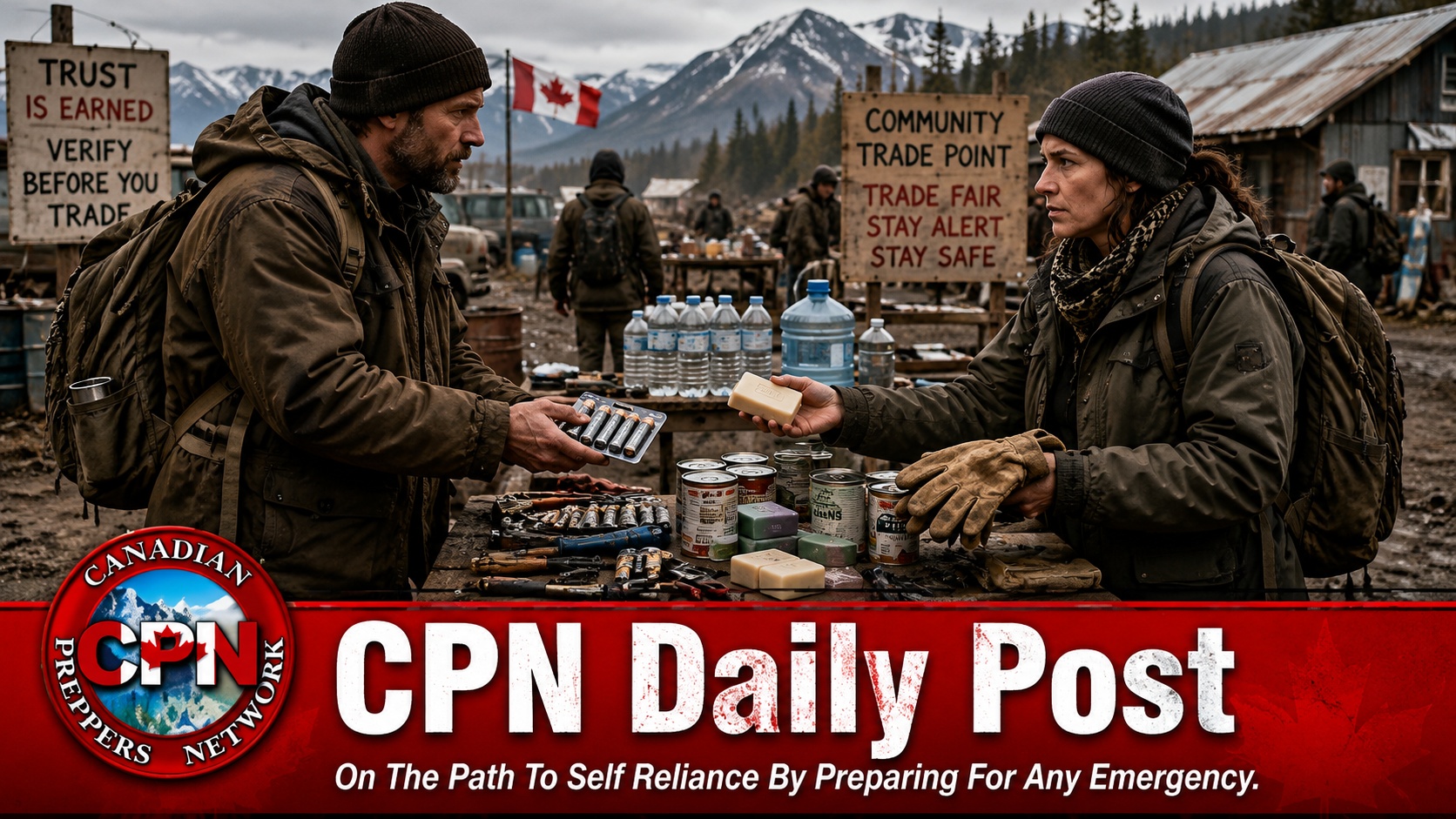
Soap. Work gloves. Socks. Sewing needles. Water treatment supplies. Repair tape. Lighters. Matches. Flashlight batteries. Canning lids. Garden seed. Hand tools. Hygiene items. Salt. Zip ties. Cordage. Candles. Laundry supplies. Toothbrushes. Razor blades. Small tarps. Manual can openers. Needles and thread. Fishing line. Mason jar accessories. First aid basics.
These things are useful, but they do not usually create intoxication, dependency, or the same kind of craving-driven repeat pressure.
The best barter goods solve practical problems without making you responsible for someone else’s bad decisions.
A person who receives soap can clean himself.
A person who receives gloves can work.
A person who receives a needle and thread can repair clothing.
A person who receives water treatment tablets can make water safer.
A person who receives batteries can power a flashlight or radio.
Those trades may still carry risk, but they do not carry the same social poison as addictive substances.
Do Not Barter From Your Main Stock
Another major mistake is trading directly from household storage.
Never let a barter partner see your pantry, tool wall, fuel cans, livestock area, medical shelf, ammunition storage, generator, radios, or water system. Even trusted people should not see more than they need to see.
If barter becomes necessary, separate trade goods from survival goods.
That means a small barter box, not your main supply room.
It should contain items you are willing to lose. It should be physically separate from the core household inventory. It should not be so large that its loss would damage your family’s survival. It should not include anything that reveals your deeper capability.
This is where many people get careless. They imagine barter as generosity. They want to help. They bring someone into the garage, open the storage room, or start digging through totes.
That moment may feel neighbourly.
It may also be the moment someone learns exactly what you have.
Barter Should Happen Away From Home When Possible
The safest trade is usually not at your front door.
A front-door trade teaches people where to return. A driveway trade shows vehicles, buildings, family members, fencing, tools, animals, and access points. A barn trade may reveal livestock and feed. A garage trade may reveal fuel, equipment, and supplies.
A neutral location is usually better.
That does not mean wandering blindly into danger with a backpack full of goods. It means thinking ahead about controlled locations: a community meeting point, a church parking lot, a known neighbour’s property, a market table at an organized event, or another place where multiple people are present and no single household is exposed.
In a functioning community, barter should become structured as quickly as possible. Public times. Public places. Known rules. No intoxication. No threats. No weapons handling. No private pressure. No following people home. No trading at night.
A community that cannot enforce basic barter rules is not ready for open barter.
Trusted Networks Beat Random Trades
The safest barter is rarely a one-on-one trade with an unknown person.
A better model is barter between trusted households, established preparedness groups, neighbouring farms, church communities, ham radio circles, hunting camps, retreat groups, or mutual-aid networks that already have some relationship before the crisis begins.
That does not make barter risk-free, but it changes the risk.
A stranger has no reputation to protect. A trusted group does. A stranger may disappear after a bad trade. A known group has to live with the consequences. A stranger may probe for weakness. A trusted group is more likely to understand boundaries, agreed locations, fair exchange, and the importance of not spreading information.
In a long disruption, reputation becomes a form of currency.
This is where pre-collapse relationship building matters. The best time to find reliable barter partners is before the shelves are empty, before the roads are uncertain, and before everyone is operating from fear. A group that has already trained together, shared meals, worked events, helped with projects, tested radio contact, or solved small problems together is in a much better position to trade safely later.
Trusted-group barter can also be more structured. One group may have extra garden seed, another may have firewood, another may have mechanical skills, another may have livestock knowledge, another may have medical experience, and another may have communications capability. Instead of random driveway trades, barter can happen through known contacts, agreed meeting points, and clear rules.
That is a much stronger model than waiting for unknown people to come knocking.
For retreat groups, this should be part of planning from the beginning. Do not just ask, “What do we have?” Ask, “Who do we trust enough to trade with, and under what rules?”
A multi-family retreat, rural preparedness circle, or regional mutual-aid group can create safer barter lanes long before a crisis. They can agree on meeting points, radio procedures, trade limits, conduct rules, and what items are never part of barter. They can also identify which skills and resources each group can offer without exposing every household’s private inventory.
This is one reason preparedness events, training weekends, radio nets, and local meetups matter. They are not just social events. They are filters. They give people a chance to observe reliability, attitude, discretion, and follow-through before anyone is under real pressure.
Unknown people can still be helped when appropriate.
But trusted networks should be the first option.
Never Trade Under Pressure
Desperation makes bad deals.
If someone shows up angry, emotional, intoxicated, demanding, vague, or unwilling to accept “no,” that is not a trade. That is pressure.
Pressure should end the conversation.
The item does not matter. The value does not matter. The sob story may be real, but the behaviour still matters.
A person who uses pressure before the trade may use pressure after the trade. A person who refuses boundaries once may refuse them again. A person who cannot accept limits over a small item may become worse when the stakes rise.
Barter should be calm, limited, and controlled.
If it feels like extortion, it probably is.
Skills Are Better Than Stuff
One of the strongest barter positions is not having extra piles of goods. It is having skills that do not reveal inventory.
A person who can repair clothing, sharpen tools, fix a bicycle, mend tack, preserve food, teach radio basics, build a rocket stove, diagnose a garden problem, split firewood properly, repair a hand pump, or help organize a work crew has something valuable without necessarily advertising a basement full of supplies.
Skill barter is not risk-free. It still exposes capability and creates expectations. But it is often less revealing than trading physical goods.
There is a difference between “I have twenty extra water filters” and “I know how to help you make a rough sand-and-charcoal pre-filter before final treatment.”
There is a difference between “I have cases of canned food” and “I can help you build a better storage rotation system.”
There is a difference between “I have a room full of supplies” and “I can repair that handle.”
The more your value comes from competence, the less you have to expose your stored inventory.
That is why homestead skills matter. CPN’s Homestead Skills in Canada hub is not just about gardening and old-time skills. It is about becoming useful when convenience disappears.
Create Rules Before You Need Them
A household should have barter rules before the first request arrives.
Those rules do not need to be complicated, but they should be firm.
Who is allowed to trade? What items are never traded? Where do trades happen? Who makes the final call? What information is never shared? What items are reserved for family only? What happens if someone returns demanding more? What happens if a neighbour asks for something you have but cannot spare? What happens if the trade involves a known addict, a desperate stranger, or someone already acting unstable?
The time to answer those questions is not when someone is standing in the driveway.
For a retreat group, the rules matter even more. One careless member can compromise everyone. If a single person trades alcohol, tobacco, cannabis, fuel, food, or medical supplies without permission, the whole group may inherit the consequences.
Group barter rules should be written, understood, and enforced.
Not because people are evil.
Because stressed people make emotional decisions.
The Barter Trap Is Really a Boundary Problem
The core danger of barter is not the trade itself.
It is the boundary that gets crossed.
A stranger becomes a repeat visitor. A neighbour becomes a dependent. A favour becomes an obligation. A trade becomes an expectation. A rumour becomes a crowd. A small compromise becomes group conflict. A bottle, pouch, bag, or jar becomes a reason for someone to come back angry when you say no.
Preparedness is not only about having what people need.
It is about deciding what you will not become.
You do not want to become the local source of alcohol.
You do not want to become the tobacco supply.
You do not want to become the cannabis connection.
You do not want to become the household everyone visits when cravings, boredom, withdrawal, hunger, or resentment boil over.
You want to be useful, careful, quiet, and hard to pressure.
That is a very different thing.
Buying Box: Safer Barter Prep Without Vice Goods
Disclosure: This article contains Amazon affiliate links. As an Amazon Associate, Canadian Preppers Network may earn from qualifying purchases.
The goal is not to build a “barter empire.” The goal is to keep a small, controlled supply of practical, boring items that solve problems without attracting the wrong kind of attention.
Work gloves
Useful for cleanup, firewood, repairs, gardening, hauling, and camp chores.
https://www.amazon.ca/s?k=work+gloves&tag=canadianprep-20
Bar soap multipacks
Hygiene becomes a serious issue fast when normal supply chains fail.
https://www.amazon.ca/s?k=bar+soap+multipack&tag=canadianprep-20
Sewing needles and heavy thread
Clothing repair, gear repair, tarps, packs, canvas, and blankets all matter more when replacement is difficult.
https://www.amazon.ca/s?k=sewing+needles+heavy+thread&tag=canadianprep-20
Water purification tablets
Small, useful, and practical for emergency kits and controlled trade.
https://www.amazon.ca/s?k=water+purification+tablets&tag=canadianprep-20
AA and AAA batteries
Flashlights, radios, headlamps, and small devices still matter when the grid is down.
https://www.amazon.ca/s?k=AA+AAA+batteries&tag=canadianprep-20
Manual can openers
Simple, inexpensive, useful, and often overlooked.
https://www.amazon.ca/s?k=manual+can+opener&tag=canadianprep-20
Zip ties and repair tape
Temporary repairs, organizing, securing, bundling, and quick fixes.
https://www.amazon.ca/s?k=zip+ties+repair+tape&tag=canadianprep-20
Small tarps
Useful for leaks, ground cover, shade, improvised shelter, equipment cover, and wood protection.
https://www.amazon.ca/s?k=small+tarp&tag=canadianprep-20
Final Takeaway
Barter may become necessary, but it should never be casual.
Trade carefully. Reveal little. Keep barter goods separate from survival goods. Avoid anything that creates intoxication, dependency, or craving-driven repeat pressure. Build trusted networks before you need them. When possible, trade through known groups instead of unknown individuals.
Do not let generosity turn your home into a supply point.
The best barter item is not the one desperate people want most.
It is the one that solves a real problem without creating a worse one.