How preparing for Preppers Meet exposes weak points in your gear, organization, and emergency plans
Preppers Meet week is here, and across Ontario people are pulling tents from basements, digging camp stoves out of garages, checking sleeping bags, charging batteries, and trying to remember where they stored everything after the last camping trip.
On the surface, this is simply preparation for a multi-day outdoor event. In practice, it is also one of the most useful preparedness exercises a household can undertake.
Packing for Preppers Meet requires you to locate your equipment, inspect it, move it, fit it into a vehicle, set it up away from home, and live from it for several days. That process exposes problems that are easy to ignore when supplies remain stacked on shelves.
You may discover that the flashlight you planned to bring has corroded batteries. The fuel canister beside the camp stove may be empty. The tent stakes may be in a different container than the tent. The power bank may be fully charged, but the cable needed for your phone is nowhere to be found.
These are minor inconveniences at a planned gathering. During an evacuation, they become serious failures.
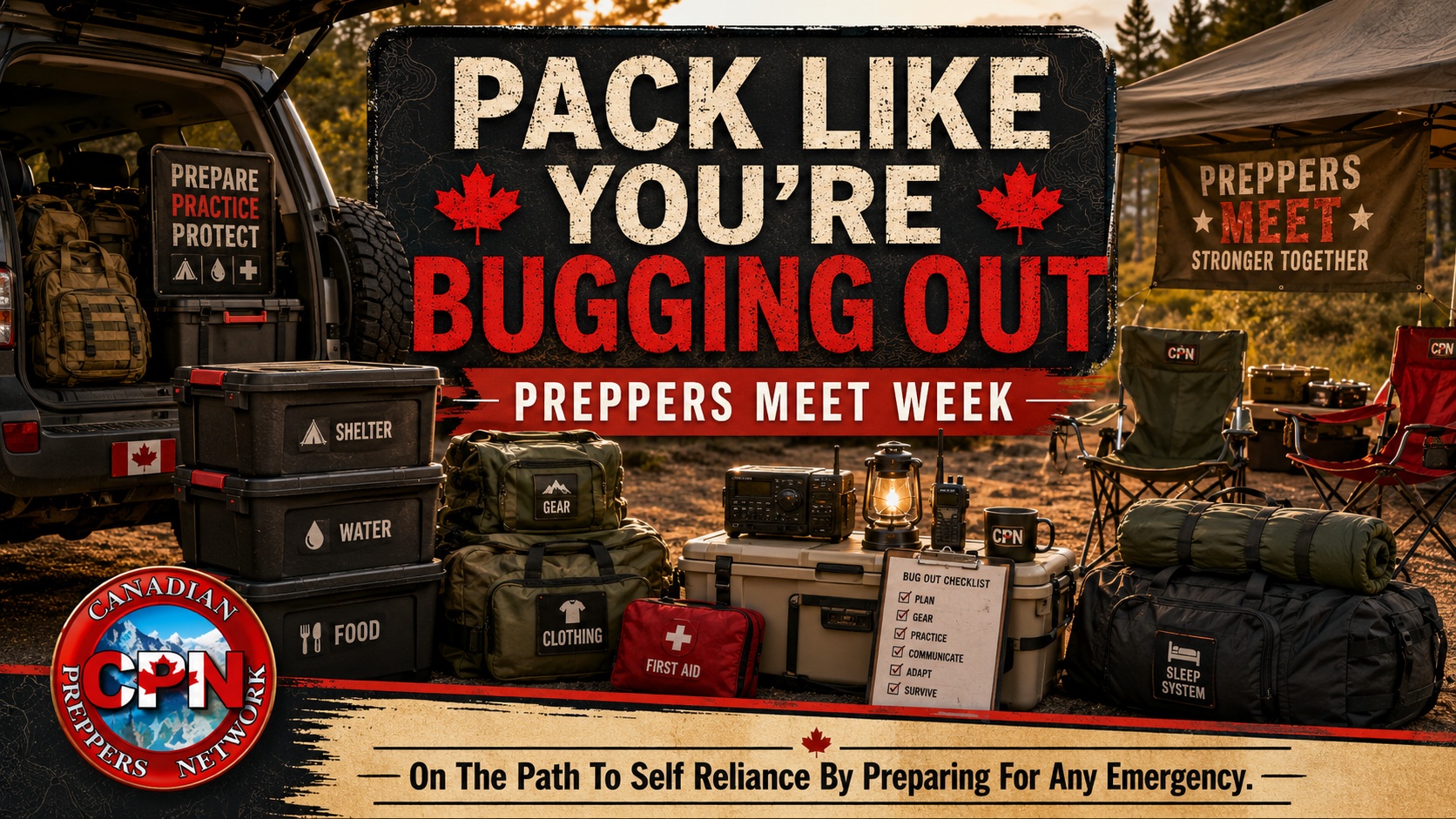
Packing for Preppers Meet should therefore be treated as more than getting ready for a weekend. It is a controlled bug-out drill with washrooms, neighbours, instructors, and a safe place to discover what does not work.
Owning Gear Is Not the Same as Being Ready
Preparedness often begins with acquisition. Food is stored. Water containers are purchased. A tent goes into the basement. First aid supplies are added to a cupboard. Flashlights appear in drawers throughout the house.
Over time, a household can accumulate a respectable amount of equipment without developing a reliable system for using it.
The problem becomes obvious when that equipment has to move.
A bug-out plan does not begin when the vehicle pulls out of the driveway. It begins when someone says, “We may have to leave,” and the household starts gathering what it needs.
Can you find the sleeping bags immediately? Are the tent poles stored with the tent? Is the camp stove clean and operational? Do you know where the fuel is? Are medications and important documents ready to move?
Can one person load the vehicle if another person is dealing with children, pets, communications, or a last-minute household problem?
If gathering the equipment requires searching several rooms, opening unmarked boxes, and trying to remember where things were placed last year, the household is not ready to leave quickly.
The gear may exist, but the system does not.
Use Preppers Meet as a Mobilization Drill
Preppers Meet provides a reason to mobilize a meaningful portion of your preparedness equipment without pretending that a disaster is occurring.
You need shelter, bedding, clothing, food, water, cooking equipment, lighting, hygiene supplies, communications, first aid, charging capacity, and basic tools. You also need to determine what fits into the vehicle and what must remain behind.
That is remarkably close to the decision-making required during an evacuation.
The difference is that you have time to correct mistakes.
Begin by creating a staging area. This might be part of the garage, a section of the basement, or an unused room. Everything intended for the trip should pass through that area before it reaches the vehicle.
Do not carry items directly from storage to the vehicle one at a time. That makes it difficult to see the complete load and increases the chance of forgetting an entire category.
Once everything is together, divide it into functional modules:
- Shelter and sleeping
- Food and cooking
- Water and sanitation
- Medical and hygiene
- Lighting and power
- Communications
- Clothing
- Tools and repairs
- Event materials and personal items
The exact categories matter less than the principle. Each container should have a purpose, and each person should understand what belongs inside it.
Build Modules, Not Piles
A loose pile of preparedness supplies is difficult to inventory, difficult to transport, and almost impossible to manage under pressure.
Modules solve that problem.
The shelter module contains the tent, groundsheet, pegs, cordage, repair tape, and any tools needed to put it up. The sleeping module contains sleeping bags, pillows, blankets, and sleeping pads. The kitchen module holds the stove, fuel, cookware, utensils, dishwashing supplies, and ignition sources.
When everything required for a task is kept together, the entire module can be loaded without rebuilding the kit every time.
This also makes weaknesses easier to identify.
When you open the shelter container, you should be able to confirm that everything needed to establish shelter is present. When you open the kitchen container, you should not have to search the vehicle for a lighter or can opener.
Our recent article, Camp Like the Grid Doesn’t Exist, discussed using camping as an opportunity to test food, lighting, charging, and other systems without depending on campsite electricity.
The same principle applies to organization. The equipment should function as a portable system rather than a collection of unrelated products.
The Vehicle Is Part of the Plan
Many bug-out plans quietly assume that everything will fit into the family vehicle.
That assumption should be tested.
Once your Preppers Meet gear is staged, load the vehicle as though you were leaving home for several days. Avoid using a trailer, roof rack, or second vehicle unless those would genuinely be available during an evacuation.
You may discover that your planned load is far larger than expected.
Bulky bedding consumes space quickly. Water is heavy. Food coolers take up more room than photographs suggest. Tents, chairs, cooking equipment, clothing, and personal items can fill a vehicle before emergency supplies are added.
This forces useful decisions.
Which items are essential? Which are comfort items? Which supplies can serve more than one purpose? Which containers waste space? Which equipment is so difficult to move that it is unlikely to leave the house during an emergency?
Loading order also matters. The first equipment required at the destination should not be buried under everything else.
Shelter, rain gear, lighting, and basic tools should remain accessible. Items that will not be needed until later can be loaded deeper in the vehicle.
Remember the simple loading rule: the first things you expect to use should usually be among the last things loaded.
Test Whether You Can Actually Live From the System
The real value of the exercise begins after arriving.
Do not treat missing equipment as nothing more than an excuse to drive into town. Record every item that was forgotten, every container that was difficult to reach, and every piece of equipment that failed.
Pay attention to small frustrations.
Did you bring several flashlights but no convenient place to keep them? Did everyone fight over the same charging cable? Was the first aid kit packed beneath the tent? Did the cooler become a flooded mess as the ice melted?
Did cooking require opening four different containers? Could you find rain gear in the dark? Did batteries last as long as expected? Could you prepare a meal when tired and hungry?
These inconveniences are information.
A tent that has never been pitched in rain remains mostly theoretical. A camp kitchen that has never prepared several consecutive meals may be badly organized. A charging system that works for an afternoon may not support a household through a four-day outage.
As discussed in Your Bug-Out Shelter Only Has One Job, equipment becomes trustworthy through use. Practice reveals whether a system is simple, durable, and realistic.
Accessibility Matters More Than Perfect Inventory
Preparedness supplies are often organized according to where they fit rather than when they will be needed.
That creates problems.
First aid supplies should not be underneath camping furniture. Rain gear should not be at the bottom of a clothing bag. Headlamps should not be packed inside a container that can only be opened after camp is established.
The CPN Medical and First Aid Hub recommends layered medical kits rather than relying on a single large box. A household kit may remain at home while smaller kits serve the vehicle, campsite, workshop, or personal pack.
The same layered approach can be used for other preparedness categories.
Keep a primary shelter system with the main load, but maintain a small emergency shelter kit in the vehicle. Carry the main communications equipment, but keep a power bank, charging cable, and basic contact information in a personal bag.
The best equipment is not merely equipment you own. It is equipment you can reach when it is needed.
Keep Power and Communications Together
Modern preparedness equipment creates a growing collection of batteries, cables, adapters, chargers, and power banks.
Without organization, the household may own plenty of stored energy but still be unable to charge the device it needs.
Keep charging equipment together in a dedicated module. Include clearly marked cables, wall adapters, 12-volt vehicle adapters, power banks, spare batteries, and any equipment-specific chargers.
Before leaving for Preppers Meet, charge everything and record which devices require which cables.
Then pay attention to actual consumption during the event.
How many times did the phones need charging? How long did the power bank last? Could the vehicle recharge it? Did a solar panel produce enough energy under real conditions? Did the household use far more power than expected?
The CPN Communications Hub emphasizes that phones and radios are part of a larger system. Power, cables, contacts, operating knowledge, and backup methods all need to work together.
Improve the System Before Unpacking
When the event is over, resist the temptation to throw everything back into the basement and deal with it later.
This is when the most valuable part of the exercise takes place.
Clean and dry all equipment. Recharge batteries. Refill fuel. Replace consumed first aid and hygiene supplies. Repair anything that broke. Update the packing list while the problems are still fresh.
Then rebuild the modules.
Items that were never used should be evaluated. Some may still be necessary emergency equipment. Others may have been packed from habit and can be removed.
Items that were constantly needed should become more accessible.
Anything forgotten should either be added to the correct module or placed on a permanent checklist.
A simple inventory card can be kept inside each container. The card does not need to document every tiny item. It should identify the critical components that make the module functional.
The shelter card might include the tent, fly, poles, pegs, groundsheet, cordage, mallet, and repair supplies. The cooking card might include the stove, fuel, ignition, pot, utensils, can opener, cleaning supplies, and water container.
Before the next trip—or evacuation—the card provides a fast inspection system.
Practical Gear for Organizing Mobile Preps
Disclosure: As an Amazon Associate, Canadian Preppers Network may earn from qualifying purchases.
Heavy-Duty Stackable Storage Totes
Strong totes protect equipment, stack efficiently, and allow complete preparedness modules to be moved directly into a vehicle.
Shop for heavy-duty stackable storage totes on Amazon.ca
Waterproof Dry Bags
Dry bags are useful for clothing, bedding, electronics, documents, and equipment that cannot be allowed to soak during rain or transport.
Shop for waterproof camping dry bags on Amazon.ca
Packing Cubes and Zippered Organizers
Smaller organizers prevent large containers from becoming mixed piles of cables, clothing, hygiene products, and small tools.
Shop for packing cubes and zippered organizers on Amazon.ca
Battery Organizer With Tester
A battery organizer keeps common battery sizes visible and protected, while a tester helps prevent dead batteries from being returned to storage.
Shop for battery organizers with testers on Amazon.ca
USB Power Banks
Power banks support phones, USB lighting, small radios, and other electronics when campsite or household power is unavailable.
Shop for USB power banks on Amazon.ca
Folding Utility Wagons
A folding wagon can reduce repeated trips while moving water, firewood, food, camping supplies, or heavy preparedness modules between the vehicle and campsite.
Preppers Meet Is the Safe Place to Find the Problems
Preppers Meet is a skills-based gathering rather than a conventional commercial expo. The event includes camping and practical presentations covering subjects such as bug-out bags, shelter, fire, water, wilderness skills, food preservation, communications, and self-reliance.
But one of the most useful lessons may take place before the first presentation begins.
Packing forces you to confront the difference between stored supplies and deployable preparedness.
It reveals whether your equipment is organized, whether the household can move it, whether the vehicle can carry it, and whether the systems work once they are away from the comfort of home.
You do not need to pretend that attending Preppers Meet is a real evacuation. It is not.
That is exactly what makes it useful.
You can test the process without panic. You can discover mistakes without serious consequences. You can compare systems with other prepared people, learn new approaches, and return home with a clearer understanding of what your household can actually accomplish.
When the weekend ends, do not simply say that the trip went well.
Ask harder questions.
What was difficult to find? What took too long to load? What failed? What did you forget? What did you carry but never need? Could you repeat the process with less warning?
Those answers will improve far more than your next camping trip.
They will improve your ability to leave home when leaving is no longer optional.
Full event, ticket, schedule, and venue information is available at Preppers Meet.