
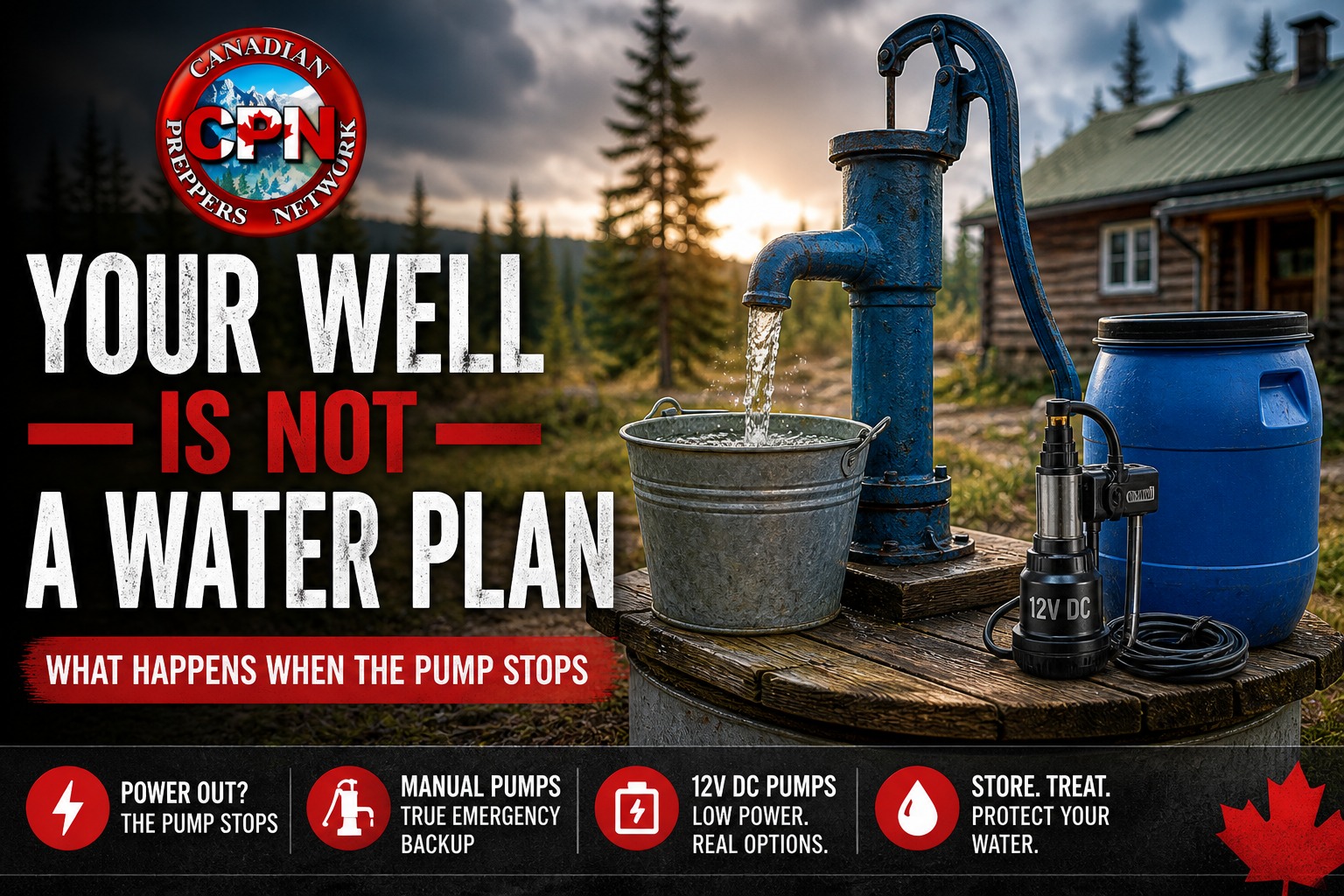
For many rural and semi-rural Canadians, the private well feels like the ultimate preparedness advantage.
No city water bill. No dependence on municipal pressure. No worrying about treatment plants, broken water mains, or boil-water advisories from town hall. The water is right there, under your own property, pulled from the ground whenever you open the tap.
That confidence is understandable.
It is also incomplete.
A well is not a water plan. A well is a water source. There is a major difference.
A source is where water comes from. A plan is how you access it, move it, store it, protect it, test it, treat it, and keep using it when the normal system fails. Most private wells are not simple hand-drawn holes in the ground. They are modern mechanical systems built around electric pumps, pressure tanks, plumbing, wiring, control switches, well caps, casing, treatment equipment, and household distribution lines.
When everything works, the system feels invisible.
When one part fails, the whole household can go dry.
That is the uncomfortable truth rural preppers need to take seriously. The presence of a well on your property does not automatically mean you have secure water during an emergency. It may mean you have excellent long-term potential, but potential is not the same as access.
Health Canada warns that emergencies such as floods, fire, drought, freezing, and power outages can damage wells or contaminate water, sometimes without any obvious change in taste, smell, or clarity. It also recommends having a backup water supply ready because a damaged or contaminated well may take days before it can safely be used again.
That should get every rural household’s attention.
The Pump Is the Weak Link
Most modern private wells depend on electricity.
That means your “independent” water supply is often tied directly to the grid. When the power goes out, the pump stops. If you have a pressure tank, you may still have a limited amount of water available for a short time, but that is not the same as having the well available. Once that stored pressure is gone, the tap becomes decoration.
Ottawa Public Health states plainly that a power outage will normally cause a private well pump to fail, and that households should use an alternate source of safe water in that situation. It also warns that during long power outages, people should avoid trying to run water or flush toilets, though winter plumbing may need to be drained if indoor temperatures drop far enough to risk frozen pipes.
This matters because many people misunderstand what their pressure tank actually does.
A pressure tank is not a long-term reserve. It is a buffer. It smooths pump cycling and keeps pressure available between pump activations. Depending on the size of the tank, your household usage, and the pressure setting, the amount of immediately usable water may be far less than people assume.
A family that casually flushes toilets, washes hands, fills kettles, gives water to animals, and tries to keep normal routines going during the first hour of a power outage can burn through that reserve quickly.
Then the reality hits.
The well is still there. The water is still underground. But without a working pump, the household cannot reach it.
That is why backup power and backup water are two separate things. A generator may get the pump running again, but only if it is sized properly, wired safely, fuelled, maintained, and compatible with the pump’s starting load. A battery power station may run lights and communications beautifully, but many are not designed to start a deep well pump.
If your preparedness plan assumes “we have a well,” the next question is simple:
How exactly are you getting that water out of the ground when the power is off?
Backup Power Must Be Built Around Critical Loads
There is a difference between owning a generator and having a power plan.
A well pump is not a phone charger. It is a critical household load. Depending on depth, pump size, wiring, and startup demand, it may require more surge power than expected. This is where many households discover the hard way that their backup power setup was built around convenience rather than survival.
Canadian Preppers Network has covered this same issue in broader energy planning. In Building Redundant Power When the Grid Can’t Be Trusted, the key point is that households should identify critical loads first: well pumps, furnace controls, refrigeration, lighting, and communications. Trying to power the whole house wastes fuel and complicates the system. Prioritizing what actually matters keeps the household functioning longer.
For a rural property, the well pump belongs near the top of that list.
That does not automatically mean the answer is a giant generator running all day. In fact, that is often the least efficient approach. A smarter setup may involve cycling the pump only when needed, filling storage containers or a pressure tank, then shutting the generator down. The goal is not to recreate normal life. The goal is to move enough water while conserving fuel.
This is where a simple but disciplined routine matters.
Run the pump. Fill containers. Refill livestock water if applicable. Top off sanitation water. Shut the system down. Protect the fuel. Repeat only when necessary.
For households still building out their system, a basic search for dual-fuel generators on Amazon.ca may be a starting point, but do not buy based on guesswork. Confirm your pump’s requirements, consult an electrician where needed, and make sure any generator connection is legal and safe. Backfeeding a panel improperly is dangerous and can kill utility workers.
Preparedness is not just having gear.
It is having gear that is correctly matched to the job.
Stored Water Still Comes First
A private well does not eliminate the need for stored water.
It increases the importance of stored water.
That sounds backwards until you think through the first few hours of an outage, flood, storm, or equipment failure. Stored water gives you immediate control. It buys time. It lets you stop using the plumbing system while you assess the situation. It gives you drinking and cooking water without rushing to start equipment in bad weather, troubleshoot electrical problems in the dark, or take chances with questionable water.
Every rural household should have water stored in containers that can be moved, poured, cleaned, and rotated. Large barrels and tanks are useful, but smaller containers matter too because they are easier to carry, separate, and distribute around the home.
A few sturdy water storage containers on Amazon.ca are not glamorous, but they solve the most immediate problem: having safe water available before you need to solve the well problem.
This is the same principle discussed in Water Storage and Filtration for Canadian Households. Storage is the first layer of control. Filtration and collection become more important as an emergency continues, but stored water is what protects the household in the opening stage.
That opening stage is where most people make mistakes.
They assume the outage will be short. They keep using water normally. They flush toilets casually. They run taps to “see if it still works.” They drain pressure. They delay filling containers. By the time they realize the event may last longer than expected, their easiest water has already been wasted.
A better rule is simple:
When the power goes out, stop treating tap water as unlimited.
A Well Can Be Contaminated Without Looking Contaminated
Clear water does not mean safe water.
This is especially important after flooding, heavy rain, wildfire, nearby chemical spills, septic failure, or any event that may affect groundwater or well components. A private well is not protected by a municipal treatment plant. The owner is responsible for knowing whether the water is safe.
Health Canada warns that contamination may occur without noticeable changes in taste, odour, or clarity. After an emergency, it advises well owners to make sure their water is safe before using it again and to contact local public health or drinking-water authorities when needed.
That should change how preppers think about “backup sources.”
If your well head has been underwater, if your septic field has flooded, if nearby fuel tanks or chemical storage areas have been compromised, or if the ground around the casing has washed out, the problem is not just access. It is quality.
A filter on the counter may not solve that.
Filters have limits. Some are excellent for sediment, bacteria, and protozoa. Some include carbon for taste and certain chemicals. Some are built for biological threats but not chemical contamination. Some reduce certain contaminants but do not make broad safety guarantees. Some are damaged by freezing. Some clog quickly when water is dirty.
This is why a layered water system matters.
Canadian Preppers Network covered this in Gravity vs Pump vs Powered Water Filtration. A proper system is not one magic filter. It includes stored water, gravity filtration, manual backup, and purification suited to the threat. The article also makes an important point: micron size determines capability, not marketing language.
For rural well owners, that means water treatment should match the actual risk.
Sediment is one problem. Bacteria are another. Chemicals are another. Fuel contamination is another. Agricultural runoff is another. A single device may not address all of them.
This is where well water test kits on Amazon.ca can be useful as a household screening tool, but they are not a replacement for proper lab testing when contamination is suspected. For serious concerns, especially after flooding, fuel exposure, septic problems, or illness, contact your local public health authority and use approved testing.
Do not guess with drinking water.
Manual Access Is Not Always Simple
When people imagine a grid-down well plan, they often picture a hand pump bolted to the top of the well casing.
That may be a very good solution.
It is not always a simple one.
The first number that matters is not always the total depth of the well. It is the static water level — the depth from ground level down to the standing water in the well when the pump is not running. A drilled well may be 180 feet deep, but the standing water may sit much higher than that. The pump has to lift water from the static water level, then account for drawdown as water is pumped.
That number determines what kind of manual system may work.
A shallow pitcher pump or suction pump is generally limited to about 25 feet of vertical lift. If the static water level is deeper than that, a simple above-ground pump will not do the job. At that point, you need a true deep-well hand pump, where the working cylinder is installed down inside the well below the static water level.
This is the key difference between a decorative hand pump and a real emergency water system.
Companies such as Bison Pumps and Simple Pump make deep-well hand pump systems designed for wells where ordinary suction pumps will not work. Bison lists deep-well systems for static water levels up to 250 feet, or up to 300 feet with its heavy-duty pump head and handle option. Simple Pump lists its deep-well hand pump for static water levels up to 325 feet when pumping to ground level at ambient pressure.
These systems are not generic hardware-store pumps. They must be matched to the well casing, static water level, pump depth, frost conditions, and existing electric submersible pump setup.
For preparedness purposes, the goal does not have to be full household pressure. The first goal is simpler:
Get water from the well into a container without electricity.
That alone changes the entire emergency picture.
A true deep-well hand pump may not run showers, laundry, or pressure-dependent fixtures, but it can keep drinking water, cooking water, livestock water, and basic sanitation water available when the grid is down.
For readers starting their own research, a broad Amazon search for deep well hand pumps can show the category, but serious systems usually require proper sizing and may need to come from specialty suppliers.
The warning is simple:
A hand pump can be an excellent grid-down backup, but only if it is a real deep-well pump matched to your well. A cheap shallow pump on the wrong well is not a preparedness solution. It is yard art.
12-Volt DC Pumps: Useful, But Know Their Limits
Another option worth considering is a low-voltage DC submersible pump.
For off-grid properties, cabins, livestock water, remote tanks, or emergency well access, a 12-volt or 24-volt DC pump can be a practical middle ground between a manual hand pump and a full-size AC well pump running from a generator.
The appeal is obvious. A DC pump can potentially run from batteries, solar panels, or a small dedicated off-grid power setup. It may use far less power than a conventional household well pump. It can be set up to move water into a cistern, pressure tank, elevated storage container, or holding barrel without firing up a large generator every time someone needs water.
But this category also gets oversold.
A small 12-volt pump is not automatically a replacement for a full household well system. Many low-voltage deep-well pumps are better understood as water-moving pumps, not full domestic-pressure systems. They may be excellent for slowly filling a storage tank, but less suitable for running an entire home as if the grid were still up.
The SHURflo 9300 is a common example in this category. Pentair’s SHURflo solar submersible pump sheet lists it as a potable-water well pump with a maximum lift of 230 feet and 24 VDC nominal operation. Retail listings commonly describe the 9300 as a 12/24 VDC pump for 4-inch wells or larger, with lower performance on 12 volts than on 24 volts.
That is still extremely useful in a preparedness context.
A pump that slowly fills containers for several hours during daylight can be more valuable than a powerful pump that burns fuel quickly. A household does not necessarily need full pressure during an emergency. It needs enough safe water moved from the well into storage before the next outage, storm, fuel shortage, or freezing night.
Other DC pump systems, such as Aquatec SWP models, are also designed for off-grid water supply from solar, wind, or battery sources. Aquatec describes its SWP pumps as operating from 12–30 VDC power sources, including solar modules with controllers or 12V and 24V battery banks.
The casing size is not a minor detail.
A pump that physically will not fit down your well is useless. A pump that can fit but cannot lift to your static water level is useless. A pump that can lift the water but cannot supply enough volume for your household may still be useful, but only if you understand its role.
For deep wells, also pay attention to voltage. Many people search for “12-volt deep well pump” because they already own 12-volt batteries, but higher-voltage DC systems are often more practical as lift and water demand increase. A 24-volt or controller-driven solar pump may move water more efficiently with less voltage drop over long cable runs. Professional solar pumping systems, such as Lorentz PS2 systems, are built around integrated solar pump designs rather than simply clipping a pump to a battery. Lorentz describes the PS2 line as covering 100 watts to 4 kilowatts across submersible, surface, and swimming pool applications, using DC brushless motor technology.
For the average prepared household, the realistic use case looks like this:
The main AC well pump runs the home under normal conditions.
Stored water covers the first stage of an outage.
A generator can run the main pump when larger volumes are needed.
A deep-well hand pump provides no-electricity access if the situation becomes longer or fuel becomes scarce.
A DC submersible pump provides a lower-power way to slowly refill storage from batteries or solar.
That is a serious layered plan.
A DC pump should not be treated as magic. It needs wiring, fusing, controls, pipe, check valves, freeze protection, safe lowering equipment, and a way to store the water it produces. It also needs to be protected from sediment, dry running, electrical mismatch, and winter damage.
For readers who want to research the category, start with 12-volt submersible well pumps on Amazon.ca, solar deep well pumps on Amazon.ca, and 12/24V water pump controllers on Amazon.ca. Just be careful: many search results will be transfer pumps, RV pumps, bilge pumps, or shallow-water pumps, not true deep-well systems.
The product description must match the well.
Look for maximum lift, maximum submersion depth, casing diameter, voltage, flow rate at your lift, potable-water suitability, cable length, controller requirements, and whether the pump is meant for continuous use or intermittent duty.
The best pump is not the one with the biggest claim on the box.
It is the one that can actually move water from your well, with your power system, into your storage plan, in your climate, when the grid is down.
Winter Makes the Problem Harder
Canadian water preparedness cannot be separated from winter.
Freezing changes everything. Hoses freeze. Outdoor tanks freeze. Fittings crack. Pumps fail. Generator starting becomes harder. Fuel storage becomes more demanding. Plumbing in an unheated structure can split. A pressure loss during a deep freeze can turn from inconvenience into major damage.
Health Canada includes freezing among emergency conditions that can affect well safety and function. Ottawa Public Health also warns that during prolonged winter power outages, plumbing may need to be drained if indoor temperatures fall far enough to risk frozen-water damage.
That means rural water planning needs a cold-weather version.
Where will stored water be kept so it does not freeze?
How will containers be accessed if the driveway is blocked?
Can the generator be started safely in winter conditions?
Is the fuel treated and rotated?
Can water be moved indoors without hoses freezing?
Is there a sanitation plan if the well pump and toilets are both out of service?
Do not wait until January to answer those questions.
A water plan that only works in July is not a Canadian water plan.
Do Not Forget Sanitation
When the well stops, drinking water gets the attention. Sanitation becomes the second crisis.
Toilets, handwashing, dishwashing, laundry, animal care, and basic cleaning all consume water. Even if you have enough drinking water stored, a household can become unpleasant and unhealthy very quickly without a sanitation plan.
This is especially important for homes on private wells and septic systems. Water use affects both sides of the system. If the pump is down, flushing may be limited. If the septic field is flooded, damaged, or saturated, flushing may create additional problems. If the home is crowded during an emergency, the water demand increases sharply.
This is where many preppers underestimate volume.
A person can survive on a limited amount of drinking water, but a functioning household needs more than survival rations. Cooking requires water. Cleaning cookware requires water. Hygiene requires water. Pets and livestock may require a lot of water. Medical issues can increase water needs. Hot weather increases demand. Physical labour increases demand.
That is why stored water should be divided mentally into categories:
Drinking and cooking water.
Hygiene water.
Cleaning water.
Toilet or sanitation water.
Animal water.
Not all water needs to be treated to the same level, but it does need to be planned. Greywater, rainwater, melted snow, or stored utility water may have roles in sanitation, but they should not be casually mixed with drinking water systems.
For longer emergencies, review Filtration vs Purification: Where DIY Charcoal and Sand Filters Actually Fit. Improvised filtration can support a broader system, but it should not be mistaken for guaranteed purification.
Build the Rural Water Plan in Layers
A serious well-water preparedness plan should have layers.
The first layer is stored drinking water. This is the water you can use immediately without equipment, electricity, or decisions.
The second layer is stored utility water. This can support flushing, cleaning, and basic sanitation.
The third layer is backup power for the well pump. This may be a generator, a professionally installed transfer switch, a properly sized inverter system, or another setup matched to the actual pump.
The fourth layer is manual water movement. This includes pumps, siphons, carts, buckets, hoses, and containers that make water usable once it is collected or stored.
The fifth layer is manual well access. This may mean a properly installed deep-well hand pump matched to the static water level and casing, not a shallow pitcher pump pretending to be a deep-well solution.
The sixth layer is low-power pumping. A 12V, 24V, or solar-compatible submersible pump may not give full household pressure, but it can refill containers or tanks with far less fuel demand than running a large generator for every water task.
The seventh layer is treatment. This may include sediment filtering, gravity filtration, boiling when appropriate, and proper testing. A gravity water filter on Amazon.ca is a useful household tool because it does not require electricity, but it should still be matched to the water source and threat.
The eighth layer is testing and local knowledge. Know your well depth. Know your static water level. Know your pump type. Know where your well head is. Know where your septic field is. Know whether flooding reaches either one. Know where local lab testing is available. Know who services wells in your area before every neighbour is calling them at once.
The ninth layer is restraint.
That may be the most overlooked layer of all.
When something goes wrong, stop using water casually. Preserve pressure. Protect stored supply. Avoid contaminating clean containers. Separate drinking water from utility water. Do not run questionable water through clean household systems unless you know what you are doing. Do not assume that because the tap worked yesterday, it is safe today.
The Real Advantage of a Well
None of this means a private well is a liability.
A well can be an enormous advantage.
In a long disruption, a functioning well may be far better than depending on municipal systems, delivery trucks, bottled water, or public distribution points. A reliable well on a protected property can support a household, garden, livestock, neighbours, and a long-term retreat plan.
But that advantage only exists when the system around the well is prepared.
A well with no backup power is vulnerable.
A well with no stored water leaves you exposed during the first stage of failure.
A well with no testing plan can become a health risk.
A well with no winter plan is only half-prepared.
A well with no manual access still leaves you dependent on modern convenience.
A well with no low-power pumping option may leave you burning fuel just to refill containers.
The preparedness mindset is not “I have a well, so I’m fine.”
The preparedness mindset is “I have a well, so I need to protect, access, and back it up properly.”
That shift matters.
Because when the lights go out, the pump stops.
When the pump stops, the tap lies.
And when the tap lies, the household finds out whether it has a real water plan — or just a hole in the ground.
Related Reading from Canadian Preppers Network
Water Storage and Filtration for Canadian Households
Gravity vs Pump vs Powered Water Filtration
Building Redundant Power When the Grid Can’t Be Trusted
Filtration vs Purification: Where DIY Charcoal and Sand Filters Actually Fit
Gear Mentioned
Water storage containers on Amazon.ca
Well water test kits on Amazon.ca
Manual transfer pumps on Amazon.ca
Deep well hand pumps on Amazon.ca
12-volt submersible well pumps on Amazon.ca
Solar deep well pumps on Amazon.ca
12/24V water pump controllers on Amazon.ca
Gravity water filters on Amazon.ca

2 Comments