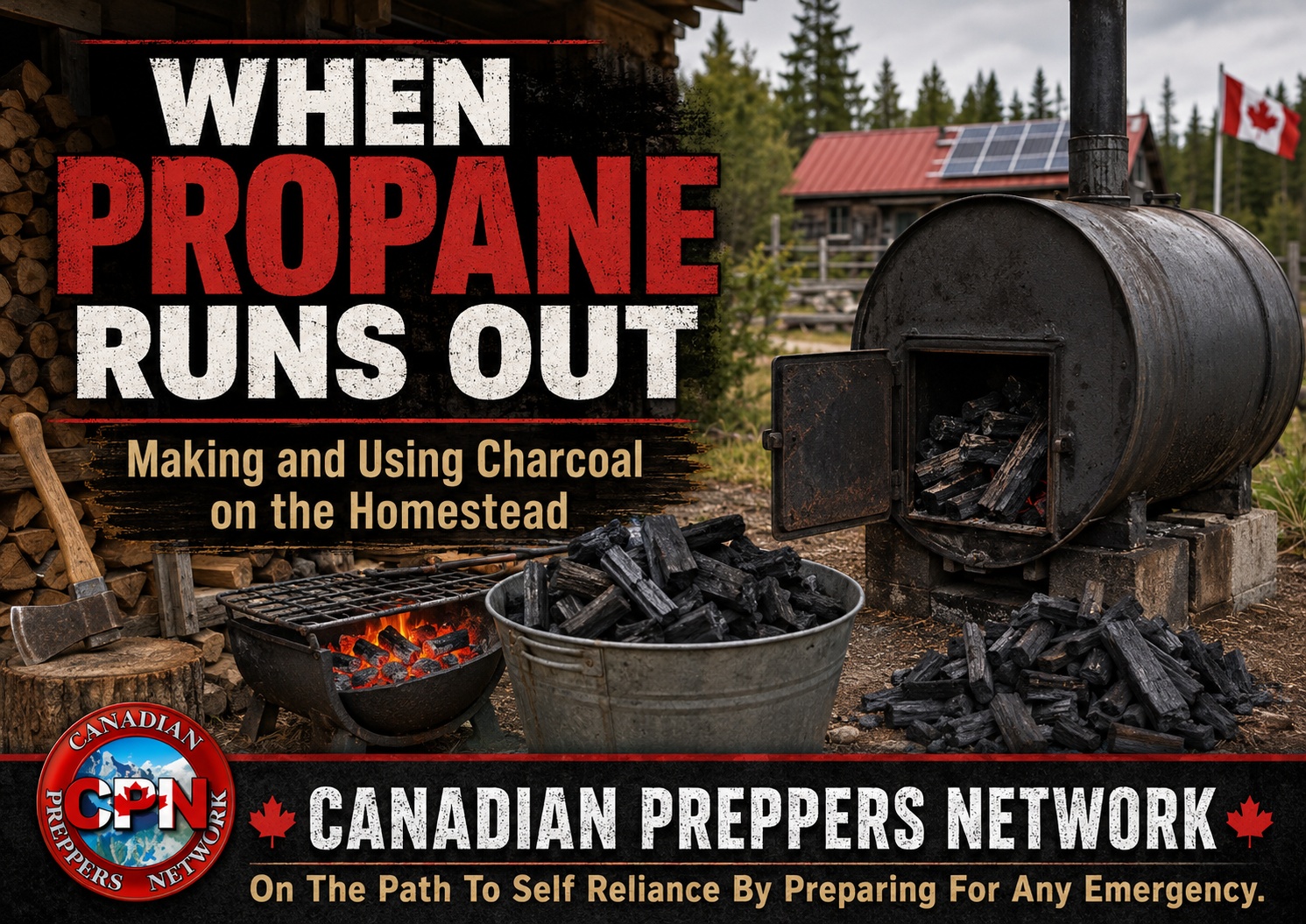
Charcoal is more than barbecue fuel. It is stored heat, forge fuel, soil amendment, filtration material, odour control, and a barter item when modern supply chains stop behaving.
Charcoal is one of those old homestead skills that looks simple until you really think about what it offers. A stick of firewood gives you heat once. A bag of charcoal gives you concentrated, portable, relatively clean-burning fuel that can be stored, moved, sorted, crushed, traded, and used in several different systems around the homestead.
For modern Canadians, charcoal usually means summer grilling. For older homesteads, blacksmith shops, camps, farms, and remote work sites, it meant something much more serious. It was a way to turn ordinary wood into a denser, hotter, more controllable fuel. In a long outage, fuel shortage, evacuation, retreat situation, or broken supply chain, that matters.
Charcoal is not magic, and it is not something to fool around with casually. Making it involves fire, smoke, heat, carbon monoxide, and local burn regulations. Health Canada warns against using fuel-burning outdoor equipment, including charcoal or wood-burning gear, inside homes, garages, sheds, campers, or tents because of carbon monoxide risk. Anyone making charcoal also needs to follow local open-air burning bylaws, fire restrictions, and seasonal burn bans.
That said, the skill itself is worth understanding.
The basic idea is simple. Charcoal is made by heating wood with limited oxygen. Instead of allowing the wood to burn completely into ash, the process drives off moisture and volatile gases, leaving behind a carbon-rich fuel. Good charcoal is lightweight, black, brittle, and rings slightly when knocked together. Bad charcoal is either half-burned wood or useless ash.
Why Charcoal Matters On A Homestead
The first use is cooking. Charcoal produces a steady, high heat and is easier to manage than a smoky open wood fire. In a grid-down kitchen setup, an outdoor charcoal cooker can stretch fuel and reduce smoke compared with burning raw wood. That matters if the goal is to cook without wasting good hardwood or creating a giant smoke signal every time supper goes on.
The second use is blacksmithing and repair work. A small forge does not require modern coal if you have decent charcoal and airflow. This is not about hobby metalwork. It is about heating, bending, straightening, and repairing small iron parts when replacement parts are no longer easy to buy.
The third use is water pre-filtration. Charcoal is not the same thing as commercial activated carbon, and it should not be treated as a complete water purification system. However, crushed clean charcoal can help reduce some odours, colour, and unpleasant taste before proper filtering, boiling, or chemical treatment. It is a supporting step, not the final safety step.
The fourth use is odour control. A container of dry charcoal can help absorb smells in an outhouse, animal shed, root cellar, storage tote, or damp utility area. Crushed charcoal can also be mixed into bedding or compost systems in small amounts to help manage moisture and odour.
The fifth use is soil improvement. When charcoal is intentionally prepared for soil use, it is usually called biochar. The important difference is that garden biochar should be “charged” before being added heavily to soil. Fresh charcoal can temporarily tie up nutrients. Soaking it in compost tea, manure slurry, diluted urine for compost systems, or rich compost lets it absorb nutrients before it goes into garden beds.
The sixth use is barter. In a hard-times economy, useful fuel has value. A dry sack of well-made hardwood charcoal is easier to trade than a random pile of wet firewood. Someone with a forge, smoker, outdoor kitchen, or camp setup may want it.
How Charcoal Is Made
The safest way to think about charcoal production is not as “burning wood,” but as controlled conversion. You are using heat to cook wood in a low-oxygen environment. If too much air gets in, the wood turns to ash. If too little heat reaches the wood, it remains half-converted.
There are three broad homestead methods.
The first is the covered pit method. This is old, simple, and dirty. Wood is stacked in a shallow pit, started carefully, then covered with soil or other fire-resistant material to restrict air. It can work, but it is harder to control, smokier, and more likely to waste material. It also leaves more room for accidental spread if done carelessly.
The second is the sealed metal container method. Dry wood is placed inside a plain steel container with limited venting, then heated from outside by a separate fire. The wood inside cooks down into charcoal without open flame consuming it directly. This method is easier to understand on a small homestead scale, but it still requires outdoor space, non-galvanized metal, fire control, and patience.
The third is the retort method. A retort is a more deliberate version of the same principle: wood is heated in a chamber with restricted oxygen, and gases are vented or burned off in a controlled way. Retorts are more efficient, but they are also more technical. For most readers, the key point is the concept, not building an elaborate unit on day one.
Best Wood For Homestead Charcoal
For homestead charcoal, hardwood is usually preferred. Maple, oak, beech, birch, and fruit woods can all produce useful charcoal if properly dried. Softwoods can work, but they tend to produce lighter, faster-burning charcoal.
Rotten wood, painted wood, pressure-treated lumber, plywood, particle board, and unknown construction scraps should be avoided. You do not want chemical residue in cooking fuel, garden amendments, or anything used around livestock areas.
The wood should be dry and cut into reasonably consistent pieces. Mixed sizes convert unevenly. Tiny scraps may turn to fines, while large chunks may remain brown and woody inside. The goal is not perfection; the goal is a usable batch that can be sorted afterwards.
Cooling, Sorting, And Storage
Once charcoal is made, it should be cooled completely before storage. This is where people get careless. Charcoal can hide heat inside pieces that look dead on the outside. A sealed pail, shed, or woodpile is not the place to discover that a batch was still alive. Let it cool in a safe outdoor location until there is no heat at all.
Storage should be dry, labelled, and away from buildings or ignition sources. Damp charcoal is still useful after drying, but it is unpleasant to handle and less reliable. Sort larger pieces for cooking or forge use. Save smaller chunks and fines for compost, odour control, or soil charging.
Charcoal should also be kept separate by intended use. Cooking charcoal should come from clean wood only. Garden charcoal can tolerate more variation, but still should not include treated or contaminated material. Forge charcoal is less fussy, but it should still burn cleanly and predictably.
Charcoal Is Not Ash
There is also a difference between charcoal and ash. Ash is what remains after combustion is mostly complete. It can be useful in small amounts for certain garden and cleaning applications, but it is alkaline and should not be dumped heavily into soil without understanding your conditions. Charcoal is carbon-rich fuel. Ash is mineral residue. They are not interchangeable.
This distinction matters. A homesteader who understands the difference can use both materials intelligently. A homesteader who treats them as the same thing can damage soil, waste fuel, or contaminate systems that should have stayed clean.
The Larger Preparedness Lesson
For preparedness, charcoal fits into the larger homestead skill stack. It connects woodlot management, outdoor cooking, blacksmithing, sanitation, gardening, and barter. It also teaches a bigger lesson: waste streams become resources when skills replace shopping.
A branch pile is not just brush. It is future cooking fuel. Sawing scraps are not just scraps. They may become forge fuel or biochar. The black dust at the bottom of a charcoal batch is not garbage. It can be charged and added to compost. On a functioning homestead, very little should move in only one direction.
The mistake is treating charcoal as a product instead of a process. If you only think of it as something bought in a bag, it remains another supply chain dependency. If you understand how it is made, sorted, stored, and used, it becomes part of the homestead economy.
That does not mean every prepper needs to start making charcoal tomorrow. It means every serious homesteader should understand the principle, the uses, the safety concerns, and the equipment needed to experiment responsibly where legal.
In a normal summer, charcoal is convenient. In a long emergency, it becomes stored heat. In a rebuilding economy, it becomes a craft product. In a retreat group, it becomes one more small skill that reduces dependence on the outside world.
The people who survive hard times are not always the people with the biggest stockpile. Often, they are the people who can look at wood, scrap, ash, soil, animals, tools, and labour — and see systems.
Charcoal is one of those systems.
Related CPN Resources
Energy Production in Canada
https://canadianpreppersnetwork.com/canadian-preppers-network-preparedness-hubs/energy-production-in-canada/
Homestead Skills in Canada
https://canadianpreppersnetwork.com/canadian-preppers-network-preparedness-hubs/homestead-skills-in-canada/
Wilderness Skills in Canada
https://canadianpreppersnetwork.com/canadian-preppers-network-preparedness-hubs/wilderness-skills-in-canada/
Water Collection & Purification in Canada
https://canadianpreppersnetwork.com/canadian-preppers-network-preparedness-hubs/water-collection-purification-in-canada/
Preparedness Buying Box
Carbon Monoxide Alarms
https://www.amazon.ca/s?k=carbon+monoxide+alarm&tag=canadianprep-20
ABC Fire Extinguishers
https://www.amazon.ca/s?k=abc+fire+extinguisher&tag=canadianprep-20
Heat-Resistant Work Gloves
https://www.amazon.ca/s?k=heat+resistant+work+gloves&tag=canadianprep-20
Metal Storage Pails With Lids
https://www.amazon.ca/s?k=metal+pail+with+lid&tag=canadianprep-20
Garden Sieve / Soil Sifter
https://www.amazon.ca/s?k=garden+sieve+soil+sifter&tag=canadianprep-20
Outdoor Cooking Grate
https://www.amazon.ca/s?k=outdoor+cooking+grate&tag=canadianprep-20
Reference
Health Canada: Carbon Monoxide And Fuel-Burning Equipment
https://www.canada.ca/en/health-canada/services/air-quality/pollutants/carbon-monoxide/preventing-exposure.html