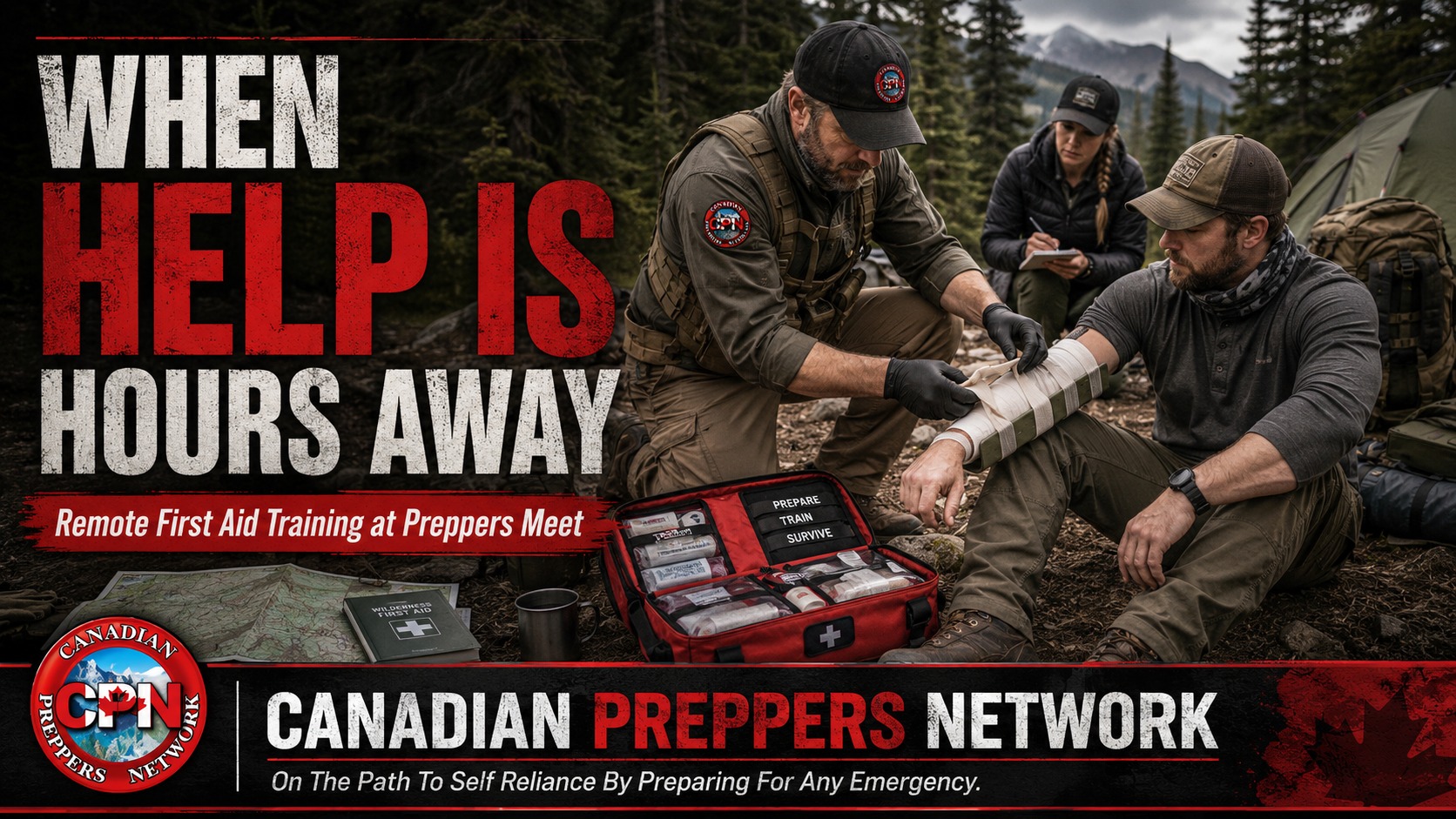
Why the Remote First Aid course at Preppers Meet may be one of the most important skills you can add this year
Most first-aid advice assumes help is close.
Call 911. Keep the person stable. Wait for responders. Hand the situation over to professionals.
That works when roads are open, ambulances are available, cell service is working, and the emergency system is not overloaded.
But that is not the world preppers plan for.
In rural Canada, on remote properties, at hunting camps, during storms, on back roads, at off-grid retreats, and in a prolonged emergency, help may not be minutes away. It may be hours away. In a worse situation, it may not be coming on any predictable timeline at all.
That is where ordinary first aid starts to run out of room.
A basic first-aid kit is useful. A shelf of supplies is useful. A trauma pouch looks impressive on a gear table. But when someone is hurt, cold, confused, dehydrated, immobile, or getting worse far from organized care, the real question is not what you bought.
The real question is whether anyone present knows what to do next.
That is why the Remote First Aid course at Preppers Meet deserves serious attention.
Training For The Gap Between Injury And Help
Preppers Meet is offering a Remote First Aid & CPR C certification course on July 8th and 9th in Alliston, Ontario. The course is listed as 20 hours, with a three-year certification, optional free camping, and registration through the instructor. Preppers Meet also lists the discount code PREPPER for 20% off registration.
This is not just another casual preparedness talk. It is a structured training course aimed at people who live, work, or recreate in non-urban, remote, or wilderness settings where organized health care may be hours away.
That makes it a natural fit for preppers.
Preparedness is full of people who buy gear for events they have never practised. Medical preparedness is one of the worst places to make that mistake. When something goes wrong, you do not want the best-looking kit in the room. You want the calmest, best-trained person in the room.
Remote first aid is built around the ugly part of emergencies: the waiting period. The time after the problem starts, but before professional help arrives. That is the part most people avoid thinking about, and it is exactly the part preppers should be training for.
The Problem With “I Have A First-Aid Kit”
Preppers love kits.
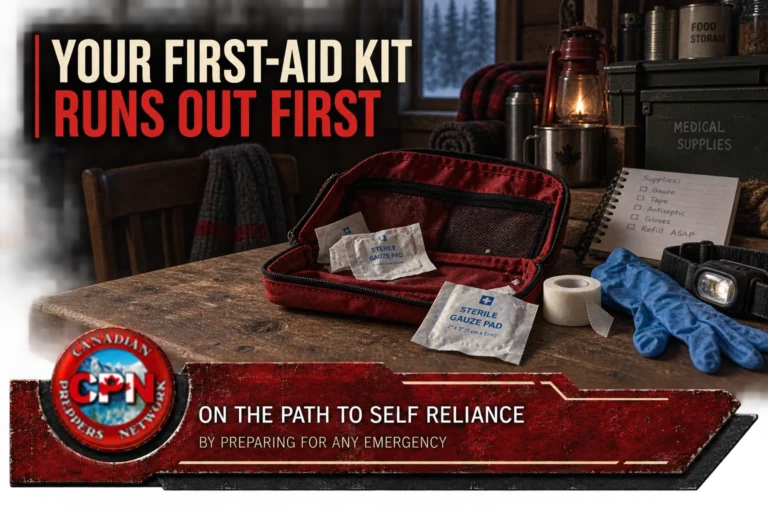
That is not a criticism. Kits matter. Medical supplies matter. Gloves, dressings, wraps, splints, blankets, CPR barriers, cold packs, and reference materials all have a place.
But a kit is not a medic.
A first-aid kit cannot assess a scene. It cannot decide whether the situation is stable or getting worse. It cannot organize a group, monitor someone over time, manage exposure, prepare for evacuation, document what happened, or communicate clearly when stress is high.
Training does that.
The Canadian Red Cross describes Remote First Aid as a 20-hour course for people in non-urban, remote, or wilderness environments, including settings where organized health care may be two or more hours away. The course focuses on providing care in a remote setting for up to 24 hours.
That is a very different mindset from “patch it and wait.”
For preppers, that difference matters. A storm, flood, wildfire evacuation, vehicle breakdown, blocked road, long power outage, or overloaded emergency system can all turn an ordinary situation into a delayed-care situation. The further you are from immediate help, the more judgement matters.
Why This Matters In Canada
Canada is built for delayed response.
That is not an insult to emergency services. It is geography.
We have long rural roads, forested land, farms, cottages, hunting areas, northern communities, remote worksites, backcountry trails, and winter conditions that can turn a simple problem into a serious one.
Even near populated areas, a bad storm or infrastructure failure can change the timeline fast. Roads close. Cell service drops. Ambulances get tied up. Neighbours get cut off. A normal wait becomes a long wait.
That is where remote first aid becomes a core preparedness skill.
A household with food storage, radios, water filters, and a generator is still vulnerable if nobody knows how to manage a medical problem beyond the first few minutes. A retreat group with tools, firewood, and communications plans is still weak if one injury throws everyone into panic. A bug-out plan is incomplete if nobody has trained for what happens when someone cannot keep moving.
The farther you get from immediate care, the more valuable training becomes.
What The Course Covers
According to the Preppers Meet course listing, the Remote First Aid course includes planning and assessment, CPR and AED, wound care, head, neck and spinal injuries, bone, muscle and joint injuries, sudden medical emergencies, environmental injuries and illnesses, poisons and wildlife, extended care and evacuation, and occupational health and safety.
The listing also says participants receive a Wilderness & Remote Field Guide, a trip plan, and information on the Canadian Red Cross First Aid app.
That course content is exactly why this belongs in a prepper discussion. It is not just about learning a single technique. It is about learning how to think when the situation is messy, resources are limited, and help is not right around the corner.
That kind of training is hard to replace with books, videos, or gear lists.
You can read about first aid all winter. You can buy supplies by the box. You can organize bins, label pouches, and print checklists. None of that replaces having an instructor correct your assumptions, pressure-test your understanding, and make you work through scenarios.
That is the point of training.
Preppers Meet Is Becoming More Than A Weekend Event
Preppers Meet is not just a place to walk around and look at booths.
The 2026 event runs July 7th to 12th in Alliston, Ontario, with the core festival days running July 9th to 12th. Optional training takes place earlier in the week and is registered separately.
That structure matters.
It allows people to arrive before the main weekend, take serious training, and then stay for the broader workshops, demonstrations, vendors, conversations, and community building.
The Remote First Aid course fits that model perfectly.
Take the training first. Then spend the weekend around people who care about self-reliance, bushcraft, preparedness, communications, food, shelter, water, field skills, and practical resilience.
That combination is far more useful than another online argument about what belongs in a bug-out bag.
The Friday Night Medical Session Adds Another Layer
Preppers Meet is also featuring The Doctor’s Not In, a Friday night session focused on wilderness medical decision-making when you are on your own.
That is a strong companion to the Remote First Aid course.
The certification course gives structure, fundamentals, and recognized training. A scenario-based medical decision-making session pushes the mindset further into real-world uncertainty.
That is where preppers need to get better.
Not just “what does the textbook say?”
But “what do we do with the people, weather, distance, tools, information, and time we actually have?”
Who Should Consider Taking It?
This course is an obvious fit for campers, hunters, anglers, paddlers, hikers, homesteaders, off-grid property owners, retreat groups, bushcraft enthusiasts, rural families, and anyone responsible for others away from immediate help.
But it is also useful for people who do not think of themselves as wilderness travellers.
A power outage in winter can turn a normal home into a delayed-care environment if roads are blocked and phones are unreliable. A storm-damaged rural road can turn a simple call for help into a waiting game. A community emergency can make professional response slower than anyone is used to.
Remote first aid is not only about the deep woods.
It is about the gap between injury and help.
Preppers live in that gap.
Do Not Treat The Certificate As The Finish Line
A certificate is useful. Recognized training matters. But the certificate is not the finish line.
The real value is what you do with the training afterwards.
Review your field guide. Repack your first-aid kits. Replace expired supplies. Add what is missing. Remove the junk you do not understand. Teach your household where the medical supplies are. Write down important contacts and notes. Think through your property, vehicle, campsite, retreat, and travel plans with delayed help in mind.
Training should change the way you prepare.
It should make your kits smarter, your plans more realistic, and your group calmer under pressure.
That is the difference between collecting gear and building capability.
Related Reading
Preppers Meet 2026: Canada’s Hands-On Preparedness Training Event
Medical & First Aid Preparedness
Communications When The Grid Goes Silent
Practical First-Aid Training Support Box
Disclosure: As an Amazon Associate, Canadian Preppers Network may earn from qualifying purchases.
Training comes first. Gear supports training. For anyone taking Remote First Aid or building a more serious household medical layer, these are practical categories to review before and after the course.
First-Aid Kit Refill Supplies
Useful for rebuilding household, vehicle, range, camp, and retreat kits after you understand what each item is for.
CPR Face Shields and Pocket Masks
Compact barrier devices belong in serious first-aid kits, especially for group events, vehicles, and shared emergency bags.
Emergency Blankets and Hypothermia Supplies
Exposure management matters in Canadian conditions, especially during outdoor incidents, winter travel, or long waits for help.
SAM-Style Splints and Elastic Wraps
Splinting and support supplies are common additions to remote, vehicle, and retreat medical kits once users have proper training.
Nitrile Gloves and Basic PPE
Gloves are one of the easiest supplies to overlook and one of the first things used during real first-aid situations.
Waterproof Notebooks for Field Notes
Written notes help track times, observations, contacts, medications, allergies, and decisions when stress makes memory unreliable.
Headlamps for Hands-Free Work
A hands-free light is one of the simplest upgrades for night incidents, vehicle kits, camp kits, and power-outage medical situations.
Bottom line: do not buy medical gear as decoration. Take training, learn what the supplies are for, and build kits you actually understand.
How To Register
The Remote First Aid course is listed through Preppers Meet, with registration handled directly through the instructor. The course page also lists the discount code PREPPER for 20% off at checkout.
View the Remote First Aid course details at Preppers Meet
Register for Remote First Aid through Get Outdoors Safety & Survival Training
Final Thought
A serious prepper does not want to be the person standing over an injury saying, “I have supplies somewhere.”
The goal is to be the person who can slow down, assess the situation, manage the scene, protect the patient, communicate clearly, and make better decisions until help arrives.
That is why the Remote First Aid course at Preppers Meet matters.
Food, water, radios, tools, and shelter all matter. But when someone gets hurt, training moves to the front of the line.
Gear can sit in a bag for years.
Skill has to be built before the emergency.