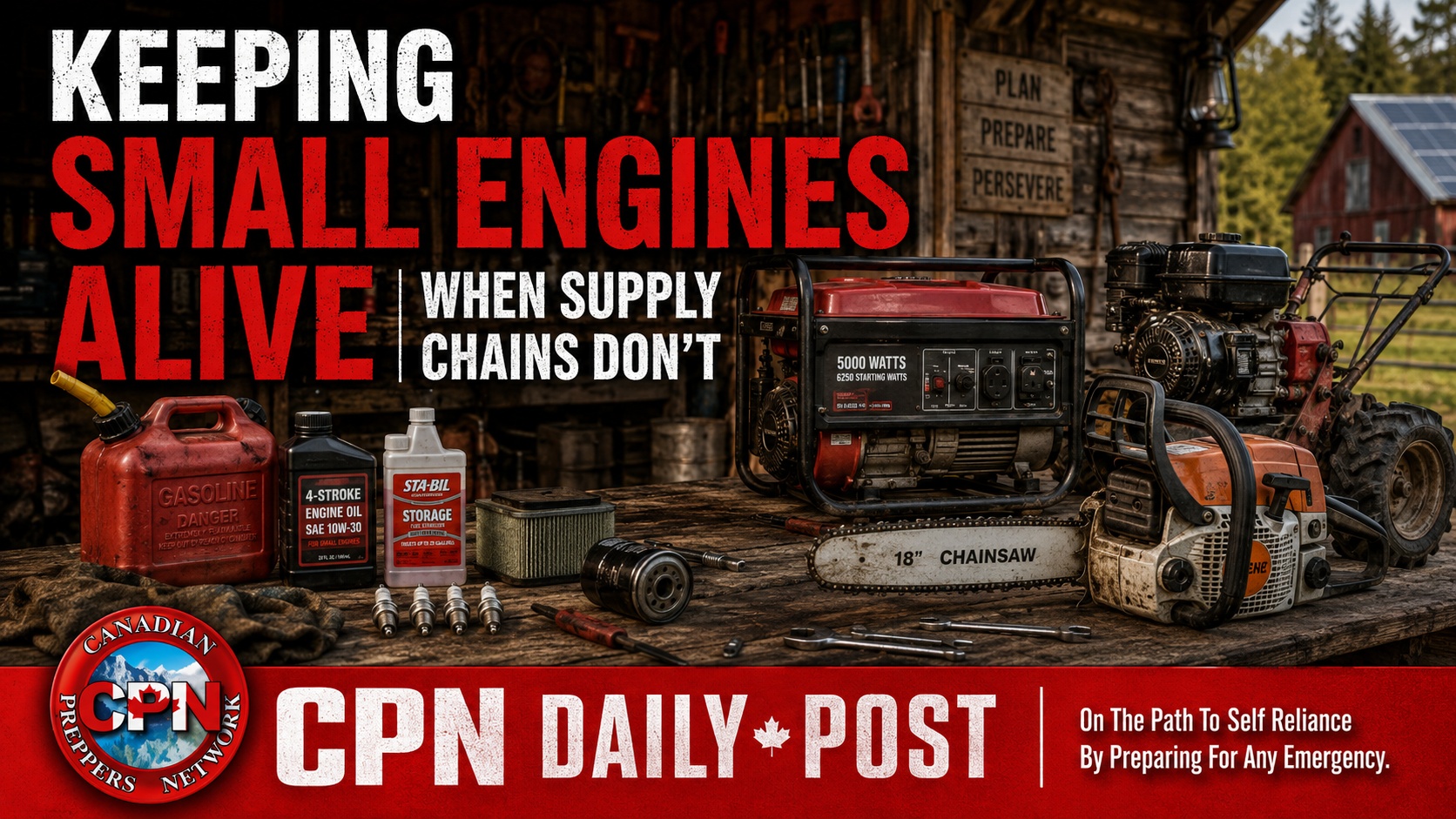
The generators, saws, pumps, tillers, and tractors you already own are only useful if they still run when parts, fuel, and repair shops become scarce.
Modern preparedness spends a lot of time talking about food storage, water filtration, radios, batteries, and security. All of that matters. But on a working homestead, small engines quietly sit behind a surprising amount of real-world capability.
The generator keeps freezers cold and batteries charged. The chainsaw turns storm damage into firewood. The water pump moves water when gravity will not cooperate. The tiller opens ground when spring does not wait for anyone. The lawn tractor hauls feed, wood, soil, and supplies long after it stops being just a lawn-care machine.
Then one day the pull cord snaps, the carburetor gums up, the air filter is packed with dust, the spark plug is fouled, or the oil has not been changed since anyone can remember.
At that point, the machine itself is not the problem. The problem is that the household treated it as an object instead of a system.
Small engines are not long-term preparedness assets because you own them. They become preparedness assets when you maintain them, stock common wear parts, understand their weak points, and keep enough basic tools on hand to solve ordinary problems without waiting for a repair shop.
That distinction matters.
A Dead Engine Is Just Heavy Scrap
Most small engines do not fail dramatically. They usually die from neglect.
Old fuel sits too long. Oil gets ignored. Filters clog. Belts crack. Mice chew wiring. Pull cords fray. Spark plugs foul. Batteries discharge. Blades dull. Chains stretch. Bolts loosen. Rubber hardens. Plastic fuel lines age. A machine that ran perfectly last season suddenly refuses to start when it is needed most.
That is annoying in normal times. In a long emergency, it can change the entire labour equation.
Without a working chainsaw, firewood becomes slower and more dangerous. Without a functioning generator, stored frozen food may become a race against time. Without a pump, water movement becomes buckets and backs. Without a tiller, garden expansion becomes hand labour. Without a tractor or utility machine, every heavy job becomes a human job.
Preparedness is often described in terms of supplies. But homestead resilience is really about keeping work possible.
That is why small-engine care belongs under Homestead Skills, not just Energy Production or shop maintenance. Engines are force multipliers. They turn stored fuel into temporary labour. They buy time. They reduce exhaustion. They help one or two people do work that would otherwise require a group.
That usefulness disappears fast when simple maintenance is ignored.
For a broader maintenance mindset, revisit the CPN piece on the Master Maintenance List.
Know Which Engines Actually Matter
Not every gas-powered machine on a property deserves the same level of attention. A preparedness household should sort small engines by importance, not convenience.
The first category is critical engines. These are the machines that directly support heat, water, food preservation, medical support, communications, or physical access. A generator, well pump engine, chainsaw, snowblower, or tractor may fall into this group depending on the property and season.
The second category is productivity engines. These include tillers, mowers, trimmers, splitters, pressure washers, and utility machines. They may not be immediately life-supporting, but they save enormous labour and help keep a homestead functioning.
The third category is comfort or convenience engines. These are useful, but not essential. They should not consume the same repair budget as the machines that keep water moving, wood cut, or power available.
This sorting matters because parts, fuel, time, and storage space are limited. If your generator and chainsaw are critical, they deserve priority for spare parts, protected storage, fresh service records, and regular test runs. If a rarely used machine has an oddball engine with no available parts, it may not be worth building a preparedness plan around.
A hard truth: the best emergency engine is often not the newest or most powerful one. It is the one you understand, can maintain, can get parts for, and can start reliably.
Standardize Where You Can
A homestead full of random engines becomes a parts nightmare.
Different spark plugs. Different filters. Different oil capacities. Different belts. Different batteries. Different fuel shutoff arrangements. Different starting procedures. Different blade sizes. Different manuals. Different specialty tools.
In normal life, that is inconvenient. In a supply shortage, it becomes a weakness.
When buying future equipment, give serious thought to standardization. That does not mean every machine must be the same brand. It means choosing common engine platforms, common maintenance parts, common fuel types, and common tool requirements where possible.
If two machines use the same spark plug, that is useful. If several machines use the same oil, that is useful. If your generator, pump, and snowblower all have understandable service points and available manuals, that is useful. If a local small-engine shop knows the engine family well, that is useful too.
Preparedness buying should not be driven only by horsepower, sale price, or online reviews. It should also ask: can I keep this thing alive five years from now?
That question changes the purchase.
Build a Small-Engine Binder
Every serious homestead should have a small-engine binder or folder.
This does not need to be complicated. Print the manuals. Record model numbers. Record serial numbers. Write down spark plug numbers, belt sizes, filter numbers, oil type, blade sizes, chain sizes, battery type, and any known quirks. Keep receipts for important parts. Add a page for service dates.
When something breaks, you do not want to be standing in a cold shed trying to read a half-worn label off a greasy engine housing.
The binder should answer simple questions quickly:
What spark plug does this take?
What oil does it use?
When was it last serviced?
What filter fits it?
What belt fits it?
Where is the spare pull cord?
Where is the manual?
What tools are needed to remove the cover, chain, blade, or filter?
What part failed last time?
This is not glamorous preparedness. It is not exciting. It does not make for dramatic photos. But it is exactly the sort of quiet system that separates useful equipment from yard ornaments.
For broader systems thinking, the Homestead Skills hub is worth tying into this idea.
Store the Boring Parts Before You Need Them
Small engines often stop over small parts.
A spark plug. A clogged filter. A broken pull cord. A cracked fuel line. A dead battery. A worn chain. A missing shear pin. A dull blade. A damaged primer bulb. A loose fastener. A bad belt.
None of these items seem important when stores are open and delivery is quick. They become very important when the machine is needed now and the part is unavailable.
The goal is not to build a full repair shop for every machine on the property. The goal is to identify common wear items for critical engines and keep a modest reserve.
For a generator, that may mean spark plugs, oil, air filters, fuel stabilizer, a spare pull cord, and basic service tools. For a chainsaw, it may mean chains, bar oil, files, spark plugs, air filters, stabilized fuel, and a scrench. For a snowblower, it may mean belts, shear pins, spark plugs, stabilizer-treated fuel, and paddles or scraper parts where appropriate. For a lawn tractor, it may mean belts, blades, filters, plugs, fuel treatment, and a battery maintenance plan.
The exact list depends on the machine. That is why the binder matters.
Do not guess. Look up the part numbers. Label parts clearly. Store them in sealed bins. Keep machine-specific parts together. A spare part you cannot identify under pressure is only slightly better than no spare part at all.
Fuel Is the Weak Link
Fuel deserves its own conversation because it is often the first hidden failure point in small-engine preparedness.
Gasoline-powered equipment is convenient, powerful, and common, but gasoline does not remain perfect forever. Storage conditions, container quality, temperature swings, ethanol content, and time all matter. Diesel, kerosene, propane, and gasoline each have different strengths and weaknesses for preparedness planning.
This is where fuel stabilizer becomes part of the system, not an optional extra.
Fuel stabilizer is one of those boring preparedness items that rarely gets attention until an engine will not start. For generators, chainsaws, snowblowers, pumps, tillers, and other seasonal equipment, treated fuel can reduce the chances of varnish, gum, moisture problems, and carburetor trouble during storage. It does not make fuel last forever, and it does not excuse sloppy rotation, but it does give small engines a better chance of starting after sitting.
That matters because many emergency-use engines spend most of their lives waiting.
A generator may sit for months between outages. A snowblower may sit through three seasons. A pump may only be used during flooding, irrigation, or emergency water movement. A chainsaw may be critical after a storm but ignored during quiet periods. These are exactly the machines that benefit from clean, rotated, stabilized fuel and regular test runs.
Fuel stabilizer should be used according to the product label, added to fresh fuel, and treated as a prevention tool rather than a magic repair product for old, stale, contaminated fuel.
The important point is this: do not build a homestead plan around fuel you do not store safely, rotate properly, treat when appropriate, or understand.
That does not mean every household needs a huge fuel reserve. It means the fuel you do keep should be treated as part of a managed system. Use approved containers. Store fuel away from living areas and ignition sources. Follow local rules. Keep it protected from weather and contamination. Rotate it before it becomes questionable. Use stabilizer where it makes sense, especially for engines that may sit unused between seasons or emergencies.
CPN has already covered the broader fuel issue in Fuel Storage in Canada: Propane vs Gasoline vs Diesel vs Kerosene.
The larger lesson is simple: a generator without reliable fuel is not an energy plan. A chainsaw without usable fuel is not a firewood plan. A pump without usable fuel is not a water plan.
Fuel, stabilizer, maintenance, and spare parts must be considered together.
Test Runs Are Not Optional
One of the worst times to discover an engine problem is during the emergency that made you need the engine.
A generator should not be tested for the first time during an outage. A chainsaw should not be pulled out for the first time after a storm has blocked the driveway. A pump should not be tested for the first time when water is already becoming urgent. A snowblower should not be started for the first time during the first serious dump of the season.
Small engines need scheduled attention.
This does not mean abusing equipment or running machines endlessly for no reason. It means setting a routine. Inspect them. Start them according to the manual. Listen for changes. Watch for leaks. Check cords, filters, blades, chains, belts, and fasteners. Confirm that the machine is still ready before the season when it matters most.
Tie this to the calendar.
Before winter, look at generators, snowblowers, chainsaws, battery maintainers, extension cords, and heating-related backup systems. Before spring, look at tillers, pumps, garden tractors, mowers, and irrigation equipment. Before storm season, look at saws, generators, pumps, fuel storage, and access tools.
The best emergency maintenance is the maintenance done before the emergency.
Safety Is Part of Reliability
A machine that injures you is not a preparedness asset.
Small engines combine heat, sharp edges, rotating parts, electricity, fuel, fumes, and noise. In a long emergency, fatigue makes all of that worse. People take shortcuts. They work in poor light. They skip eye protection. They refuel carelessly. They run equipment too close to buildings. They ignore strange noises. They let children or untrained helpers crowd the work area.
That is how useful equipment becomes a liability.
Generators deserve special respect. Fuel-burning generators must not be operated indoors, in garages, in sheds, on enclosed porches, or near open windows and doors. They should be operated outdoors with exhaust directed away from buildings, and carbon monoxide alarms should be working inside the home. The Government of Canada recommends planning to operate portable fuel-burning generators at least 6 metres, or 20 feet, from homes or buildings.
Source:
https://www.canada.ca/en/services/policing/emergencies/preparedness/get-prepared/hazards-emergencies/power-outages/how-prepare.html
Chainsaws, mowers, tillers, and tractors also deserve respect. Keep guards in place. Do not bypass safety features. Shut equipment down before clearing jams. Let hot parts cool. Keep loose clothing away from moving parts. Wear the appropriate protection. Do not work tired if the job can wait.
Preparedness is not just having the tool. It is staying functional enough to keep using it.
Reduce Engine Dependency Where Possible
There is another side to this conversation.
Small engines are useful, but every engine increases dependency on fuel, parts, tools, and maintenance. A good homestead plan uses engines where they provide major advantage, while also building manual backups where possible.
A bow saw does not replace a chainsaw for serious firewood work, but it gives you options. Hand files do not replace a powered grinder in every situation, but they keep edges working. A wheelbarrow does not replace a tractor, but it still moves material. A hand pump does not replace every powered pump, but it can keep water moving in the right setup. Hand tools do not eliminate the need for machines, but they reduce total dependence.
The goal is not to reject engines. The goal is to avoid being helpless when engines fail.
That is where Energy Production planning ties into Homestead Skills. Fuel-powered equipment can be part of a layered system, but it should not be the only layer.
Build a Small-Engine Readiness Shelf
A practical homestead should have a dedicated small-engine shelf or cabinet.
This is not a random pile of greasy parts. It should be organized, labelled, and protected. Keep fluids separate from food, animal feed, seeds, and household supplies. Keep sharp parts protected. Keep manuals dry. Keep small parts in labelled containers. Keep machine-specific kits together.
A basic readiness shelf might include:
Spark plugs for critical machines
Air filters and pre-filters
Oil filters where applicable
Correct engine oil for your equipment
Fuel stabilizer for stored gasoline and seasonal engines
Spare pull cord
Belts for key machines
Chainsaw chains and files
Shear pins for snowblowers
Blades or sharpening tools
Funnels and drain pans
Nitrile gloves and shop towels
Battery maintainer
Basic socket set and wrench set
Spark plug socket
Grease gun if your equipment requires it
Service notebook or printed maintenance sheets
The exact shelf should reflect your actual machines, not someone else’s list.
That is the key. Preparedness must be specific. “Small-engine parts” is too vague. “Two plugs, two filters, one belt, spare pull cord, fuel stabilizer, and the correct socket for the generator” is useful.
Buying Box: Small-Engine Maintenance Basics
Disclosure: As an Amazon Associate, Canadian Preppers Network may earn from qualifying purchases.
The Real Preparedness Lesson
Small engines are easy to overvalue and easy to neglect.
They are not magic. They do not eliminate the need for hand tools, stored supplies, skill, judgement, or backup plans. They depend on fuel, parts, maintenance, and safe operation.
But when they work, they are enormously valuable.
A maintained chainsaw changes firewood. A maintained generator changes outage management. A maintained pump changes water handling. A maintained tiller changes spring garden labour. A maintained tractor changes hauling, snow clearing, and property work.
The collapse of supply chains does not instantly make machines useless. Neglect does that first.
The households that keep small engines alive will not be the ones with the most equipment. They will be the ones that know what matters, stock the boring parts, treat and rotate fuel, keep records, test before the season, and maintain manual backups.
That is not flashy preparedness.
It is working preparedness.