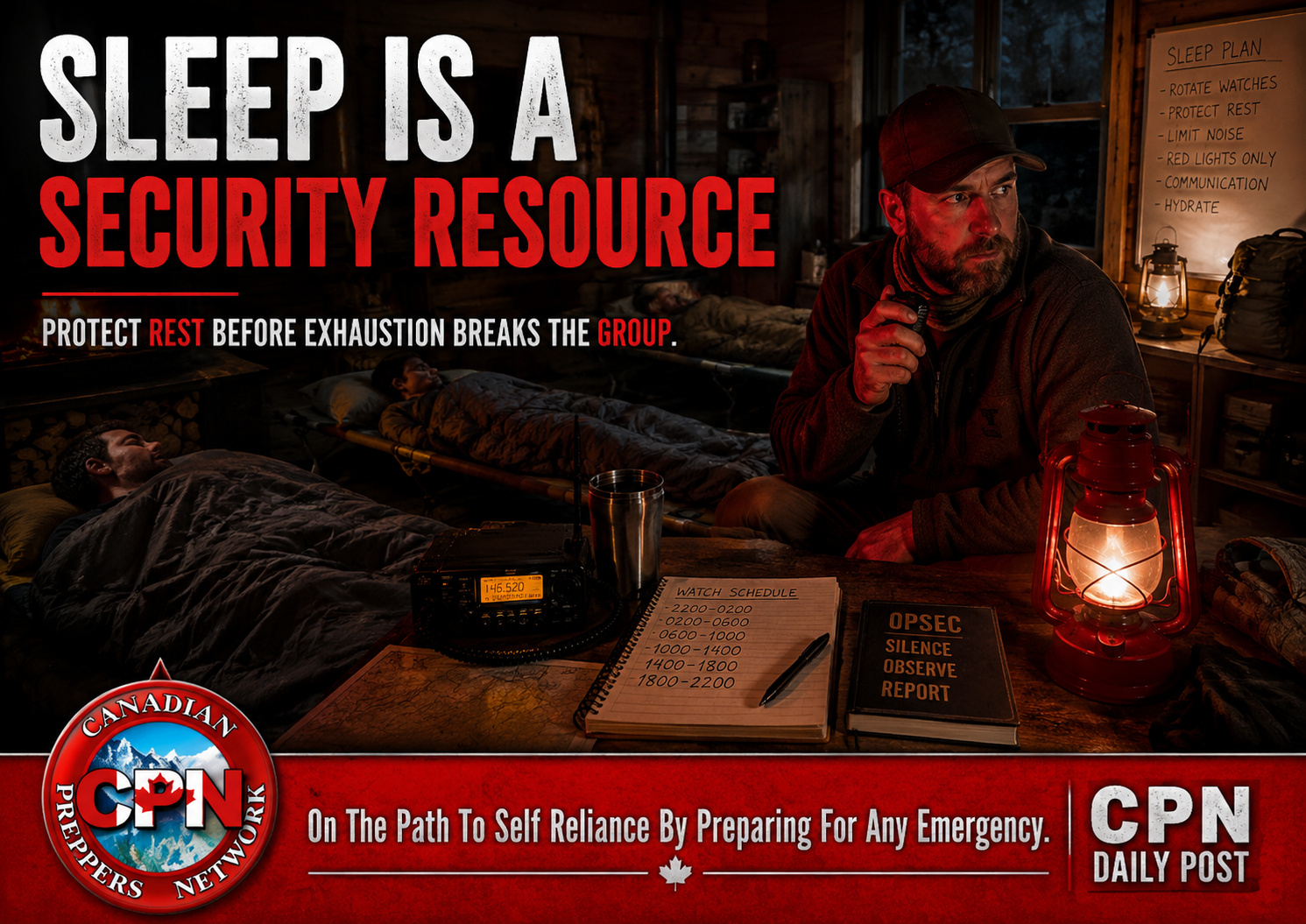
Exhaustion turns capable people into unreliable decision-makers. A preparedness group that cannot protect sleep cannot protect much else.
Most preparedness groups understand that food, water, heat, communications, medical supplies, and security have to be managed.
Sleep is usually treated differently.
It is considered personal time—something people will squeeze in after the work is done, the fire is fed, the radios are checked, the children settle down, the animals are handled, and the night watch has been covered.
That approach may survive one difficult night. It will not support a group through a prolonged emergency.
When people do not sleep, the work is never truly finished. It is simply handed to increasingly exhausted people who make more mistakes, communicate less clearly, become easier to anger, and take longer to recognize that something is going wrong.
Sleep is not a comfort item.
It is an operational resource.
Exhaustion Changes the Person
A tired person does not merely perform normal tasks more slowly.
Fatigue affects attention, reaction time, memory, judgment, emotional control, and the ability to adapt when conditions change. Sleep-deprived people may repeat questions, forget instructions, miss radio calls, fixate on a poor decision, or become unnecessarily argumentative.
They may also become more confident in bad decisions precisely when their ability to evaluate those decisions is deteriorating.
NIOSH fatigue training material notes that the impairment associated with approximately 17 hours of continuous wakefulness can resemble the impairment associated with a blood-alcohol concentration of 0.05 percent. After 24 hours awake, the comparison rises to approximately 0.10 percent.
The comparison is imperfect, but the operational lesson is clear: the person who insists that they are “fine” may be functioning far below their normal ability.
That matters during ordinary life. It becomes critical when someone is driving an evacuation vehicle, monitoring a wood stove, administering medication, operating a generator, watching for fire, handling livestock, interpreting radio traffic, or deciding whether the group should move.
Research on sleep deprivation and decision-making has also found that inadequate sleep can interfere with problem-solving, emotional control, adaptability, and risk evaluation.
Those are exactly the abilities a preparedness group needs most.
The Most Capable People Are Often the First to Break
In many households and retreat groups, the same few dependable people carry the heaviest load.
They know where the tools are. They understand the water system. They can start the generator, troubleshoot the radios, organize meals, manage security checks, calm frightened people, and make decisions without needing constant direction.
That makes them valuable.
It also makes them vulnerable.
When something goes wrong, everyone calls the competent person. When a shift is uncovered, the competent person fills it. When somebody panics, the competent person stays awake. When equipment fails at 3:00 a.m., the competent person gets out of bed.
Eventually, that person is still technically in charge but is no longer thinking clearly enough to lead.
A group that depends on one exhausted problem-solver does not have strong leadership. It has a single point of failure.
The time to build redundancy is before the crisis. The principles discussed in Build the Circle Before the Storm apply here: shared work should reveal who can learn, who follows procedures, and who can take responsibility without constant supervision.
Every critical task should have at least one backup person.
That includes water treatment, heat, food preparation, radio monitoring, medical routines, animal care, sanitation, and group coordination. Cross-training is not merely about replacing someone who is absent. It allows competent people to sleep without being called back every twenty minutes.
Night Watch Can Destroy the Entire Schedule
The most obvious sleep problem in a preparedness group is night watch.
The plan often looks simple on paper. Someone stays awake while everyone else sleeps. A few hours later, another person takes over.
In practice, the schedule quickly begins to slip.
A watch member is late. Someone is nervous about being alone. A child wakes up. A radio check takes longer than expected. The person ending a shift decides to stay up for breakfast. The next person cannot fall asleep during the day.
By the second or third night, the group is accumulating fatigue faster than it can recover.
Long, solitary night shifts are especially dangerous because inactivity encourages drowsiness. A person sitting quietly in darkness may experience a microsleep—a brief, involuntary episode of sleep—without consciously deciding to sleep.
NIOSH guidance on microsleeps warns that severely fatigued people cannot reliably force themselves to remain awake or control when these episodes occur.
A watch schedule should therefore be designed around human limitations, not wishful thinking.
Depending on group size and conditions, shorter overnight rotations may work better than assigning one person most of the night. Two-person shifts may be justified during higher-risk periods, especially when the duties include checking heat sources, monitoring weather, receiving radio traffic, or walking an exterior route.
The exact structure will vary, but several rules should remain firm.
The schedule must be written before people become exhausted. Shift changes must happen on time. The outgoing person must give a clear handover. The incoming person must be fully awake before assuming responsibility. Nobody should extend a shift simply to prove toughness.
Most importantly, the same dependable people cannot be placed on every difficult shift.
Separate Being Available From Being on Duty
A common failure in group living is the belief that everyone should always be available.
That creates a noisy, restless environment in which nobody is truly working and nobody is truly resting. Every conversation wakes someone. Every minor problem becomes a group discussion. Every radio transmission draws a crowd.
A functioning group needs a clear distinction between people who are on duty and people who are off duty.
Those on duty handle routine questions, monitor communications, watch heat and power systems, deal with ordinary disturbances, and decide whether a sleeping person genuinely needs to be awakened.
Those who are off duty should be protected from interruptions unless the situation exceeds the authority or ability of the duty team.
This requires written responsibilities.
A person monitoring the property should know whether they can investigate a noise, wake a second observer, contact the group leader, or activate an agreed alarm. Someone caring for the heating system should know the normal operating range and what conditions require assistance. The radio operator should know which messages can wait until morning.
The Early Detection Plan Every Prepper Property Needs can reduce pressure on night staff by creating layers of observation and warning.
The goal is not to keep everyone awake. It is to give a small number of alert people enough warning to wake the rest when necessary.
Protect a Real Sleeping Area
Telling people to sleep is useless if the sleeping area makes rest impossible.
A crowded retreat may contain radios, generators, children, pets, tools, cooking equipment, people entering and leaving, bright lights, and constant conversation. Even when someone is assigned eight hours off duty, they may receive only scattered fragments of sleep.
A designated sleeping area should be darker, quieter, and physically separated from the main work area whenever the location allows it.
This may mean using a back room, basement, bunkhouse, trailer, tent, screened section of a barn, or temporary partition. Sleeping people should not be placed beside the radio desk, kitchen, entrance, generator wall, or woodpile route.
Light discipline also matters inside the group.
Bright white light can wake an entire room and make it difficult for people to settle again. Low-output red task lighting can help duty staff move through shared areas without flooding the space with light.
It does not make anyone invisible, and it should never replace proper illumination for hazardous work, but it can reduce needless disruption.
Temperature and bedding matter as well. A person who is shivering, sweating, lying directly on cold ground, or being bitten by insects is not receiving useful rest.
NIOSH sleep guidance indicates that most adults need roughly seven to eight hours of quality sleep each day, although individual needs vary.
During an emergency, the group may not be able to provide an uninterrupted eight-hour block, but it should still work toward a protected primary sleep period and additional rest when operations permit.
Quiet Hours Need Enforcement
Quiet hours cannot be a polite suggestion.
They have to be treated as part of the operational schedule.
That means unnecessary conversations move away from sleeping areas. Equipment is staged before nightfall. Tools are not thrown into metal boxes beside the bunks. Children are given a separate evening routine where possible. Dogs are not allowed to wander repeatedly through the sleeping area. Radios use earpieces or low volume where appropriate.
People preparing for an early shift should lay out clothing, footwear, lights, and duty gear before going to sleep.
The point is not military rigidity.
It is preventing thirty small disturbances from destroying the recovery period of the people expected to keep the group functioning the following day.
Earplugs and sleep masks can help off-duty members, but they create an obvious concern: a sleeping person may not hear an alarm.
The answer is not to keep everyone half-awake. It is to maintain an alert duty person who is responsible for waking sleepers when necessary. Personal sleep aids should only be used within a system that includes a reliable wake-up procedure.
Naps Help, but They Do Not Erase the Debt
Brief naps can temporarily improve alertness, particularly when the alternative is continuing to work without rest.
NIOSH guidance on workplace naps notes that a brief nap may increase alertness for a period afterward.
That makes naps useful during sustained operations.
They are not a substitute for regular sleep.
A twenty-minute nap may help someone finish a necessary task, but it does not turn an exhausted person into a safe driver, competent decision-maker, or reliable night observer.
Caffeine has similar limitations. It can temporarily reduce the sensation of sleepiness while leaving the underlying sleep debt unresolved.
A group should not use coffee, energy drinks, or constant short naps to maintain an impossible work schedule.
The schedule has to change.
Tasks may need to be postponed. Security checks may need to be simplified. Meals may need to become less elaborate. Meetings may need to be cancelled. Non-essential radio monitoring may need to stop.
People may need to accept that a lower level of activity performed safely is better than continuous activity performed badly.
Create a Fatigue Stand-Down Rule
People are often reluctant to admit they are too tired for a task.
They may fear appearing weak, lazy, frightened, or unreliable. Others may worry that reporting fatigue will force a friend to take an extra shift.
That culture creates hidden risk.
A preparedness group should have a simple fatigue stand-down rule: a person showing clear signs of dangerous exhaustion can be removed from a high-consequence task without being punished or humiliated.
Warning signs may include repeated mistakes, blank staring, missed communications, unusual clumsiness, confusion about time, forgetting recently issued instructions, extreme irritability, or repeatedly nodding off.
Removal from duty should be presented as risk management, not a character judgment.
Transport Canada’s fatigue-risk guidance treats fatigue as a hazard that can be managed through formal policies, scheduling, monitoring, and mitigation rather than simply demanding that workers try harder.
A preparedness group should take the same approach.
No one should be driving, supervising a dangerous heat source, administering medication, or making major movement decisions simply because they refuse to admit they need sleep.
The Daily Briefing Should Include Rest
Most group briefings focus on supplies, security, weather, work, and equipment.
Add sleep.
Who slept? Who was repeatedly disturbed? Who is scheduled for the next night rotation? Who needs to be relieved from a demanding task? Which sleeping-area problem needs to be corrected before evening?
This does not require a long discussion or private medical details.
It requires acknowledging that fatigue affects the group’s operational capacity just as surely as a low fuel supply or failing battery bank.
The communication plan should also help protect sleep. Scheduled check-ins, message windows, relays, and disciplined radio traffic reduce the need for someone to monitor static around the clock.
Build a Low-Power Message Network explains how scheduled communications can replace continuous, inefficient monitoring.
Good communications discipline creates quiet periods.
Quiet periods create sleep opportunities.
Sleep opportunities preserve judgment.
Gear That Helps Protect Group Rest
Equipment cannot repair a badly designed duty schedule, but it can make limited sleep opportunities more effective.
As an Amazon Associate, Canadian Preppers Network may earn from qualifying purchases.
Folding Camp Cots
Keeping sleepers off cold, damp, or uneven floors can improve comfort while preserving floor space underneath for personal gear.
Closed-Cell Foam Sleeping Pads
Simple foam pads provide insulation without pumps, valves, batteries, or complicated repairs.
Reusable Earplugs
Useful for off-duty sleepers in noisy group environments, provided an awake duty person remains responsible for alarms and emergency wake-ups.
Blackout Sleep Masks
Helpful for day sleepers, shared rooms, trailers, tents, and locations where windows cannot be completely covered.
Red-Light Headlamps
Allow duty staff to perform simple, low-risk tasks without repeatedly lighting the entire sleeping area.
Vibrating Alarm Watches
A silent vibrating alarm can wake the next shift member without sounding an alarm beside every sleeping person in the room. A human backup should still confirm that the replacement is awake.
More group-planning equipment can be found in the Mental Resilience and Community Building Buying Guide.
Rest Is Part of Readiness
There may be nights when nobody sleeps enough.
A wildfire, flood, medical emergency, evacuation, security concern, severe storm, or major equipment failure may force a group to operate beyond its normal limits.
The mistake is allowing emergency conditions to become the permanent schedule.
A group cannot remain vigilant by keeping everyone awake. It cannot maintain security by exhausting the people responsible for it. It cannot improve morale by treating sleep as laziness. It cannot protect its strongest members by calling on them every time something goes wrong.
The disciplined group does not merely assign work.
It assigns recovery.
Sleep has to be protected, scheduled, monitored, and treated as a limited resource. Because once exhaustion begins making decisions for the group, the group is no longer operating according to its plan.
It is simply reacting badly.