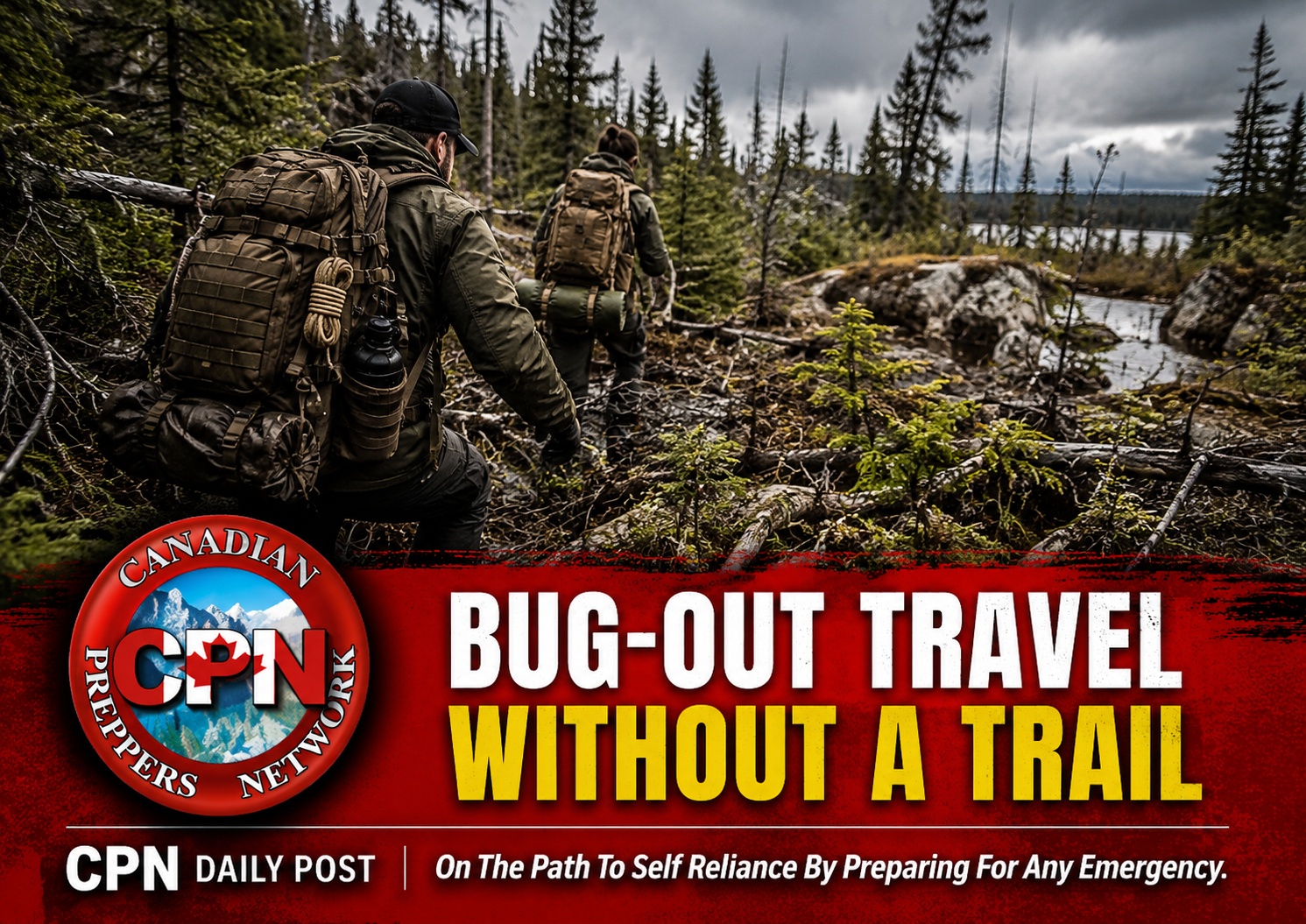
Why off-road movement through Canadian terrain is slower, harder, and more dangerous than most bug-out plans admit
A lot of bug-out planning quietly assumes there will be a road, a trail, a clear path, or at least some kind of obvious route to follow. That may be true for the first few kilometres. It may even be true for the first day. But once roads are blocked, trails are crowded, bridges are out, culverts are washed away, or the direct route becomes unsafe, the plan changes fast.
That is when travel stops being a matter of “just head north” and becomes a wilderness skill.
Moving through Canadian bush without a trail is not the same as hiking. It is slower, wetter, rougher, and far more tiring. Every hill, swamp, creek, blowdown, cut line, beaver pond, and patch of thick regrowth has a say in how far you actually get. A person who can walk twenty kilometres on a road may struggle to cover five in rough bush with a loaded pack.
That does not mean wilderness bug-out travel is impossible. It means it has to be planned honestly.
Canadian Preppers Network has already covered broader wilderness bug-out realities in Wilderness Bugout Survival. Today, we are narrowing the focus to one specific skill: moving when there is no trail left to follow.
The First Rule: Speed Is Not the Goal
The biggest mistake people make when thinking about off-trail travel is assuming that speed matters most. In reality, speed is usually what gets people hurt.
Fast movement creates sloppy foot placement. Sloppy foot placement causes twisted ankles, falls, wet boots, broken gear, lost items, and poor route decisions. Once you are injured, cold, wet, or exhausted, every other part of the plan gets worse.
The goal is controlled movement.
That means choosing a route that preserves energy, avoids unnecessary hazards, and keeps the group functional. A slower route that follows higher ground, avoids swamp, and keeps people dry may be better than a straight-line route that looks shorter on the map.
This is especially important in Canada, where the “short way” often means alder, muskeg, deadfall, black spruce, steep gullies, or a creek crossing that looked harmless from above.
A good bug-out route is not the shortest route. It is the route you can still complete after fatigue, bad weather, limited daylight, and human error have entered the picture.
Map Distance Is Not Real Distance
On a map, a kilometre is clean. On the ground, it may be a fight.
A straight line through the bush does not account for detours around water, steep slopes, thick brush, private land, cliffs, washouts, or areas where visibility drops to a few metres. It also does not account for the mental load of constantly navigating.
Trail hiking lets you switch off part of your brain. Off-trail travel does not.
Every few minutes, someone has to make decisions. Are we drifting too far east? Is that drainage leading where we think it is? Is this low ground passable? Is the group spreading out? Are we burning too much daylight? Is it time to stop?
That kind of decision-making is tiring. The more tired the group gets, the more mistakes creep in.
This is why practical navigation matters. GPS is useful, but it should not be the only system. Phones die. Batteries fail. Screens break. Cold weather shortens battery life. Tree cover, terrain, and poor signal can all reduce confidence.
A map and compass are not old-fashioned decorations. They are backup brains.
For more on low-tech navigation when electronics fail, see CPN’s Winter Navigation & Wayfinding When Electronics Fail.
Use Handrails, Not Heroics
One of the best ways to move without a trail is to stop thinking like a straight-line traveller and start thinking in terms of handrails.
A handrail is a major terrain feature that helps guide your movement. It might be a river, ridgeline, hydro corridor, old logging road, lake shore, fence line, railway line, drainage, or distinct edge between two types of terrain.
Instead of trying to walk directly to a point through dense bush, you move toward a feature you can recognize, then follow it until it leads you closer to where you need to go.
This reduces navigation errors.
For example, if your destination is near the north end of a lake, it may be safer and easier to aim for the lake shore first, then follow the shore to the target area. That route may be longer on paper, but the lake becomes a guide. You are less likely to wander past your destination without realizing it.
The same idea applies to ridges and drainages. Moving along higher ground can help you avoid wet lowlands, improve visibility, and make navigation easier. Following a drainage may lead to water, but it can also pull you into thick brush, unstable banks, or cold low ground. The terrain decides whether it helps or hurts.
The skill is not memorizing one perfect method. The skill is reading what the land is giving you.
Water Is Both a Route Problem and a Survival Resource
Water shapes off-trail travel more than most people expect.
Creeks, ponds, swamps, beaver dams, flooded lowlands, and wet ditches can add hours to a route. Sometimes the best crossing is not where you first meet the water. Sometimes the safest choice is to follow the bank until you find a better place. Sometimes the right answer is to stay dry and avoid the crossing altogether.
Wet feet are not a minor inconvenience on a long bug-out movement. They increase friction, soften skin, speed up heat loss, and make every step worse. In cold weather, they can become a serious problem quickly.
At the same time, water access is one of the reasons a wilderness route may be chosen in the first place. A route that crosses reliable water sources gives you options for refilling, resting, cooling down, and reducing carried weight.
The catch is that found water still has to be treated.
A bug-out route that depends on streams, lakes, or ponds should include a realistic water plan: pre-filtering dirty water, filtering or disinfecting it, carrying enough between sources, and protecting bottles or bladders from freezing in winter.
CPN’s Water Collection & Purification in Canada hub is a good place to connect that wilderness movement problem to the larger preparedness system.
Group Movement Is Slower Than Solo Movement
A single person can make decisions quickly. A group cannot.
Every additional person adds variables: pace, fitness, fear, injuries, pack weight, footwear, navigation ability, medical issues, and emotional stress. Children, older adults, pets, and anyone carrying awkward gear will slow the group further.
This does not mean the group is a weakness. A good group can share load, rotate navigation, spot hazards, help with injuries, and make better decisions than one exhausted person. But only if the group is honest about pace.
The group moves at the speed of the slowest functional member.
That has to be built into the plan before the emergency. If your map says the route is twelve kilometres, but your group can only realistically move one kilometre per hour through rough terrain, that is not a half-day trip. It may become an overnight problem.
That changes everything.
Now you need shelter, insulation, water, food, headlamps, signalling gear, dry socks, and a decision point for when to stop. A bug-out route that looks manageable in daylight can become dangerous once people keep pushing after dark.
The best off-trail travellers are not the ones who never stop. They are the ones who know when stopping is the smart move.
Obstacles Should Be Expected, Not Surprising
If your route crosses wild terrain, obstacles are not exceptions. They are the route.
Blowdowns may force detours. Beaver activity may flood old trails. Logging roads may be gated, washed out, or grown over. Snowmobile trails may be useless outside winter. ATV trails may end suddenly. A creek that was ankle-deep in August may be unsafe in spring runoff.
This is why alternate routes matter.
A serious bug-out plan should not have one line on a map. It should have options. Primary route. Slower backup route. Bailout point. Water source. High ground. Road crossing. Possible shelter site. Avoidance area. Rendezvous point.
The more you study the route before you need it, the less guessing you will do under stress.
This is also where paper maps still earn their place. A printed topo map, marked with key features and sealed in a waterproof bag, gives you something that does not depend on battery life. It also lets the whole group understand the route instead of relying on one person holding one phone.
Clothing Matters More Than Camouflage
Off-trail travel punishes bad clothing.
Cotton gets wet and stays wet. Cheap rain gear tears. Loose straps snag. Poor boots create blisters. Thin pants get shredded by brush. Overheated hikers sweat through their base layers and then chill when they stop.
The clothing goal is simple: protect the body while managing moisture.
That means sturdy footwear already broken in, wool or synthetic socks, brush-resistant pants, layered tops, gloves, rain protection, and a hat suitable for the season. In tick and mosquito country, gaiters and tucked cuffs can make travel more tolerable. In wet country, dry socks protected in a waterproof bag are worth more than another gadget.
A bug-out bag should not be packed as if the person carrying it will be walking a sidewalk. If the realistic route includes bush, swamp edges, cold rain, and rough ground, the clothing system has to match.
The same goes for pack organization. The things needed during movement should be reachable without unpacking the entire bag: map, compass, headlamp, snacks, water treatment, rain layer, gloves, first aid, flagging tape, and dry socks.
If everything important is buried, it will not get used when it should.
Marking a Route Can Save the Return Trip
In normal recreational hiking, marking a route may be unnecessary or even inappropriate depending on the location. In a real emergency movement, especially on private land, retreat land, or a pre-planned group route, temporary route marking can be valuable.
Flagging tape, reflective tacks, natural markers, or pre-identified landmarks can help prevent a group from losing time on the return trip or guide a second group moving later.
The key is discipline.
Do not create a confusing mess of random markers. Do not rely on markers alone. Do not assume they will remain in place. Weather, animals, people, and darkness can all interfere. Route markers should support navigation, not replace it.
For group retreats, hunting camps, rural properties, or emergency rally points, this is worth practising ahead of time. A short marked access route through rough ground may matter more than an impressive gear shelf at home.
Know When to Stop
There is a dangerous moment in wilderness travel when people know they should stop, but push anyway.
They are tired. The light is fading. The weather is changing. Someone has a sore ankle. The group is off pace. The destination feels close, even though nobody is completely sure. That is when bad decisions start sounding reasonable.
“Just another kilometre.”
“We’ll find a better spot.”
“We can make it before dark.”
“Let’s cross here.”
In rough terrain, stopping early can be the safer decision. It gives time to choose a better site, collect water, put on dry layers, build shelter, organize gear, check feet, eat, and reset the plan before full darkness.
Pushing late often creates the opposite: a poor campsite, wet gear, panic navigation, rushed decisions, and injuries that could have been avoided.
A good bug-out route should have pre-selected stop points. Not perfect campsites. Just realistic places where the group can pause, reassess, and stay overnight if necessary.
That might be high ground near water, a known clearing, a sheltered tree line, an old camp, a gravel pit, a cabin approach, or a safe edge of a field with permission. Whatever the option, it should be identified before the emergency.
Buying Box: Practical Gear for Off-Trail Bug-Out Movement
CPN is an Amazon Associate and may earn from qualifying purchases.
The point of this gear is not to make wilderness travel easy. It will not be easy. The point is to reduce preventable failures: getting lost, losing daylight, soaking gear, injuring feet, or being unable to treat water.
Map and Compass Tools
A baseplate compass, protected map, and simple route notes should be part of any serious off-trail movement plan.
Waterproof Map Case
Paper maps only help if they survive rain, snow, mud, and wet hands.
Trekking Poles for Rough Ground
Poles can help with balance on slopes, creek edges, deadfall, and uneven terrain.
Outdoor Gaiters
Gaiters help keep debris, snow, mud, and wet brush out of your boots and pant cuffs.
Waterproof Dry Bags
Dry socks, insulation layers, maps, electronics, and fire-starting gear need real protection inside the pack.
Headlamp With Spare Batteries
If travel runs late or camp setup happens after sunset, hands-free light becomes essential.
Emergency Whistle and Signal Mirror
Simple signalling tools can help keep a group connected or draw attention if someone becomes separated.
Portable Water Filter
A route that depends on wild water needs a treatment plan, not wishful thinking.
Flagging Tape
Temporary route marking can help on private land, retreat properties, group access routes, or emergency return paths.
For a broader equipment overview, see CPN’s Wilderness Skills Buying Guide.
Practice Before It Matters
No article can turn someone into a capable off-trail traveller. This is a skill that has to be practised in controlled conditions before it is needed under pressure.
Start small. Walk a short section of bush with a map and compass. Learn how slowly you actually move. Test footwear. Find out where your pack rubs. Practise taking a bearing. Learn how thick terrain changes your pace. Try navigating to a visible handrail instead of a tiny target. Practise stopping before dark and setting up a basic overnight system.
Better yet, train with people who already have field experience.
That is one of the reasons events like Preppers Meet matter. Hands-on training exposes weaknesses that armchair planning hides. Navigation, shelter, first aid, water, fire, and field movement are not just topics to read about. They are skills to put in your hands, under supervision, while mistakes are still cheap.
Final Takeaway
Bug-out travel without a trail is not about charging heroically through the woods. It is about moving carefully, reading terrain, protecting the group, and knowing when the land is telling you to slow down.
Roads may fail. Trails may disappear. Bridges may be blocked. Crowds may force detours. Weather may change the plan. In those moments, the prepared person is not the one with the fanciest pack. It is the one who can look at the land, choose a realistic route, and keep moving without turning a bad situation into a worse one.
The bush does not care what the map promised.
Plan accordingly.