Most people think water storage is simple: buy a few cases of bottled water, stack them in the basement, and call it done.
It isn’t.
Water is heavy, bulky, and deceptively difficult to manage over time. And in a Canadian home—where space is limited, winters are harsh, and supply chains stretch thin—poor planning shows up fast.
If you approach water storage the wrong way, you don’t just waste space. You end up with less water than you think, stored in ways that fail when you need it most.
Let’s fix that properly.
Start With the Real Numbers
The standard rule is 4 litres per person per day.
For a family of four:
4 × 4 × 30 = 480 litres
If you haven’t already, this ties directly into your food planning reality here:
https://canadianpreppersnetwork.com/how-to-build-a-30-day-food-supply-in-canada-without-overspending/
Because both fail for the same reason—people underestimate volume.
Why Bottled Water Is a Dead End
Cases of bottled water feel convenient, but they are one of the least efficient ways to store large volumes.
They waste space, degrade over time, and create a false sense of security.
They belong in short-term kits—not your primary system.
The Space-Efficient Storage Strategy
1. Modular Storage That Actually Fits
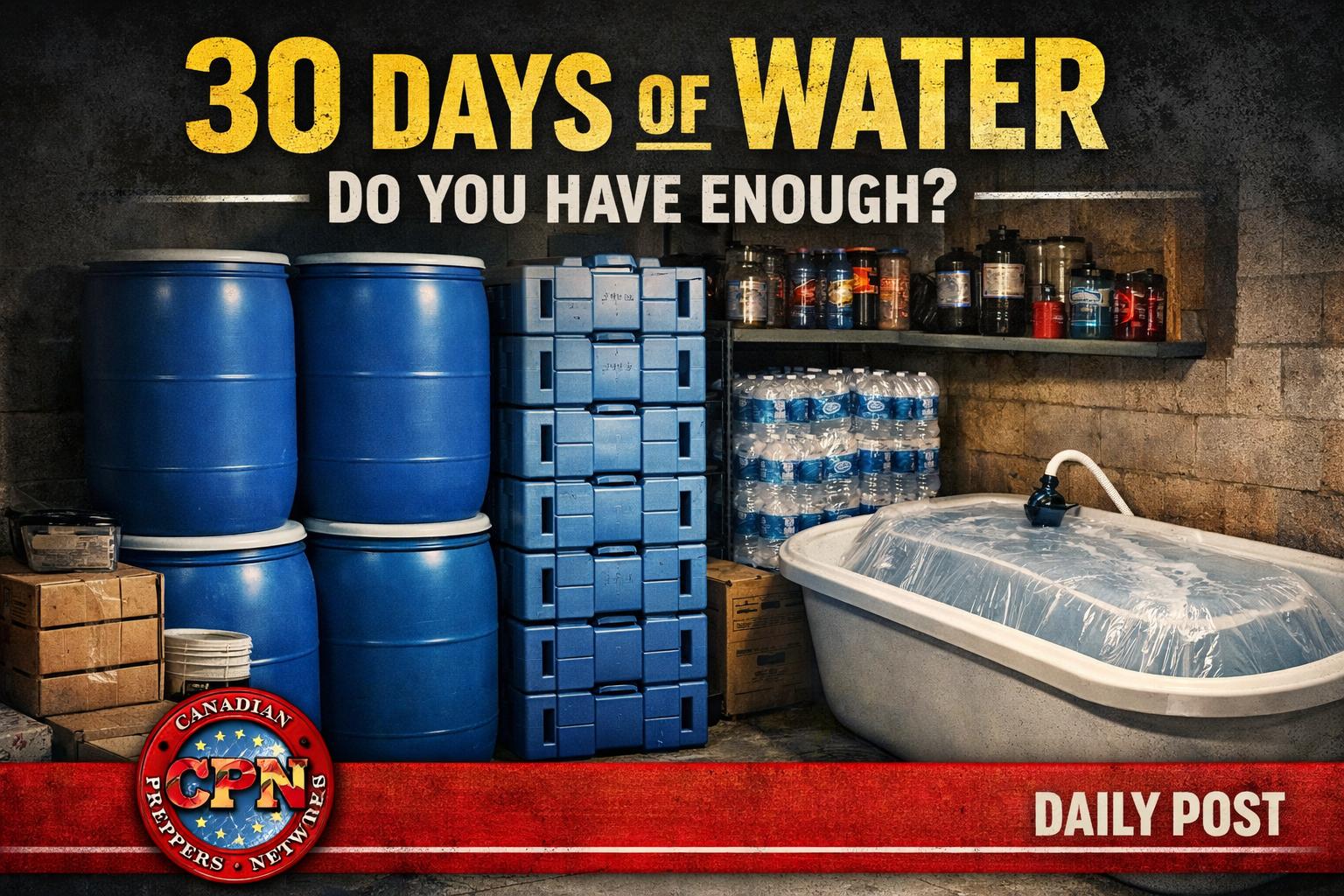
Stackable systems like the WaterBrick Stackable Water Container
👉 https://www.amazon.ca/s?k=WaterBrick+water+container&tag=canadianprep-20
These allow dense, stable storage in:
- Closets
- Basement corners
- Under shelving
You’re maximizing usable volume—not stacking air.
2. Bulk Storage That Anchors Your Supply
For your main reserve, use larger containers like the Reliance Aqua-Tainer 26L Water Container
👉 https://www.amazon.ca/s?k=Reliance+Aqua-Tainer+26L&tag=canadianprep-20
These give you:
- High volume per footprint
- Reliable dispensing
- Long-term stability
For deeper system thinking, this connects well with:
https://canadianpreppersnetwork.com/closed-loop-water-system/
3. Emergency Surge Capacity
When you have warning, you can scale fast.
The WaterBOB Bathtub Emergency Water Storage
👉 https://www.amazon.ca/s?k=WaterBOB+bathtub+water+storage&tag=canadianprep-20
…lets you store hundreds of litres in hours.
That’s not your base plan—but it can save you.
Treatment and Longevity
Water doesn’t stay safe indefinitely.
Use something like Aquamira Water Treatment Drops
👉 https://www.amazon.ca/s?k=Aquamira+water+treatment+drops&tag=canadianprep-20
This extends storage life and gives you flexibility.
For filtration methods and deeper purification options:
https://canadianpreppersnetwork.com/water-filtration-methods-for-canadian-preppers/
Distribute the Weight
480 litres in one spot is a structural risk.
Spread it across:
- Basement
- Closets
- Utility spaces
This improves both safety and accessibility.
Rotation Without Burnout
Keep it simple:
- Label by date
- Rotate every 6–12 months
- Use old water productively
Simple systems get maintained. Complex ones get ignored.
Canadian Reality: Winter
Water freezes—and when it does, your plan fails.
Keep primary storage indoors.
Snow is not a solution—it’s a last resort that costs time and fuel.
The System That Works
A real plan includes:
- Bulk storage
- Modular storage
- Emergency surge
- Treatment capability
That’s resilience—not guesswork.
Final Thought
If your plan is a few cases of bottled water, you don’t have 30 days.
You have a buffer.
And buffers run out.
┌────────────────────────────────────────────┐
📘 Acres of Preparedness: Planning the Last Safe Place
A practical blueprint for building a self-sufficient life—covering water, food, and long-term resilience.
👉 https://amzn.to/4mRu7b5