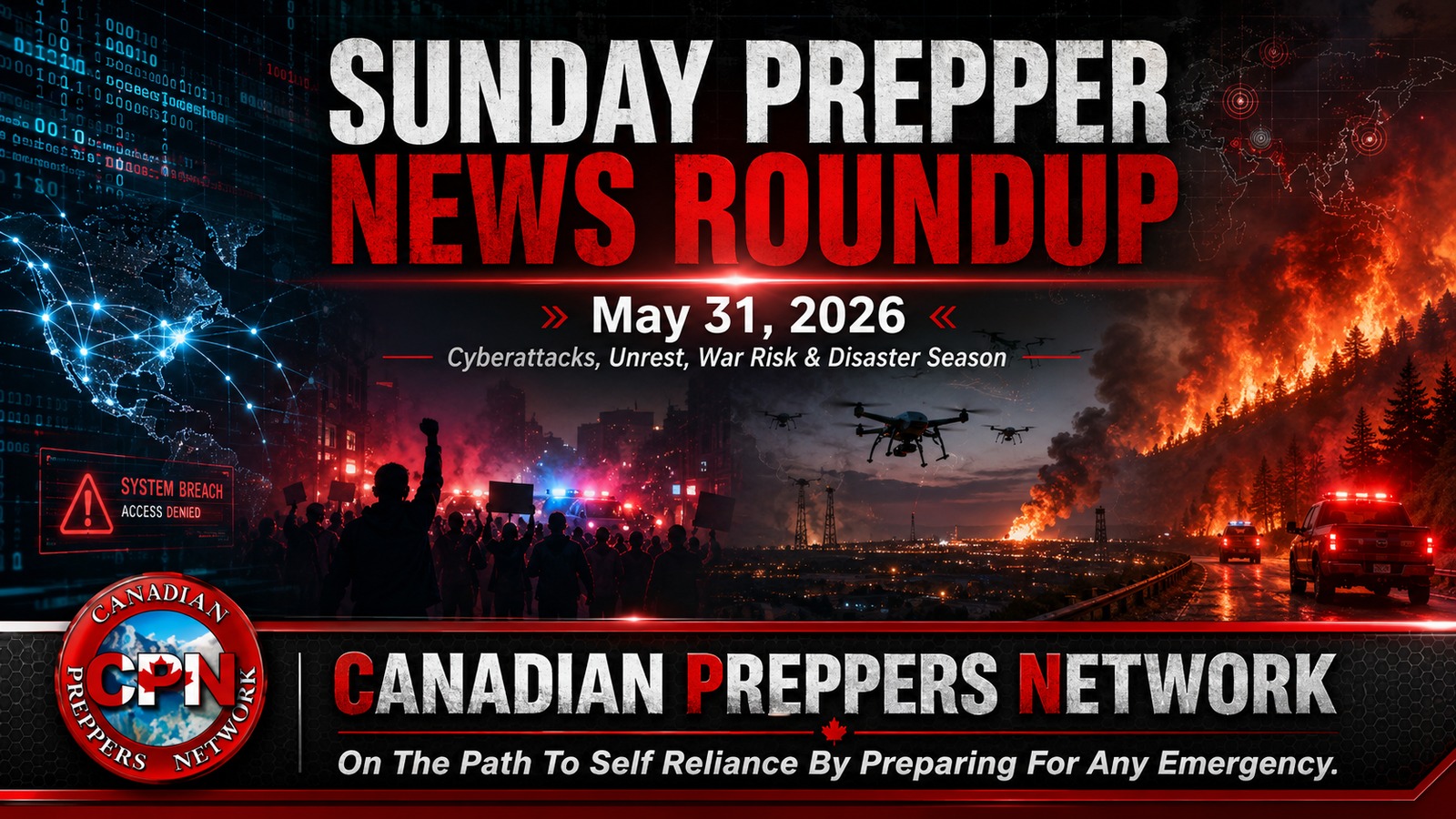
Cyberattacks, Unrest, War Risk, And Disaster Season
This week’s warning signs did not come from one single crisis. They came from several directions at once.
Cyberattacks disrupted schools and medical-sector supply chains. Civil unrest forced curfews and mass arrests. War continued to push toward energy infrastructure, shipping routes, drone warfare, and nuclear-site risk. At the same time, Canada moved deeper into wildfire season while forecasters reminded the public that a quieter hurricane outlook is not the same thing as safety.
For preppers, that matters. Real emergencies rarely arrive in neat categories. A cyberattack can interrupt supply chains. A protest can close roads. A war halfway around the world can affect fuel prices. A wildfire can force evacuation while communication systems are already overloaded. The serious preparedness lesson is not panic. It is overlap.
When systems fail, they often fail together.
Cyberattacks Are Still Hitting Ordinary Systems
One of the more Canadian-relevant cyber stories this week involved Canvas, the online learning platform used by many universities and colleges. Canadian institutions, including the University of British Columbia, were affected after a cyber breach involving Instructure, the company behind Canvas. Users were warned not to log in while institutions investigated and restored access.
At first glance, a school platform may not sound like a survival issue. But it is another reminder that modern life depends on fragile digital gateways. Education, employment, healthcare, banking, logistics, and government services all run through third-party platforms most people never think about until they stop working.
A more serious supply-chain example came from West Pharmaceutical Services, a company tied to pharmaceutical packaging and medical manufacturing. Reports said the company detected a ransomware attack involving stolen data and encrypted systems, forcing it to take affected infrastructure offline and disrupting operations. The company later said it had restored operations, but the event still shows how ransomware can reach beyond office computers and into production, shipping, and medical supply chains.
The preparedness takeaway is simple. Keep paper copies of critical information. Do not assume portals, apps, student accounts, benefit systems, medical records, or employer platforms will always be available. Password managers, offline backups, printed contacts, and hard copies of essential documents are no longer “tech paranoia.” They are basic household resilience.
Civil Unrest Can Change A City Overnight
In Newark, New Jersey, protests outside the Delaney Hall immigration detention facility escalated enough that officials imposed a nightly curfew around the area. Reports described confrontations between demonstrators and authorities, arrests, state police involvement, and a controlled protest zone as officials tried to reduce tension.
Regardless of one’s politics, the preparedness angle is obvious. Civil unrest does not need to engulf an entire city to affect ordinary people. A few blocks of disorder can close roads, disrupt work, delay emergency response, and put bystanders in the wrong place at the wrong time.
France offered another example after Paris Saint-Germain’s Champions League victory. Celebrations turned into serious disorder, with hundreds detained, vehicles burned, shops damaged, and police officers injured. This was not a food shortage, a war, or a blackout. It was a mass public gathering that changed character quickly.
For Canadian families, the lesson is situational awareness. Avoid large crowds when tension is rising. Know alternate routes home. Keep fuel in the vehicle. Do not depend on one bridge, one subway line, one highway, or one downtown route. If you work or travel near protest zones, stadiums, government buildings, or major event areas, have a plan to leave early and move around trouble instead of through it.
War Is Moving Deeper Into Infrastructure
The war in Ukraine continued to show how modern conflict targets the systems behind the battlefield. Ukraine reported drone strikes against Russian energy infrastructure, including oil and fuel-related sites. Russia separately claimed that a Ukrainian drone struck part of the Russian-controlled Zaporizhzhia nuclear power plant. Ukraine denied the accusation, and international nuclear officials expressed concern about the need to inspect and verify the situation.
The important point for preppers is not to take every wartime claim at face value. The important point is that energy sites, fuel logistics, drones, and nuclear facilities are all part of the modern conflict environment.
Russia also launched one of the heaviest recent missile and drone attacks against Kyiv, reportedly using hundreds of drones and missiles. Civilian infrastructure was damaged and people were forced back into shelters. This is what prolonged high-tech warfare looks like: not just soldiers at a front line, but pressure on power, transport, housing, communications, and morale.
The Middle East also remains a major risk zone. Reuters reported that the U.S. carried out strikes against an Iranian military site and shot down Iranian one-way attack drones near the Strait of Hormuz. That waterway matters far beyond the region because it is one of the world’s most important energy chokepoints. Any serious disruption there can ripple into shipping, fuel prices, insurance costs, and political pressure worldwide.
For Canadians, overseas war risk often shows up as price shock before it shows up as direct danger. Fuel, fertilizer, shipping, replacement parts, and imported goods are all exposed to global instability. Preparedness means reducing dependence where possible: safe fuel storage within legal limits, alternative heat, backup power, local food production, basic repair supplies, and enough household inventory to ride out short-term disruption.
Canada Is Already In Wildfire Season
The Government of Canada reported that, as of its latest wildfire update, there were 65 active wildfires across the country, with six listed as out of control. The total area burned so far this year was reported at more than 18,935 hectares.
That is not the worst Canada has seen, but it is enough to take seriously. Wildfire season is not only a rural problem. Smoke can travel hundreds or even thousands of kilometres. Evacuations can overload highways. Hotels fill. Fuel stations run dry. Rural roads can close quickly. Power lines and communication towers can be affected.
A wildfire plan should not be vague. It should include a vehicle-ready evacuation kit, paper maps, pet supplies, copies of insurance documents, medications, N95-style respirators for smoke, backup communications, and a clear decision point for leaving before the official panic begins.
Waiting for the last possible moment is not toughness. It is gambling with traffic, visibility, fuel, and access.
Hurricane Season Is Still Worth Watching
NOAA’s 2026 Atlantic hurricane outlook called for a below-normal season, forecasting 8 to 14 named storms, 3 to 6 hurricanes, and 1 to 3 major hurricanes. That may sound reassuring, but below-normal does not mean harmless.
One major storm in the wrong place can do enough damage to matter. Atlantic storms can affect Eastern Canada, supply chains, travel, fuel distribution, insurance markets, and emergency resources. Even when a storm weakens before reaching Canada, the rainfall, wind, coastal surge, and infrastructure stress can still be serious.
The prepper takeaway is not to obsess over hurricane tracks months in advance. It is to build basic weather resilience before the warning cone appears: water storage, sump pump backup, battery lighting, roof and gutter maintenance, tarps, hand tools, communications plans, and enough food to avoid last-minute shopping chaos.
Flooding In China Shows The Speed Of Water Disasters
In southwestern China, flooding and landslides in Chongqing killed at least nine people, left others missing, and forced thousands to relocate. Heavy rain, flash flooding, and landslides remain among the most underestimated disaster threats because they can turn local terrain into a trap very quickly.
Canada is no stranger to this. Flooding does not need to be national news to destroy a basement, cut a road, contaminate wells, or isolate a rural property. The basic preparations are not complicated: know the high ground, keep valuables and supplies off basement floors, have a manual way to move water, store drinking water separately from wells or municipal supply, and never assume a familiar road is safe under moving water.
The Pattern: Systems Are Being Tested From Multiple Directions
This week’s stories are not connected by one grand event. They are connected by pressure.
Digital systems are being attacked. Public order is becoming easier to disrupt. Wars are reaching deeper into energy infrastructure and strategic chokepoints. Natural disasters are moving into their seasonal windows. Governments and institutions keep telling the public to be prepared, but the practical work still falls on households, communities, and local networks.
That is where Canadian preparedness needs to stay focused.
Have backups that do not depend on apps. Keep enough supplies at home to absorb disruption. Build local relationships before you need help. Keep vehicles, documents, medications, fuel, water, and communications ready enough that you are not starting from zero when the alert comes.
The world does not need to end for preparedness to matter.
It only takes one system you depend on to fail at the wrong time.
Sources And Further Reading
Government of Canada wildfire season update:
The Government of Canada provides update on the 2026 wildfire season preparedness and forecast
NOAA 2026 Atlantic hurricane outlook:
NOAA predicts below-normal 2026 Atlantic hurricane season
Canvas / Instructure cyber breach affecting Canadian schools:
Several Canadian universities face security breach involving Canvas
West Pharmaceutical ransomware attack:
West Pharmaceutical Services hit by disruptive ransomware attack
Newark Delaney Hall protests and curfew:
New Jersey governor blames out-of-state agitators for inflaming Newark ICE detention protests
France PSG celebration unrest:
France detains hundreds after violent clashes as Paris Saint-Germain won Champions League
Ukraine energy strikes and Zaporizhzhia nuclear plant concerns:
Ukraine hits Russian energy targets and denies striking Kremlin-occupied nuclear plant
Russia / Ukraine Zaporizhzhia claim and denial:
Russia says Ukrainian drone struck Zaporizhzhia nuclear plant, Kyiv denies
China flooding in Chongqing:
Three dead and 17 missing after flooding in China’s Chongqing