Why flax, hemp, nettle, cattail, and bark fibre may become essential medical crops after the supply chain dies.
In a long collapse, the first aid kit does not fail in one dramatic moment. It fails one dressing at a time.
A cut hand takes the first gauze pads. A burn takes the next roll. A sprained wrist uses up the last elastic wrap. Someone gets a deep scrape while hauling firewood, and suddenly the household is cutting corners with dirty rags, reused padding, and whatever can be found in the bottom of a drawer.
That is when people discover the truth about long-term medical preparedness: the hard shortage is not always medicine. Often, it is material.
Bandages, pads, wraps, slings, splint ties, wound covers, absorbent layers, and clean storage cloth are all consumable supplies. They are used, stained, washed, worn out, burned, buried, or discarded. A group may have the knowledge to clean a wound and monitor an injury, but if it cannot keep producing clean coverings and support materials, even small injuries become harder to manage.
For the broader medical preparedness framework, see the CPN hub on Medical & First Aid in Canada. This article looks at one specific weak point inside that larger system: replacing the consumable materials once the modern supply chain is gone.
This is where fibre crops matter.
A serious retreat or homestead should not think only in terms of calories, firewood, water, and security. It should also think in terms of textile production. Not clothing fashion. Not decoration. Medical fabric. The rough, practical, boring material that keeps a wound covered, a splint tied, an arm supported, and a patient protected from dirt.
In normal times, we buy gauze and tape. In a collapsed world, someone has to grow, harvest, process, spin, weave, wash, dry, and store the replacements.
That is not glamorous work. It is not fast work. But it may be the difference between having a medical system and merely having memories of one.
Natural Material Is Not Automatically Medical Material
The first mistake is thinking that anything natural is safe.
A leaf is natural. So is dirt. So is mould. So is pond water. Natural does not mean clean, and clean does not mean sterile.
That distinction has to be understood before a group starts improvising medical supplies from the land. Raw moss, leaves, grass, bark, wool, fluff, and plant fibre should not be casually pressed into open wounds. They may absorb fluid, but they can also carry grit, insects, spores, bacteria, and other contamination.
The goal is not to shove nature into an injury. The goal is to use natural materials intelligently.
Most raw materials are best used as outer layers, padding, wraps, ties, splint supports, carrying systems, and absorbent filler inside cleaner woven covers. The material touching a wound should be the cleanest, smoothest, most carefully processed fibre the group can make. Even then, it is not the same as modern sterile gauze.
That is the reality. A post-collapse household cannot pretend it has a hospital. It can, however, avoid making things worse through sloppy thinking.
Medical fibre production is not about primitive romance. It is about discipline.
The Medical Fibre Plot
Most preparedness gardens focus on food. That makes sense, but food alone does not solve long-term survival.
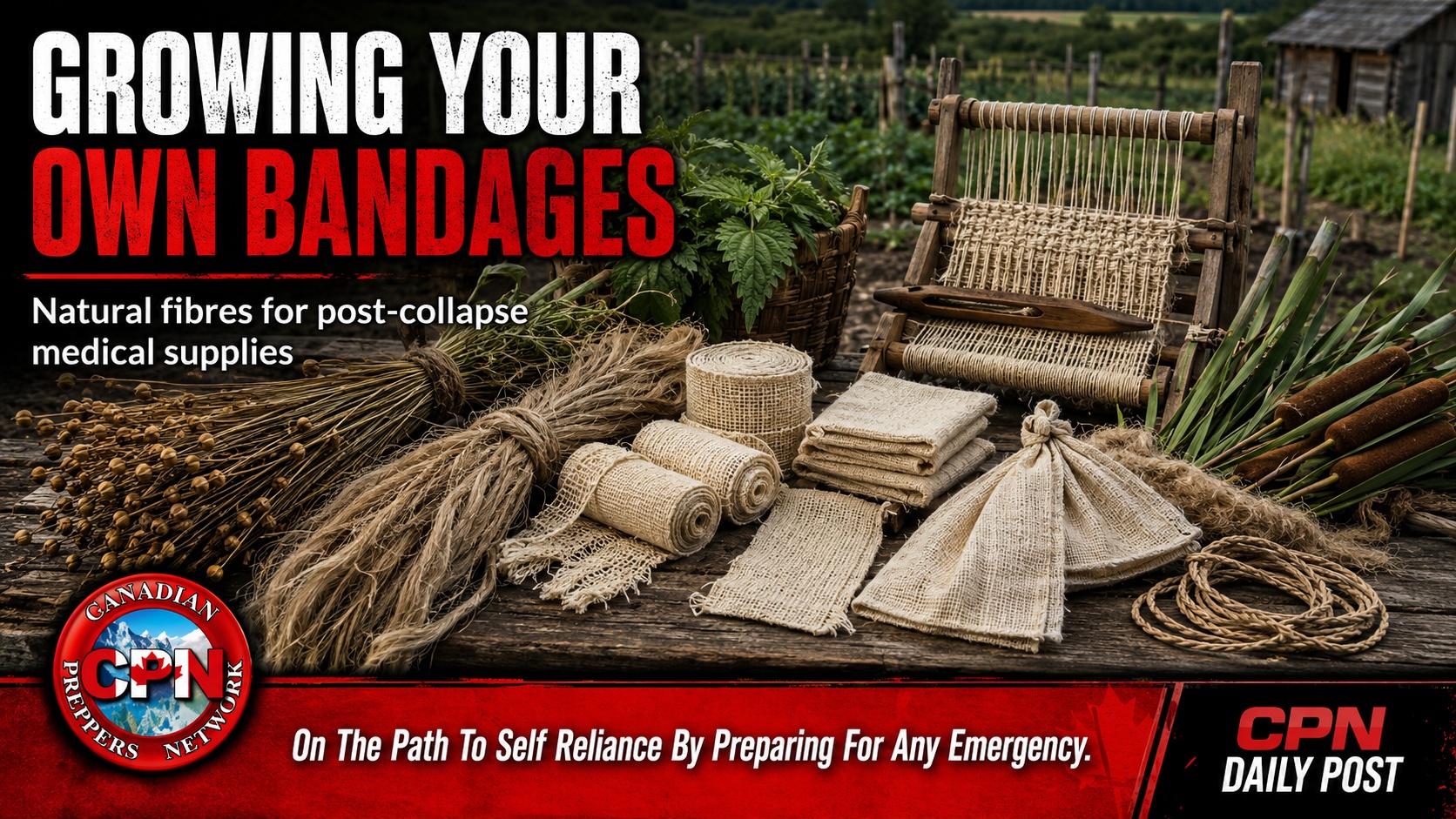
A mature retreat should also consider a small fibre plot. This does not have to replace food production, but it should be treated as a real system. A patch of flax, a legal hemp plot where permitted, a managed nettle bed, cattail harvesting areas, willow coppice, and useful bark-fibre trees can all contribute to a long-term medical supply chain.
CPN has already looked at this wider subject in Animals and Plants Used for Textile Production in a Survival Group. The medical angle is narrower: not “Can we make clothing?” but “Can we keep producing the cloth, cordage, padding, and wraps needed to care for injured people?”
The objective is not to make fine linen shirts. The objective is to make practical medical textiles.
That means woven strips, rough pads, slings, splint ties, cordage, absorbent envelopes, patient carriers, storage bags, and repair thread. Some of it will be crude. Some of it will be ugly. None of that matters if it works.
In a collapsed world, the prettiest bandage is the one that is clean, available, and replaceable.
Flax: The First Medical Fibre Crop
Flax deserves serious attention.
It grows in cooler climates, produces long bast fibres, and can be processed into linen. Historically, linen has been one of the great practical fabrics of human survival: clothing, sacks, wrappings, towels, sails, thread, and bandage material.
For medical use, flax is valuable because it can produce relatively smooth fibre compared with many rougher plant sources. Properly processed and woven linen can be used for wound-covering cloth, bandage strips, slings, outer wraps, medical storage pouches, and absorbent layers.
The work begins in the field.
Flax grown for fibre is not managed exactly like flax grown only for seed. Fibre quality depends on long stems, dense planting, and harvesting at the right stage. Once harvested, the stems must be retted, which means using moisture and microbial action to help separate the fibre from the woody core. After retting, the flax is dried, broken, scutched, hackled, spun, and finally woven.
Those words sound old-fashioned because they are. But in a long collapse, old-fashioned often means functional.
Breaking crushes the woody stalk. Scutching scrapes away broken stem material. Hackling combs and aligns the fibres. Spinning turns fibre into thread or yarn. Weaving turns that thread into usable cloth or strips.
This is labour-heavy. A household will not casually grow bandages over a weekend. A fibre system must be learned before it is needed.
That is the real lesson: if flax is going to matter after collapse, someone should be experimenting with it now.
Hemp: Strength for Wraps, Cordage, and Support
Hemp is another powerful fibre crop, but in Canada its cultivation remains regulated under the Cannabis Act and associated Industrial Hemp Regulations. Growing industrial hemp legally requires compliance with federal rules governing approved cultivars, licensing, and THC limits, so anyone considering hemp production should verify current requirements with Health Canada and applicable provincial authorities.
For post-collapse medical logistics, hemp’s greatest strength is not fine wound cloth. It is strength.
Hemp fibre can be turned into cordage, webbing, straps, outer wraps, splint ties, stretcher supports, storage bags, and durable utility cloth. It may be rougher than well-processed linen, but roughness is not a problem when the material is used outside the wound layer.
A medical system needs more than soft pads. It needs ties that do not snap. It needs straps that hold a splint in place. It needs webbing for stretchers. It needs lashings for carrying frames. It needs cord for hanging washed dressings in the sun, suspending mosquito netting around a sick bed, tying bundles, sealing storage bags, and securing patients during movement.
Hemp belongs in the support side of the medical supply chain.
In normal first aid thinking, cordage is not treated as a medical supply. In long-term collapse thinking, it becomes essential.
Nettle Fibre: The Unpleasant Backup
Nettle is easy to overlook because most people think of it as a nuisance.
That is a mistake.
Nettle stems can produce usable bast fibre. It is not as convenient as pulling gauze from a package, and processing it is not pleasant work, but nettle has one major advantage: it can often be found or cultivated in places where other crops struggle.
A retreat that manages nettle deliberately gains another fibre source. It can be used for cordage, rough woven cloth, ties, outer wraps, storage bags, and support strips. It may not produce the cleanest wound-contact material, but it can replace many of the supporting items that disappear quickly in a medical crisis.
A nettle patch also fits the survival principle of redundancy. Flax may fail. Hemp may not be an option. Stored cloth may run out. Nettle gives a household another path.
In a true collapse, uncomfortable work becomes normal work.
Cattail: Padding, Filler, and Matting
Cattail is not a linen crop, but it is still valuable.
The fluff can serve as absorbent filler or padding, especially when sealed inside a cleaner woven envelope. The leaves can be woven into mats. The stalks can contribute to light structures. Around a sick area, cattail materials can be used for padding, bedding layers, outer absorbent packs, splint cushioning, kneeling mats, and temporary patient supports.
The important warning is that cattail fluff should not be treated as sterile wound dressing. Loose fluff directly against an open wound is a contamination risk and may be difficult to remove. Its better use is inside a woven pouch or between layers, where it adds absorbency without becoming embedded in the injury.
Think of cattail as the filling, not the wound surface.
That distinction applies to many natural materials. Moss, grass, leaves, wool, fluff, and bark fibre may all have uses, but the cleaner processed fabric should separate the wound from the raw material whenever possible.
Bark Fibre, Willow, and Wooden Support
Not all medical fibre needs to become cloth.
Inner bark from trees such as basswood, willow, cedar, and elm has long been used for cordage and lashings. In a medical context, these materials are useful for tying splints, making carrying baskets, binding frames, hanging supply bundles, and building simple supports around a patient.
Willow and similar flexible woods also matter for splints and frames. Straight sticks, split boards, bark sheets, woven panels, and light wooden supports can immobilize injuries when properly padded. The wound itself may require a clean woven cover, but the injury also needs protection from movement.
That is where wood and bark shine.
A finger splint, wrist support, leg splint, stretcher frame, backboard, or wound guard does not need to be made from modern plastic to work. It needs to be shaped, padded, secured, and checked often enough that it does not create new damage.
The medical fibre system and the woodlot belong together. This is also where wilderness skills overlap with medical planning. A group that can identify useful plants, process fibre, cut straight splint wood, and improvise support materials has a much deeper medical capability than a group with only a store-bought kit.
Weaving for Medical Use
The kind of weaving needed for survival medicine does not have to be complex.
A group does not need to produce fine household linen immediately. It should start with simple, repeatable items.
Narrow woven strips can replace many bandage rolls and ties. Wider strips can become slings and wraps. Small square or rectangular pieces can become wound covers. Coarser envelopes can be filled with cattail fluff or other padding to make absorbent pads. Heavy webbing can support stretchers or immobilization systems.
A simple frame loom, backstrap loom, rigid heddle loom, or tablet-weaving setup can produce practical material. The tools can be made from wood, bone, cordage, and simple hand tools. The key is not speed. The key is repeatability.
A retreat should be able to say: we can make narrow ties; we can make flat pads; we can make slings; we can make splint binding; we can make absorbent envelopes; we can wash and reuse what can be reused; and we can discard what is too contaminated and make more.
That is the difference between improvisation and production.
Improvisation is what happens once. Production is what keeps happening.
The Cleanliness Problem
The hardest part of natural medical textile production is not growing fibre. It is keeping the finished material clean enough to use.
A woven pad dragged through a smoky cabin, handled with dirty hands, stored beside animal feed, or dried on a dusty fence is not a medical supply. It is just cloth.
A post-collapse group needs a cleanliness routine. Finished medical fibre should be washed, dried thoroughly, handled with clean hands, and stored separately from ordinary household goods. It should be bundled in clean containers, hung in protected storage, or sealed in boxes, tins, jars, or pouches reserved for medical use.
That cleanliness routine depends on water, heat, drying space, and sanitation discipline. For more on the water side of preparedness, see the CPN hub on Water Collection & Purification in Canada.
There should be a difference between general cloth and medical cloth.
Medical cloth should not be used for dish duty. It should not patch pants. It should not become a cleaning rag. It should not sit in the tool shed beside oil cans and mouse droppings.
Once a group allows medical material to drift back into general use, the whole system starts to decay.
Cleanliness also applies to washing and reuse. Some cloth can be washed, boiled if the fibre and weave allow it, dried completely, and reused. Some cannot. Cloth that is heavily contaminated, embedded with debris, foul-smelling, damaged, or impossible to clean should be discarded when replacement exists.
This is why production matters. A group that can make more does not have to cling desperately to unsafe material.
Direct Wound Contact Versus Support Material
A practical medical fibre system should divide supplies into two categories.
The first category is wound-contact material. This should be the cleanest, softest, smoothest, most carefully stored woven fibre available. In a long-term collapse, that may mean fine linen from flax or the best processed fibre the group can produce. It should be reserved for actual wound covering.
The second category is support material. This includes rougher fabric, hemp cordage, bark-fibre ties, nettle strips, cattail-filled pads, woven mats, splint padding, carrying straps, and storage sacks.
Support material is easier to produce and less demanding. It does not usually need to touch broken skin. That makes it the best place to use rougher natural fibres.
This division prevents waste. Fine wound cloth should not be used to tie a splint if bark cordage will do. Heavy hemp webbing should not be used as a wound pad if linen is available. Cattail filler should not be pressed into an injury when it can be sealed inside a woven envelope.
Every material has a job. Survival depends on using the right material for the right layer.
Bandages Are Only Part of the System
Once a household starts thinking in fibre systems, the medical applications expand quickly.
Woven cloth can become bed pads for the sick room. Narrow ties can mark quarantine areas. Cordage can hang privacy screens. Slings can support injured arms. Strong webbing can move patients. Pouches can organize medical tools. Clean covers can protect boiled instruments. Mats can keep patients off damp ground. Splint padding can prevent pressure injuries. Bags can separate clean supplies from used ones.
This is why fibre production belongs in preparedness planning.
People often imagine post-collapse medicine as dramatic trauma care. Sometimes it is. But far more often, it is the daily grind of keeping people clean, dry, covered, supported, and still enough to heal.
That takes material.
A household can have knowledge, courage, and a well-thumbed first aid manual, but if every dressing is gone and every wrap is filthy, the situation becomes primitive fast.
Start Before You Need It
A fibre-based medical supply system cannot be invented on the worst day of your life.
Flax has to be grown. Hemp has to be legally understood and cultivated where permitted. Nettle has to be identified and handled. Cattail has to be harvested cleanly. Bark fibre has to be stripped and processed. Cordage has to be twisted. Looms have to be built. Weaving has to be practised. Finished material has to be washed, dried, sorted, and stored.
This is not a weekend trick. It is a homestead skill set. For more on the broader skill base that supports long-term self-reliance, see the CPN hub on Homestead Skills in Canada.
It also makes sense as a group skill. One person may specialize in first aid. Another may know weaving. Another may manage fibre crops. Another may build looms and frames. Another may handle washing, drying, and storage discipline.
Post-collapse medicine is not just the job of the person with the trauma kit. It is a group system.
The medic needs supplies. The gardener grows them. The fibre worker processes them. The carpenter builds the splints and frames. The sanitation person keeps the wash system safe. The record keeper tracks what was used, what was cleaned, and what needs replacing.
That is how a retreat moves beyond stockpiling. For more on building skill depth across multiple households, see Building a 5-Family Mutual Aid Circle.
Buying Box: Tools for Growing and Weaving Your Own Medical Supplies
Affiliate disclosure: As an Amazon Associate, Canadian Preppers Network may earn from qualifying purchases.
This article is not about buying more disposable bandages. The point is to build the skills and tools needed to grow, process, weave, wash, dry, and store replacement medical materials when commercial supplies are gone.
Flax Seed for Practice Fibre Plots
Flax is one of the best starting points for learning long-term fibre production. A small test patch teaches planting, harvesting, retting, drying, and processing before the skill is needed for real.
Flax seed for planting
Drop Spindle Kit
A drop spindle is one of the simplest ways to begin turning processed fibre into thread or yarn. It is slow, but it teaches tension, twist, and fibre handling without needing a full spinning wheel.
Drop spindle kit
Rigid Heddle Loom or Small Frame Loom
A simple loom can produce narrow woven strips, rough pads, slings, ties, and repair cloth. The goal is not fancy textile work. The goal is repeatable production.
Rigid heddle loom
Weaving Shuttle and Loom Needles
Small weaving tools make it easier to produce narrow bands, practical wraps, and repair pieces without wasting finished fibre.
Weaving shuttles and loom needles
Fibre Combs or Carding Tools
Before fibre can be spun or woven, it has to be cleaned, separated, and aligned. Combs and carders help turn raw fibre into something usable.
Fibre combs and carders
Stainless Wash Basin and Drying Rack
Natural medical textile production only works if finished material can be washed, dried, sorted, and kept separate from dirty household use.
Stainless wash basin and drying rack
Sealed Storage Containers
Once woven material is cleaned and dried, it needs protected storage. A clean textile ruined by dirt, damp, mice, or smoke is no longer a medical supply.
Sealed storage containers
Final Thought
A box of gauze is preparedness for the first injury. A fibre system is preparedness for the hundredth.
In a short emergency, manufactured first aid supplies are best. Use them. Store them. Rotate them. Protect them. For conventional medical supplies, see the CPN Medical and First Aid Buying Guide.
But in a long collapse, every disposable item becomes a countdown. Sooner or later, the package is empty.
When that day comes, the household with only a first aid kit starts making bad compromises.
The household with fibre crops, cordage skills, simple looms, clean storage habits, and disciplined medical routines has options.
It can grow flax. It can process nettle. It can harvest cattail. It can twist cordage. It can weave strips. It can pad splints. It can make slings. It can replace what gets used.
That does not recreate a hospital.
But it does keep the household from falling all the way back to dirty rags and wishful thinking.
And in a collapsed medical system, that may matter more than almost anything else.