A regional prepper net gives isolated groups a wider field of view after the grid, supply chain, and public order have failed
A stocked retreat can still be blind.
That is one of the hardest truths in long-term preparedness. A group can have food, water, tools, seed, livestock, medical supplies, trained people, backup power, and a defensible location, yet still have no idea what is happening twenty kilometres away.
The road south may be blocked. The bridge to the next township may be gone. Smoke on the horizon may be a brush fire, a burning barn, or a settlement being stripped. A group you trusted may have stopped answering. A nearby hamlet may still have order, water, and a working clinic. Another may have gone silent.
In the first few days of an emergency, people worry about whether the grocery store is open, whether the gas station still has fuel, and whether the cell towers will come back.
In a true long-term collapse, that world is already over.
The grocery stores have been emptied. The pumps are dry. The police dispatch line may not answer. The internet is a memory. The official voices have gone quiet or become unreliable. Roads are blocked by dead vehicles, fallen trees, washed-out culverts, abandoned checkpoints, or people you do not want to meet.
At that point, communication is no longer about convenience.
It is about regional awareness.
A single family can watch its driveway. A retreat group can watch its road. A rural neighbourhood can keep an eye on its own concession. But none of them can see the whole region alone. The real threat may be one valley over. The safer route may be twenty kilometres north. The nearest working well may be held by a community that still has rules. The group that was supposed to be your fallback contact may have packed up, burned out, or vanished.
Without outside information, every decision becomes a gamble.
That is why serious preparedness groups should be thinking beyond the household radio plan. A family communications plan matters. A local handheld radio plan matters. But after the grid, supply chain, and public order have failed, the larger question becomes simple:
Who can still tell you what is happening beyond your own road?
That is the purpose of a regional prepper net.
It is not a militia. It is not a command structure. It is not a fantasy war room. It is not a place to brag about supplies or broadcast private locations.
It is an information net.
Its job is to help independent groups share useful observations, confirm what they can, mark uncertainty honestly, and build a wider picture of the region while each group remains responsible for itself.
In normal times, build this properly. Get trained. Get certified where required. Learn the bands, antennas, operating habits, message discipline, and equipment limits now, while mistakes are still cheap. The collapse is not the time to discover that nobody knows how to raise an antenna, conserve batteries, pass a clear report, or hear the next ridge.
For readers building their communications plan from the ground up, the CPN Communications hub is the best starting point because it pulls together household contact planning, radio options, low-tech messaging, emergency alerts, and backup power in one place: Communications in Canada.
The Net Is There To Build A Map
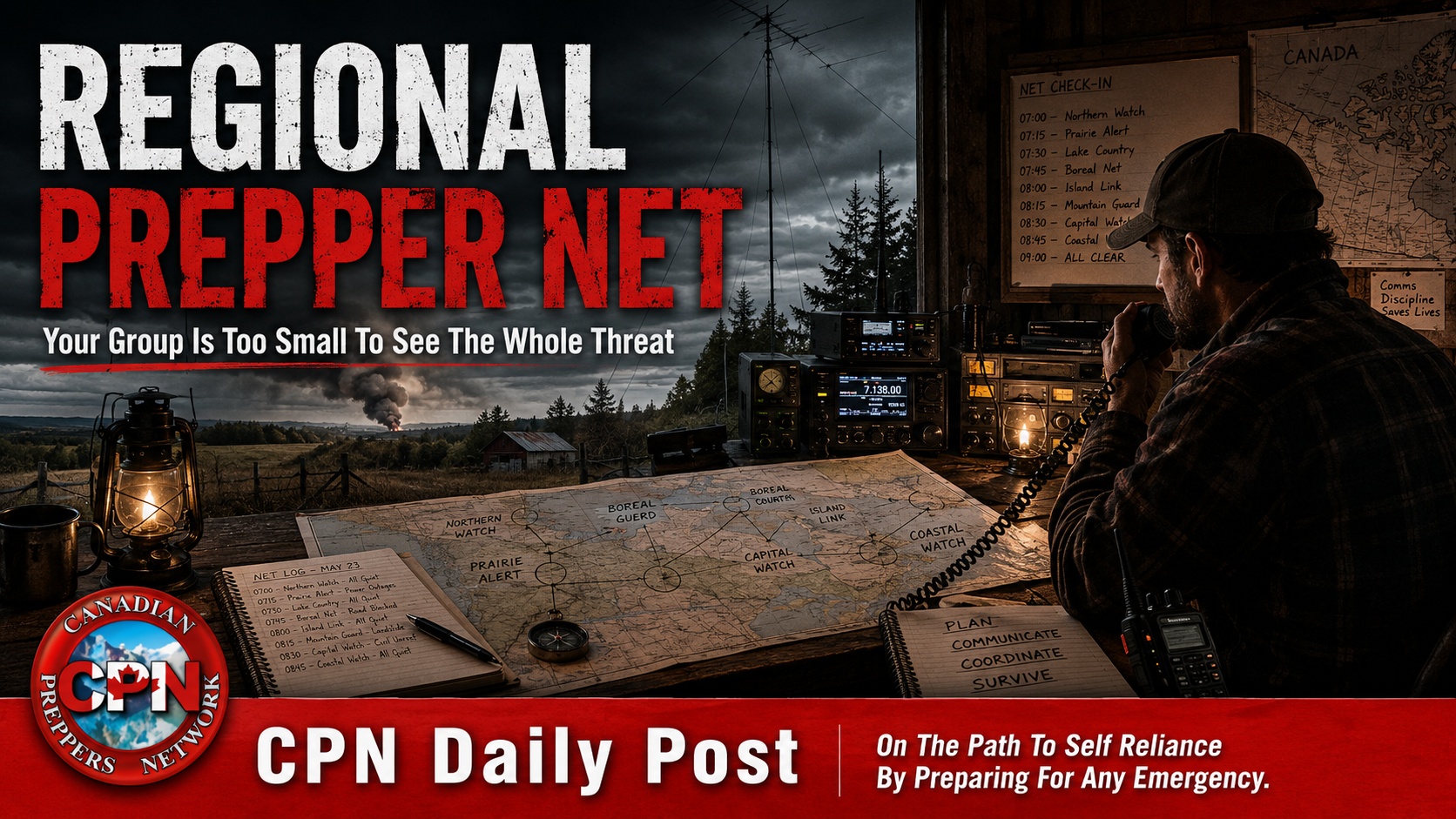
A regional net is not just voices on a radio. The real product is the map.
Every group should already have paper maps of its immediate area. Roads, bridges, trails, wells, watercourses, farms, woodlots, rail lines, hydro corridors, high ground, low ground, and choke points should be marked before they are needed. A good group knows its own area.
A regional net expands that picture.
Over time, reports from trusted stations begin to fill in the blank spaces. One group knows the north road is still passable. Another confirms that the west bridge is blocked. A third reports smoke coming from the old mill road. A fourth has lost contact with a farm that used to answer every dusk check-in.
That information changes decisions.
The map should be updated with simple, practical markings. Green areas are known friendly or functioning. Yellow areas are uncertain, changing, or unverified. Red areas are unsafe, blocked, burned, or actively problematic. Black areas are dead zones where no reliable information exists. Blue marks show water sources. Brown marks show farms, mills, workshops, woodlots, and livestock areas. Cross marks can identify medical skill, sick houses, or quarantine concerns. Bridges should be marked as intact, damaged, blocked, destroyed, or unknown.
This is not about creating panic. It is about replacing guessing with observation.
A regional net gives your group sight.
What Matters After The Stores Are Gone
A weak communications plan asks whether the store is open.
A serious long-collapse net asks different questions.
Is the bridge still standing?
Is the back road clear?
Is the old mill occupied?
Is the river ford usable?
Is there smoke south of the ridge?
Are strangers moving in groups?
Did the farm on the concession answer its scheduled check-in?
Is the clinic still manned?
Has anyone confirmed safe water east of town?
Are travellers still moving alone, or only in groups?
Which areas have stopped answering entirely?
Once the shelves are empty and the pumps are dry, the net stops caring about business hours. Nobody is reporting that the hardware store opened late. Nobody is asking about debit machines.
That world is gone.
The useful reports become older, harsher, and more physical. Roads. Bridges. Water. Smoke. Movement. Illness. Weather damage. Human behaviour. Contact lost. Contact restored. Route open. Route closed. Settlement organized. Settlement silent.
A mature regional net does not chase rumours of hidden supplies. It builds a living picture of survival conditions.
Bands Are Tools, Not Status Symbols
A regional prepper net should not choose bands because they sound impressive. Each band needs a job.
The question is not, “What radios do we own?”
The question is, “What kind of distance are we trying to cover, through what terrain, at what time of day, with what antennas, and with how much power?”
A proper net separates short-range property work from local ridge-to-ridge work, regional HF from night HF, and wider-area monitoring from daily group check-ins.
No single band does everything.
The band plan should be written down before it is needed. It should say which band is used for local property control, which band handles the main local net, which band is used for regional daytime coverage, which band is used at night, and which bands are only for monitoring or opportunity.
A radio collection is not a communications system.
A band plan is.
The Property Layer: Short-Range Handhelds
The first communications layer is the household, retreat, work-party, or farm layer.
This is where approved short-range handheld radios are useful. They are not magic, and they are not regional communications tools. They are for the close bubble around your own people.
Their job is simple.
A work crew at the woodlot checks in with the house. A gate watch calls back to the main building. A livestock chore team reports a problem. A vehicle moving between two nearby properties confirms arrival. A family group on foot stays together without shouting. A lookout alerts the house that someone is coming up the road.
This layer should use plain, short messages. It should not carry sensitive details. It should not become a chatter channel. It should not be expected to reach the next township.
Terrain will decide what these radios can really do. A handheld across an open field may work well. The same handheld in a hollow, behind a ridge, inside a vehicle, or inside a metal-sided building may be almost useless.
The rule is simple: test them where they will actually be used.
Test from the barn. Test from the garden. Test from the gate. Test from the road bend. Test from the woodlot. Test from inside the house during bad weather. Test with the actual people who will carry them.
This layer is for local control.
It is not the regional net.
The Road Layer: CB And Traveller Chatter
CB radio can still have a place in a collapse communications plan, especially around roads, convoys, rural movement, and people who already use it.
It should not be treated as secure. It should not be treated as organized. It should not be trusted without verification.
Its value is that it may pick up loose road information from people passing through an area. In normal times, that may be truckers, drivers, or local users. In a collapse, it may be travellers, scavengers, farmers, or people moving between settlements.
That makes CB useful for listening, but dangerous for oversharing.
A prepper group should not broadcast where it lives, what it has, how many people are present, or where it is moving. CB is best treated as a road-awareness tool, not a command channel.
Useful CB traffic might include blocked routes, downed trees, bridge trouble, smoke, abandoned vehicles, or movement on a road corridor. Even then, it should be logged as unconfirmed unless a trusted station verifies it.
In a regional net, CB belongs in the monitoring layer.
It tells you what strangers are saying.
It does not tell you what is true.
Two Metres: The Local Workhorse
Two metres is often the most practical amateur band for local and near-regional preparedness communication.
This is where a lot of useful work can happen. Equipment is common, antennas are manageable, and many radio operators already have some experience with it. In a collapse net, two metres should be treated as the main local amateur layer.
Its jobs include local group check-ins, farm-to-farm contact, ridge-to-valley communication, vehicle-to-base communication, relay work from high ground, and local simplex backup when larger systems are gone.
Two metres is not guaranteed. It is affected by terrain. It likes height. A station on a ridge may hear half the county. A station in a hollow may barely reach the next road. Trees, buildings, hills, weather, antenna height, coax loss, and radio power all matter.
The best two-metre station is usually not the person with the most expensive radio. It is the person with the best location, best antenna height, most reliable power, and most disciplined operating habits.
For base stations, a proper outside antenna changes everything. A dual-band vertical on a mast, roof mount, tower, or high outbuilding will usually outperform a handheld inside a kitchen. For vehicles, an external antenna should be considered mandatory. For field use, a roll-up J-pole or portable mast antenna can turn a weak handheld into a useful relay station.
Two metres should have a primary simplex frequency and a secondary simplex frequency. The net should practise without depending on established repeaters, because in this scenario the repeaters should be assumed down.
For a collapse net, two metres is where the daily local picture often begins.
Who answered the dawn check-in? Which road stations are still alive? Which relay can hear the valley? Which group needs to be contacted through a hilltop station? Which area has gone silent?
Two metres is not the whole net, but it may be the most important local layer.
This is where many people overestimate handheld radios. Real-world range is not the same as advertised range, especially in Canadian terrain, forest, hills, vehicles, and bad weather. For a more practical look at range expectations, see: How Far Can Your Radio Really Reach?
Seventy Centimetres: Shorter, Tighter, And Useful In The Right Place
Seventy centimetres is another common amateur band, often used with the same dual-band radios that cover two metres.
It should not simply be treated as “the same thing, but higher.” It behaves differently.
Seventy centimetres can work very well for short local paths, property-to-property links, compact field stations, and situations where clear line of sight exists. Its antennas are small, which makes it convenient for vehicles, portable kits, and temporary setups.
But it can be less forgiving in heavy terrain. Hills, dense forest, deep valleys, and poor antenna placement can punish it quickly. In a rural post-collapse net, seventy centimetres may be excellent between certain fixed points and weak between others.
Its best preparedness uses include backup local traffic, short-range station-to-station contact, portable relay work where line of sight is good, and moving routine side traffic off the main two-metre net.
That last point matters.
If the main two-metre net is handling check-ins, Net Control does not need two neighbouring stations tying it up while they sort out a local work party, water run, or road check. They can move to seventy centimetres, deal with the issue, then return with a clean report.
That keeps the main channel clear.
Seventy centimetres is a good tool. It is not always the best first tool.
Six Metres: The Sometimes Band
Six metres sits in an odd place. It is above HF but below the more familiar two-metre band. Some operators call it the magic band because, when conditions open, it can reach much farther than expected.
That is exactly why it should not be the backbone of a survival net.
Six metres can be useful between trained stations that have tested it properly. It can also surprise you during band openings. But fewer people have suitable equipment, fewer have good antennas for it, and its best behaviour is not always predictable.
For a regional prepper net, six metres is an optional specialist layer.
Its best use is experimentation between known fixed stations, especially stations with room for better antennas. If two retreat groups or homesteads can make reliable six-metre contact across difficult ground, that is worth knowing. If not, nothing critical should depend on it.
Use six metres as a bonus path.
Do not build the net around it.
220 MHz: Useful If Your People Actually Have It
The 220 MHz band can be useful, but it should be treated realistically.
Many preppers will not already own 220 MHz equipment. Many common handhelds and mobile radios are built around two metres and seventy centimetres instead. That makes 220 less useful as a first-choice regional net band.
However, lower popularity can also be an advantage among trained operators who intentionally build around it. A quieter band can be useful for a disciplined local net, provided enough stations have compatible equipment, antennas, and experience.
The key phrase is “provided enough stations.”
A band that only one person can use is not a net. It is a private hobby.
For most groups, 220 MHz belongs in the optional layer. It may be valuable for a local cell, a specialist relay, or a backup path between known stations. It should not replace two metres or HF in the basic plan.
Forty Metres: The Daytime Regional Band
Forty metres is one of the most important HF bands for a regional prepper net.
This is where the net reaches beyond the local line-of-sight bubble without needing a repeater. That matters when hills, valleys, forest, distance, or dead infrastructure cut local stations off from each other.
For regional preparedness, forty metres is often associated with NVIS-style communication. NVIS stands for Near Vertical Incidence Skywave. Instead of trying to send a signal low toward the horizon for long-distance contacts, the antenna sends much of the signal upward so it comes back down over a closer regional area.
That is exactly what many prepper groups need.
They are not trying to talk across the ocean. They are trying to reach the next valley, the next county, the retreat group north of the river, or the station beyond the ridge that VHF cannot reach.
Forty metres is often most useful during the day and into early evening, depending on conditions. It should be tested locally because soil, season, antenna height, solar conditions, noise, and time of day all matter.
For a regional net, a forty-metre dipole should be treated as core infrastructure.
It does not have to be fancy. It does have to be measured, raised, tested, documented, and repairable. A low dipole may be more useful for regional NVIS-style work than a high antenna designed only for distant contacts.
The forty-metre job list is straightforward: daytime regional check-ins, contact beyond VHF terrain blocks, county-to-county information sharing, backup when established repeaters are dead, regional relay between distant local cells, and wider mapping of which settlements and groups are still answering.
Forty metres should be part of the midday and dusk net plan.
If the stores are gone, the fuel is gone, and travel is risky, forty metres may be how you learn what is happening beyond walking distance.
For readers who want to understand regional HF coverage in more detail, especially the difference between long-distance radio work and near-regional coverage, this companion article goes deeper into the NVIS concept: Using Ham Radio NVIS For Reliable Regional Communications.
Eighty Metres: The Night Regional Band
Eighty metres matters because collapse does not stop at sunset.
In fact, the dusk and night periods may become the most important times to know what is happening. Groups are locking down. Road movement becomes harder to see. Smoke, weather, cold, noise, and human movement all change after dark.
Eighty metres can be valuable for evening and overnight regional contact. It often supports shorter regional paths at night when forty metres may stretch longer or behave differently.
The downside is antenna size. Eighty-metre antennas are physically longer, harder to fit on small properties, and more demanding to install well. The band can also be noisy, especially in storm season or electrically noisy areas.
That does not make it optional for serious groups. It means it must be planned.
A group with land should test an eighty-metre dipole, inverted-V, or other wire antenna before it is needed. A group without room for a full-size antenna may need to experiment with compromises, but compromises must be tested honestly. Do not assume a shortened antenna will do the job just because it tunes.
Eighty metres is for dusk and night regional nets, late check-ins from outlying stations, contact with groups that could not be reached on VHF, night relay attempts after missed local contacts, winter evening nets when darkness comes early, and longer regional picture updates when the day’s reports are collected.
In a long collapse, the dusk net may become the most important net of the day.
Eighty metres may become one of the most important bands in the system.
Twenty Metres: Wider Awareness, Not Local Control
Twenty metres is useful, but it should not be misunderstood.
For a prepper group, twenty metres is usually not the band for local control. It is better understood as a wider-awareness band. When conditions are favourable, twenty metres can reach much farther than the immediate region.
That makes it useful for listening and broader contacts, but less useful for calling the farm across the valley.
In a post-collapse setting, twenty metres may help a group understand what is happening outside its own region. Are other provinces still active? Are distant operators reporting the same outage? Are there signs that the disruption is local, regional, national, or continental? Are distant stations still organized?
That sort of information may not tell you whether your own bridge is passable, but it helps frame the scale of the disaster.
Twenty metres belongs in the monitoring and wider-awareness layer.
Do not use twenty metres as the main daily survival net for nearby groups unless testing proves it works for that purpose. For most regional prepper nets, forty and eighty metres will matter more for practical close-in HF coverage.
Ten Metres: Excellent When Open, Unreliable As A Backbone
Ten metres can be spectacular when conditions are good. It can also be dead when conditions are poor.
That makes it useful, but not dependable enough to serve as the backbone of a regional prepper net.
Ten metres may be worth monitoring during periods of strong solar activity or when operators notice the band opening. It can provide longer-distance contacts with modest antennas when conditions cooperate. But a group should not schedule its critical local survival net around a band that may not be there when needed.
Use ten metres for opportunity.
Do not use it for dependency.
Listening Bands: Not Everything Requires Transmitting
A regional net should also have listening assignments.
Some stations should spend more time receiving than transmitting. Listening uses less power, creates less exposure, and helps build the map without clogging the net.
Listening posts may monitor local AM/FM broadcast while it still exists, shortwave broadcast for wider context, known amateur nets, CB road chatter, and direct field observations from work crews and road scouts.
The listening post does not repeat everything it hears.
It filters.
It asks: Is this useful? Is it verified? Is it direct observation? Is it rumour? Does it affect movement, water, security, fire, illness, weather, or contact with trusted groups?
A listening post should bring clean information to the scheduled net, not dump noise into the system.
Match The Band To The Message
The net should decide which band carries which kind of message.
A gate check does not belong on HF.
A regional bridge report does not belong only on a handheld.
A rumour from a road traveller should not be treated the same as a direct report from a trusted station.
A missed check-in from a retreat group may begin on two metres, move to a relay station, and then be carried into the dusk HF net if the silence continues.
A water warning may begin as a local observation, then move to the wider net if illness appears in more than one area.
A smoke column may be reported by a lookout on a property radio, confirmed by a ridge station on two metres, and mapped regionally during the evening net.
That is how layers work.
The local layer sees. The VHF/UHF layer connects nearby stations. The HF layer reaches past the terrain. The listening layer adds context. The logger turns all of it into a map.
Without that structure, everyone is just talking.
With it, the region starts to come into focus.
Assume The Repeaters Are Down
In normal times, repeaters are useful. They sit on towers, hills, buildings, and commercial sites. They extend range. They let small stations reach farther than they could on their own.
But this article is not about normal times.
In a long collapse, assume the repeaters are gone.
Some may stay alive for a while. A few may have battery backup, solar support, or dedicated operators keeping them on the air. But no survival communications plan should depend on someone else’s tower, someone else’s battery bank, someone else’s locked equipment shelter, or someone else’s ability to reach the site.
A fixed repeater depends on too many fragile things.
It depends on power. It depends on access. It depends on batteries. It depends on antennas surviving weather. It depends on coax, controllers, filters, and hardware. It depends on people still being able to maintain it. It may depend on internet links, remote controls, or infrastructure that has already failed.
Even if a repeater survives, it may become crowded, monitored, jammed with useless chatter, or taken over by people who have no discipline. A wide-area repeater that was helpful in normal times may become a liability when every frightened, bored, angry, or desperate voice in the region discovers it is still working.
For a post-collapse net, repeaters are a bonus while they last.
Simplex is the foundation.
Simplex Comes First
Simplex means direct station-to-station communication without a repeater.
It is less impressive, but more reliable because the path either works or it does not. There is no hidden infrastructure pretending to solve your problem. If North Ridge can hear East Hill directly, that path belongs to the net. If Valley Farm can only reach Net Control through a relay, that weakness needs to be known and written down. If South Road disappears whenever the leaves are on the trees, that is not a theory. That is a tested failure.
Every group should map its simplex paths before trouble starts.
Who can hear Net Control? Who needs a relay? Which ridge covers the valley? Which station can reach both east and west? Which mobile station becomes useful when parked on high ground? Which household is invisible unless it raises a better antenna?
Simplex testing builds the real coverage map.
Repeaters can hide weak planning. Simplex exposes it.
That is exactly why it matters.
Human Relays Before Machine Relays
Before building any field repeater, build the human relay plan.
A disciplined human relay station is often more useful than a machine. A relay operator can hear one station, pass the message to another, ask for clarification, mark uncertainty, and decide whether the message is worth moving immediately or holding for the next scheduled net.
Machines repeat everything.
Good operators repeat what matters.
For example, Valley Farm may not reach Net Control directly. But Valley Farm may reach East Hill. East Hill may reach Net Control. In that case, East Hill becomes the relay.
That path should be logged:
Valley Farm to East Hill.
East Hill to Net Control.
Reliable at dawn and dusk.
Weak at midday.
Requires outside antenna.
Alternate relay: North Ridge.
That is real communications planning.
A human relay can also move. A truck parked on a hilltop, a foot team on a ridge, or a temporary station on high ground may solve a coverage problem for one check-in window without leaving equipment exposed.
In a post-collapse region, a reliable person with a radio, notebook, good antenna, and known high point may be worth more than a repeater nobody can repair.
Hand-Built Field Repeaters Have A Place
A long-collapse net may eventually deploy small, simple, hand-built field repeaters.
These should not be treated as magic. They are not there to recreate the modern repeater network. They are there to solve one specific problem.
A field repeater might cover one valley. It might link three trusted farms. It might bridge a dead zone between two ridges. It might support a road corridor during a movement window. It might let low-power stations reach Net Control during the dawn and dusk nets. It might be deployed only when needed, then recovered before it becomes a target.
Small is better than impressive.
A huge wide-area machine may sound attractive, but it also attracts attention, noise, abuse, and problems. A small low-power relay with a clear job is often more valuable. It serves the net without announcing itself to half the region.
The question is not, “How far can we make this thing reach?”
The question is, “What exact gap does this relay close?”
If nobody can answer that clearly, do not build it.
A Field Repeater Is Infrastructure
A hand-built repeater is not just a radio in a box.
It needs power. It needs an antenna. It needs weather protection. It needs concealment or protection from theft and damage. It needs a known location. It needs a recovery plan. It needs spare parts. It needs someone capable of fixing it. It needs a schedule so it is not transmitting endlessly for no reason.
Power is the weak point. A repeater that dies after one night is not infrastructure. A battery system must be sized honestly. Solar charging must be tested in bad weather, not just on a perfect summer afternoon. Cables, fuses, connectors, charge controllers, and battery condition all matter.
The antenna is the other weak point. A poor antenna on a great radio is still a poor station. A modest radio on a well-placed antenna can be extremely useful.
The field repeater should be treated like a cache, a tool, and a liability all at once.
It can help the net see farther.
It can also be found.
Keep Field Repeaters Temporary When Possible
A permanent repeater site may not be realistic in a collapse. It needs protection, maintenance, power, and access. A temporary relay may be more practical.
Deploy it for a dusk net. Use it during a road movement. Place it on a ridge for a scheduled regional check. Run it during a storm recovery window. Recover it when the job is done.
Temporary systems are harder to depend on, but easier to protect. They also force the net to stay disciplined. The relay exists for a purpose and a window, not for endless chatter.
A good collapse net does not need constant radio traffic.
It needs predictable windows, short reports, and reliable paths.
The Repeater Priority Order
The regional net should plan communications in this order:
First, direct simplex contact.
Second, human relay stations.
Third, mobile or portable relays from known high ground.
Fourth, small field repeaters built for specific coverage gaps.
Fifth, existing repeaters only while they remain available.
That order keeps the net honest.
If a surviving repeater is available, use it carefully. If it fails, the net should not collapse with it.
The goal is not to say, “There is a repeater nearby, so we have communications.”
The goal is to say, “We can operate without repeaters. If one survives, good. If we need a small field relay, we know where it goes, how it is powered, who maintains it, when it operates, and what problem it solves.”
The Radio Is Not The Plan. The Antenna Is The Plan.
Preppers love buying radios. Fewer love building antennas, testing range, logging results, and solving power problems.
That is backwards.
A handheld radio with a poor antenna inside a house is a short-range convenience tool. A modest radio connected to a good outside antenna can become a serious station. A mobile radio in a vehicle with a proper external antenna is far more useful than a handheld sitting in a cup holder. A simple wire antenna, properly cut and raised, may do more for HF communication than a more expensive radio attached to a bad compromise.
For VHF/UHF base stations, a dual-band vertical mounted as high as practical is a major upgrade. It should have decent coax, weatherproofing, strain relief, and a power plan that does not depend entirely on the wall outlet.
For vehicles, an outside antenna should be considered mandatory if the vehicle is part of the net. A convoy or road scout that cannot reach anyone beyond the next bend is not providing much value.
For portable VHF/UHF work, a roll-up J-pole, slim-jim, small mast, or throw-line antenna can turn a weak field station into something useful.
For HF, serious groups should test simple wire antennas before they need them. A 40-metre dipole for regional daytime work. An 80-metre dipole for night. An end-fed or random wire with a tuner as a compromise field setup. Spare wire, insulators, cordage, coax, connectors, tape, fuses, a throw line, and a way to raise the antenna without powered equipment.
Every station should have an antenna map.
That means a written note showing where the antenna goes, which tree or mast supports it, which direction it runs, which coax is used, what band it works on, and what results were achieved during past tests. In a long-term emergency, the regular radio operator may be sick, injured, away from the property, or exhausted. Someone else should be able to read the notes and put the station on the air.
The antenna system should be repairable with hand tools.
If the plan depends on delicate gear, proprietary parts, perfect weather, and the one person who remembers how it all goes together, it is not a plan. It is a hobby station pretending to be infrastructure.
That is why antenna knowledge matters as much as radio choice. A simple, repairable antenna system can turn a weak station into a useful station, while a poor antenna can cripple expensive equipment. For practical VHF/UHF antenna options, see: DIY UHF/VHF Ham Radio Antennas: A Practical Guide.
Assign Real Roles
A net without roles becomes noise.
The first role is Net Control. This station opens the net, calls stations in order, controls the pace, asks for relays, handles priority traffic, keeps reports short, and closes the session.
The second role is Alternate Net Control. This station must be able to take over if the primary station is off the air. Ideally, it should not be in the same house, same road, same town pocket, or same power failure zone as the primary.
The third role is Relay Stations. Relays are chosen by geography and signal path, not popularity. North, south, east, and west is a simple beginning. In rough terrain, ridges and high ground matter more than friendship. A quiet operator on a good hill may be more valuable than a loud operator with expensive equipment in a bad location.
The fourth role is Listening Posts. These stations monitor assigned sources and report useful information at the proper time. One may monitor local broadcast. One may monitor amateur traffic. One may collect reports from work crews or road scouts. One may compare weather and fire conditions. The goal is to avoid everyone chasing the same rumour.
The fifth role is Logger. This person writes things down. Station, time, report, source, confidence level, follow-up required. Stress destroys memory. Paper preserves the picture.
A net does not need dozens of people to begin. Three to five reliable stations in different directions are enough to start. Reliability matters more than numbers.
Set Check-In Times Before The Collapse
A net fails when people do not know when to listen.
Random calling burns power, creates confusion, and encourages people to talk too much. A disciplined net uses windows.
In normal times, start with a monthly full regional check. Same day, same time, same order. First Sunday of the month at 1900 local is a simple example. Keep it short. Who is present? Who is absent? Who can hear whom? What failed? What needs repair?
A weekly local cell check is also useful. This can involve only nearby stations testing direct communication, relay paths, battery status, and operator discipline.
Quarterly, run a no-grid drill. No wall power. No internet lookup. No cellphone coordination. Radios on battery, vehicle, solar, or generator. Antennas deployed as they would be during a real outage. This is where the embarrassing failures show up, which is exactly why the drill matters.
During a long-term emergency, move to survival windows.
The dawn window is for morning status. Who made it through the night? Any smoke, movement, damage, sickness, missing people, failed contacts, or urgent needs?
The midday window is for scouts, work crews, water parties, and listening posts. What was seen? Which roads are passable? Which routes are no longer safe? Which water sources are still usable? Which stations need relay attempts?
The dusk window may become the most important net of the day. Groups report before night movement becomes more dangerous and visibility drops. The region gets one last shared picture before households lock down.
The night HF window is for wider contact. Stations with the right equipment, antennas, and skill attempt longer regional or provincial contact when conditions may be more favourable.
A simple emergency schedule could look like this:
0700 to 0715 local: dawn status net
1200 to 1215 local: midday field report net
1900 to 1930 local: dusk regional picture net
2130 to 2200 local: HF wider-area window
The times are less important than the habit. Everyone knows when to listen. Everyone knows when to conserve power. Everyone knows when the next chance to pass information will come.
There should also be a fallback rule.
If there is no contact on the primary frequency after five minutes, move to the secondary. If there is still no contact after ten minutes, relay stations attempt contact. If that fails, log the missed station and try again at the next window.
Do not fill the air with panic calling.
Groups that already understand amateur radio emergency nets will have an easier time building disciplined regional check-ins. The goal is not endless chatter. The goal is structure, timing, logs, and useful reports. For more on that foundation, see: Amateur Radio Emergency Nets In Canada.
Use A Fixed Report Format
Loose chatter is where useful information goes to die.
Every report should follow the same structure:
Station. Area. Time. Observation. Source. Confidence. Action needed.
For example:
North Ridge. 0708. No contact from Mill Road group for second scheduled window. Smoke visible in that direction since dawn. Source is direct observation. Confidence medium. Request relay attempt from East Hill.
West Line. 1214. South bridge blocked by dead vehicles and debris. No visible movement. Source is direct scout report. Confidence high. Mark route closed.
East Hill. 1902. Three unknown travellers seen moving north along rail bed. No contact made. Source is direct observation. Confidence high. Monitor only.
River Bend. 2136. Water illness reported at two households using creek water. Source is trusted local contact. Confidence medium. Recommend boil and filter warning to all stations.
That format does several things.
It keeps people short. It separates observation from rumour. It tells the group how much confidence to place in the report. It identifies whether action is needed. It creates a clean written log.
A good net does not hide uncertainty. It labels it.
Direct observation is strongest. Trusted second-hand information is useful but weaker. Rumour may be worth logging, but it must be marked as unconfirmed. A rumour can point toward a real problem, but it should not be treated as fact until verified.
In a collapse, bad information can be as dangerous as no information.
Comms Discipline Keeps The Net Alive
The most dangerous person on a regional net is not always the person with the weakest signal. It is often the person who talks too much.
A serious net needs rules.
No stockpile details.
No exact retreat addresses.
No medical vulnerabilities.
No group strength reports.
No unnecessary names.
No arguments on the air.
No speeches.
No dramatic speculation.
No pretending rumour is fact.
Plain language is enough. Brevity is enough. A structured report format is enough.
The goal is to pass useful information without exposing the people behind it.
A regional prepper net should not become a gossip net, a panic net, or a bragging net. If someone cannot stop talking about what they own, where they are, how many people they have, or what they plan to do, they are a liability.
The discipline is simple:
Transmit what helps the region understand conditions, and nothing more.
Choose Stations By Geography And Character
Not every prepared person belongs in the core net.
The net should be built around geography, reliability, skill, and discretion. A trusted homesteader on high ground with a simple station may be more useful than a gear collector in a poor location. A farmer who can see a regional road may be more valuable than someone with a radio room full of equipment but no discipline. A quiet operator who checks in every month is worth more than a loud one who only appears when things get exciting.
Good stations are placed where they can see or hear something useful.
High ground. Rural crossroads. River crossings. Bridge approaches. Old rail beds. Road junctions. Valley exits. Areas near farms, mills, workshops, clinics, churches, or water sources. Locations that naturally become choke points when fuel is gone and travel slows down.
The best net is not built around the most talkative people.
It is built around the people who show up, follow procedure, tell the truth, and know when to stop transmitting.
Start Small And Test For Real
The first exercise should be simple.
Choose five stations in different directions. Assign one as Net Control and one as Alternate Net Control. Choose a primary local band, a backup local band, and an HF window for stations that can use it. Set a Sunday evening check-in. Run it for fifteen minutes.
Each station reports only five things:
Local power status.
Road or route condition.
Smoke, fire, weather, or damage observed.
Known contact failures.
Equipment issues.
Net Control logs every report.
Afterward, compare notes. Who could hear whom? Which station needed a relay? Which antenna failed? Which operator was hard to understand? Which location had no coverage? Which part of the map remained blank?
Then fix one thing before the next test.
Do not try to build a province-wide network in one weekend. Do not invite everyone at once. Do not turn the first session into a two-hour radio club meeting. Build the net the way you would build any other preparedness system: small, tested, documented, repaired, and expanded carefully.
Trust is built slowly.
A regional prepper net should share information, not dependency. Each group remains independent. Each group keeps its own supplies, its own security, its own decisions, and its own responsibility.
The net simply helps those groups avoid operating blind.
A regional net also depends on relationships built before everything fails. Radio contact is only useful when the people on the other end are already known, trusted, and tested. That makes relationship-building with other groups part of the communications plan, not a separate issue: Establishing Relationships With Other Survival Groups.
Recommended Net Kit
Training comes first. Practice comes first. But equipment still matters.
A serious regional net should think in systems, not gadgets.
For the local layer, handheld radios, spare batteries, charging cables, laminated channel cards, and simple headsets can support property and work-party communication.
For the VHF/UHF layer, a proper mobile or base radio, external antenna, quality coax, backup power, and printed band plan are more useful than a drawer full of cheap handhelds.
For the HF layer, a capable HF radio, tuner if needed, 40-metre and 80-metre wire antennas, insulators, coax, cordage, throw line, spare connectors, fuses, and a printed antenna plan should be considered core equipment.
For field relays, think small and repairable. Battery box, solar charging, weather protection, spare cables, fuses, connectors, multimeter, mounting hardware, and recovery plan all matter more than making the system look impressive.
For the operator, paper is essential. Waterproof notebook, pencils, map case, laminated report format, printed contact schedule, and paper maps should be treated as communications gear.
In a long collapse, the most important accessory may not be electronic at all.
It may be the logbook.
Regional Net Buying Box
Disclosure: As an Amazon Associate, Canadian Preppers Network may earn from qualifying purchases.
A regional communications net is not built with one radio. It is built in layers: local handhelds, mobile/base stations, antennas, power, paper logs, and field repair supplies. Start with the layer your group can actually practise with, then build outward.
Local Property & Work-Party Layer
FRS Two-Way Radios
Two-Way Radio Headsets
Rechargeable AA Batteries And Charger
VHF/UHF Station Building
Dual-Band Mobile Radios
Dual-Band VHF/UHF Base Antennas
Roll-Up J-Pole Antennas
50 Ohm Coax With PL-259 Connectors
HF Regional Net Layer
40 Metre Dipole Antennas
80 Metre Dipole Antennas
Antenna Tuners
Portable Antenna Masts
Off-Grid Radio Power
12V LiFePO4 Batteries
12V Solar Charge Controllers
12V Battery Boxes
Digital Multimeters
Logging, Maps & Field Notes
Waterproof Notebooks
Map Cases
Laminating Pouches
Grease Pencils
For a broader communications gear overview, see the CPN guide here:
Emergency Communications Buying Guide
Final Thought
Your group may have food.
Your retreat may have water.
Your people may be trained, disciplined, and capable.
But if you do not know what is happening beyond your road, you are still isolated.
Isolation feels safe at first. Then it becomes dangerous. You do not know which roads are gone. You do not know which neighbours are still holding. You do not know which areas have gone silent. You do not know whether the smoke on the horizon is moving toward you or away from you.
A regional prepper net does not save you by itself.
It does not replace local security. It does not replace food storage. It does not replace medical training. It does not replace judgement.
It gives you sight.
And after the stores are looted, the pumps are dry, the phones are dead, the repeaters are silent, and the official voices have gone quiet, sight may be the difference between holding your ground and walking blind into the next disaster.
The time to build that net is now, while radios can still be tested, antennas can still be raised, operators can still be trained, and mistakes are still cheap.