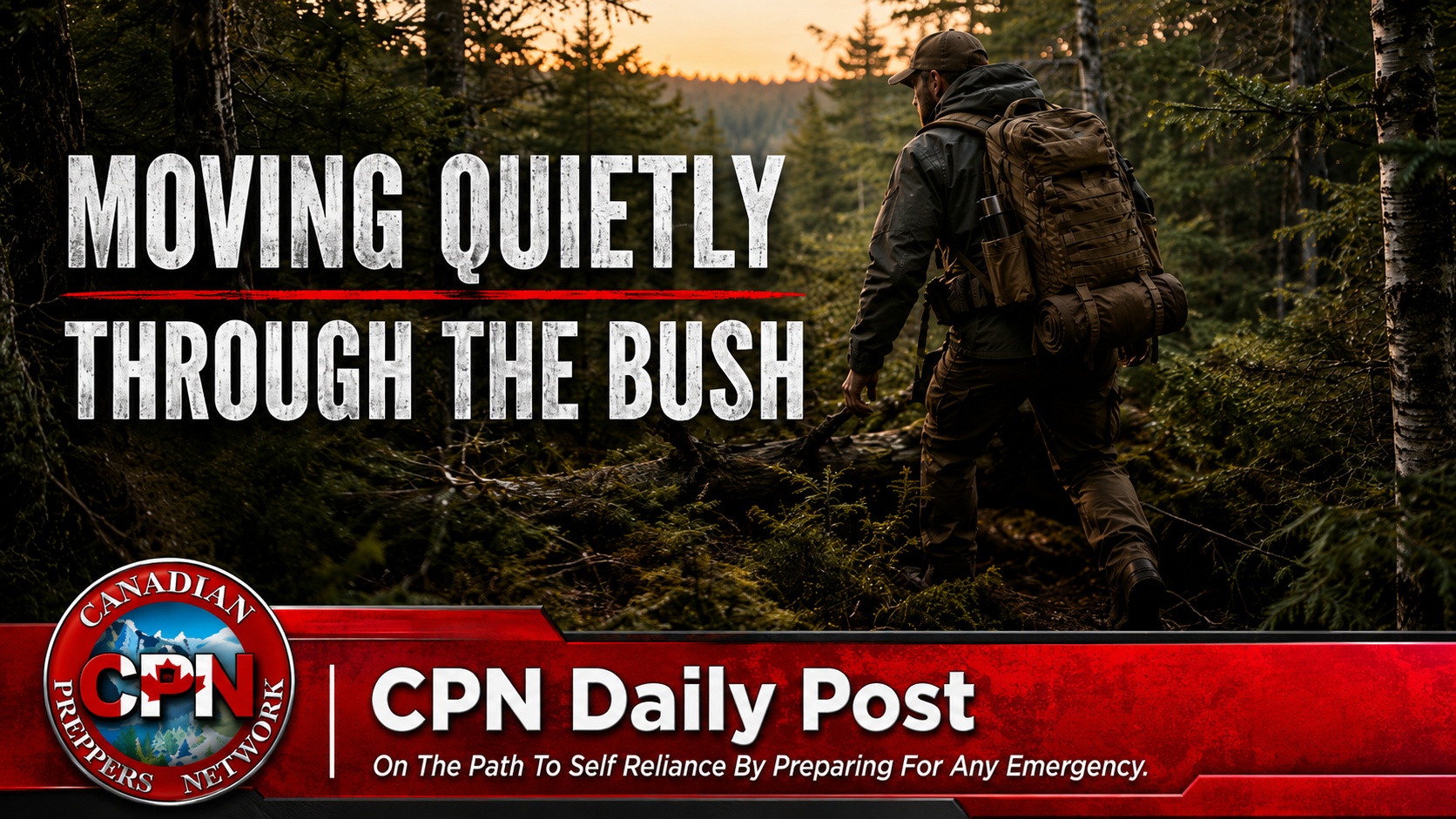
Low-profile wilderness travel is not about sneaking around. It is about moving carefully enough that the land, the weather, and your own bad habits do not give you away.
In a long-term emergency, movement becomes one of the most underrated risks.
Not because every trip through the bush is dramatic. Not because every tree line hides danger. Not because preppers should imagine themselves living in some endless action movie. The danger is much simpler than that.
People get tired. They get careless. They get loud. They choose bad routes. They push too hard after dark. They break branches, slip on wet rock, twist ankles in deadfall, lose direction, leave obvious tracks, and burn more energy than the trip was worth.
Low-profile wilderness travel is the opposite of that.
It is the skill of moving through wild ground without making unnecessary noise, causing unnecessary damage, or drawing unnecessary attention to your route. It is also the skill of arriving with enough strength, awareness, and control to be useful when you get there.
For Canadian preppers, this is not a small thing. Our terrain can be punishing. Thick bush, swamp edges, logging cuts, black spruce, alder tangles, rocky ridges, snow crust, ice, muskeg, blowdown, steep gullies, and wet cedar lowlands all have their own way of slowing people down. A person who tries to force a straight line through that country will often make more noise, burn more energy, and leave more sign than someone who takes the time to read the land first.
Quiet movement begins before the first step.
For readers building this skill into a broader plan, it fits naturally into the larger Wilderness Skills in Canada preparedness category. It also connects closely with navigation, communication discipline, first aid, and the way a group makes decisions under stress.
The Bush Punishes Hurry
The biggest mistake people make in the woods is trying to move faster than the terrain allows.
Speed feels productive. It gives the illusion of control. In reality, haste is noisy. Haste snaps branches. Haste drags packs across brush. Haste makes people step on loose rock, splash through wet ground, and push through cover instead of flowing around it.
A rushed person looks at the destination. A disciplined traveller looks at the next ten metres.
That difference matters.
Low-profile movement is not necessarily slow, but it is controlled. The pace should be steady enough to avoid constant stops, but careful enough that every person in the group can maintain it without stumbling, breathing heavily, or falling behind. Once a group starts stretching out, talking more, and crashing through brush to catch up, its profile rises fast.
The goal is not to creep along dramatically. The goal is to move at a pace the land will allow.
In open hardwoods, that may be a normal walking pace with careful foot placement. In thick spruce or wet alder, it may mean slowing down, choosing openings, and accepting that the straight route is not the best route. On steep ground, it may mean angling across the slope instead of grinding straight up or sliding straight down.
The bush does not care about your schedule. It rewards patience and punishes pride.
Read the Terrain Before Entering It
A low-profile traveller does not simply step into the bush and hope for the best. He pauses, reads the ground, and chooses a line.
That line may not be the shortest route. In fact, it often is not. The best route is usually the one that allows steady movement with the least noise, least damage, and least risk.
Dense brush looks like cover, but it can also be a trap. It catches packs, scrapes clothing, breaks twigs, and forces people to push through with their hands. Open ridges may be easier walking, but they can expose movement against the skyline. Creek beds may offer direction, but wet rock, mud, and tangled banks can slow travel and leave obvious signs. Old logging roads may be convenient, but they are also predictable corridors.
Low-profile movement is a constant trade-off.
You are looking for natural lanes: open hardwood patches, animal trails, firm ground beside wet areas, gradual slopes, old cut lines that have grown in enough to break visibility, and transitions where one type of terrain meets another. Edges can be useful, but they must be read carefully. A treeline beside a field may offer concealment from one direction while making movement obvious from another.
In summer, sound carries differently through leafy bush than through open ground. In winter, frozen snow can betray every step. After rain, wet leaves may quiet the forest floor, while soaked clothing and cold hands can reduce dexterity and decision-making. Dry autumn leaves can turn every footstep into a signal. Spring melt can make low ground miserable and loud.
The route should be chosen for the conditions that exist, not the conditions you wish existed.
This is why basic navigation tools still matter. Phones and GPS units are useful while they work, but they can also encourage straight-line thinking. A map, compass, and the habit of reading terrain keep the traveller connected to the ground instead of staring at a screen. The Wilderness Skills Buying Guide covers this kind of low-tech wilderness equipment in more detail.
Noise Discipline Is Mostly Boring
Real noise discipline is not dramatic. It is mostly small, boring habits done consistently.
Secure loose gear before moving. Buckles, metal cups, zippers, tools, keys, and hard plastic items can all tap, rattle, or scrape. A pack that sounds fine in the garage may sound ridiculous once branches start brushing against it. Anything hanging loose should be tied down, wrapped, moved inside the pack, or removed.
Clothing matters too. Some synthetic fabrics are loud against brush. Some rain gear makes a constant swish. Velcro is useful until someone opens it in quiet timber. Bright colours may be excellent for hunting season safety, but they are not always the right choice for every kind of low-profile travel. The point is not to dress like a costume. The point is to wear clothing that suits the terrain, weather, and purpose.
Footwear matters even more. Heavy boots have their place, especially in rough country, but stomping is a habit, not a requirement. A careful foot rolls onto the ground. It does not crash down. Step on solid surfaces when possible. Avoid loose sticks, hollow logs, dry bark, ice crust, and unstable rock. When the ground is noisy, shorten the stride and place the foot more deliberately.
Hands should help manage brush. Do not let branches slap back into the person behind you. Ease them aside and release them gently. Better yet, avoid pushing through brush that will fight you. Moving around a noisy patch often costs less time than forcing your way through it.
Talking should be limited, not because every word is dangerous, but because talking encourages carelessness. People who talk while moving pay less attention to their feet, their spacing, and the ground ahead. In a group, simple hand signals and planned pauses are often enough.
Most low-profile movement is not about one impressive trick. It is about removing a hundred small sources of unnecessary noise.
Group Movement Requires Discipline
One person can move quietly through the bush with practice. A group is much harder.
Groups create rhythm, noise, and confusion. One person stops and three others bunch up. Someone steps on a branch because they were watching the person ahead instead of the ground. A pack snags. Someone whispers too loudly. Someone loses sight of the line of travel and cuts a corner through noisy cover.
The larger the group, the more discipline matters.
Spacing should be wide enough that people are not constantly bumping, whispering, or being hit by branches, but close enough that visual contact is maintained. The terrain will decide the exact distance. Thick bush may require tighter spacing. Open timber may allow more room.
The lead person should not be the fastest walker. The lead person should be the best route reader. That person sets the line, avoids bad ground, and keeps the group from being pulled into noise and exhaustion. The last person should be reliable as well, because the rear of the group is where dropped gear, fatigue, and spacing problems often show up first.
Stops should be deliberate. Do not stop in exposed openings, wet depressions, trail intersections, or places where the group blocks itself. When resting, step off the obvious line of travel, stay quiet for a moment, and actually listen. Many people are so used to constant noise that they forget how much information the bush gives them when they stop moving.
A group that cannot stop quietly usually cannot move quietly either.
This is also where communications planning matters. Radios, whistles, phones, and signals all have a place, but they need agreed procedures before anyone is already separated or confused. The Communications in Canada hub is a useful companion piece for building that layered approach.
The Straight Line Is Often the Loudest Line
Modern people are trained by roads, maps, and GPS screens to think in straight lines. The bush does not work that way.
A straight line through bad terrain can become a loud, exhausting mess. It can force travel through deadfall, across wet ground, through thorn patches, or over steep slopes that could have been avoided with a wider arc.
Low-profile travel often means bending the route.
Following the contour of a hill may be quieter than climbing directly over it. Skirting the edge of a swamp may be better than cutting across it. Using open timber below a ridge may be better than walking the top. Moving through shadow and broken background may be better than crossing open ground in full view.
This is where old-fashioned navigation skills matter. A compass, map, terrain association, and memory of landmarks can keep a person from becoming dependent on the straight-line pull of electronics. Even when GPS works, it can encourage bad decisions. A screen may show the destination as close while hiding the miserable ground between here and there.
Good movement is not just about knowing where you are going. It is about choosing how to get there without letting the route punish you.
Avoid Making the Land Talk About You
Every passage through the bush leaves some sign. The question is how much.
Low-profile travel reduces unnecessary disturbance. That means avoiding broken branches where possible, not cutting live vegetation unless there is a serious reason, not trampling soft banks, not leaving food wrappers or tape scraps, not dragging gear through moss, and not making repeated trips along the exact same line until a visible path forms.
In wet ground, tracks can last. In snow, they can be obvious from a distance. In dry leaves, a line of scuffed ground can show where people passed. On moss, a careless boot can leave a clear mark. On slopes, sliding feet can scar the route.
This does not mean a person should become obsessive or impractical. In real emergencies, getting through safely matters more than leaving no trace at all. But there is a difference between unavoidable sign and sloppy sign.
Sloppy sign is broken branches at chest height because someone forced through brush. It is flagging tape left behind because nobody bothered to remove it. It is a fire ring in an obvious place. It is trash tucked under a log. It is repeated shortcuts that become trails. It is camp noise, bright light, and careless movement around a rest area.
A disciplined traveller does not treat the bush like a disposable hallway.
Water, Rock, and Deadfall Are Noise Traps
Certain terrain features deserve extra caution because they create noise and injury at the same time.
Rocky ground can be loud underfoot, especially when loose stones shift. Wet rock is worse because one bad step can cause a fall. A person trying to move quietly across rocks often becomes stiff and slow, which increases fatigue. It is usually better to choose fewer, more solid steps than to dance quickly across unstable ground.
Deadfall is another problem. It looks like a shortcut until boots start cracking punky wood and legs start dropping between hidden gaps. Climbing over deadfall is tiring. Crawling under it is awkward. Packs snag. Branches snap. Ankles twist. In many cases, it is better to detour around a heavy blowdown than to fight through it.
Water crossings require patience. Splashing through shallow water may seem simple, but wet boots change the rest of the day. Muddy banks hold tracks. Loose stones roll underfoot. In cold conditions, a wet crossing can become a serious problem long after the crossing itself is over.
Low-profile movement is not only about being quiet. It is about refusing to let the terrain turn a minor obstacle into a major injury.
This is where the connection to first aid becomes obvious. A twisted ankle, blister, cut hand, or cold-related problem can change the entire rhythm of a group. The Medical & First Aid in Canada hub is worth reviewing alongside any wilderness travel plan.
Night Movement Is Usually Overrated
Night movement sounds useful in theory. In practice, it is often slow, hazardous, and noisy.
Depth perception gets worse. Foot placement suffers. Navigation becomes harder. Small obstacles become bigger problems. A group spreads out more easily. People whisper more. Packs snag more often. Fatigue rises. Cold settles in. A wrong turn that would be obvious in daylight may go unnoticed until the group has wasted precious energy.
There are times when moving at night may be necessary, but it should not be treated as the default choice. In many wilderness situations, early morning and late evening offer a better balance of reduced visibility, cooler temperatures, and enough light to move safely.
Artificial light is another issue. A bright headlamp makes camp chores easier, but it also destroys night vision and can be seen from far away in open terrain. Red light helps preserve vision, but it is not magic. The better habit is to finish essential tasks before dark, keep gear organized, and avoid creating the need for constant light in the first place.
A person who plans well in daylight is less likely to become dependent on bad movement after dark.
Rest Without Broadcasting Your Presence
Rest stops are where discipline often collapses.
People talk. Packs are dropped loudly. Snacks come out. Wrappers appear. Someone wanders off. Someone checks a phone. Someone leans gear against a tree and forgets it. The group spreads out and then has to gather again with noise and confusion.
A rest stop should be chosen with the same care as the route.
Avoid obvious trail junctions, open ridgelines, water edges, and spots where sound carries. Pick ground that is dry, sheltered, and slightly off the line of travel. Keep packs close. Keep voices low. Deal with small problems immediately: hot spots on feet, loose straps, wet gloves, shifting loads, thirst, or navigation uncertainty.
Short, disciplined stops are usually better than pushing until everyone needs a long recovery. Once people become exhausted, quiet movement falls apart. They stumble. They complain. They stop caring where they step. They stop thinking ahead.
Fatigue is one of the loudest things in the woods.
Buying Box: Quiet Movement Starts With Practical Gear
Gear will not make a careless traveller quiet, but the wrong gear can make even a careful traveller louder, slower, and more vulnerable to injury. The goal is not to buy a costume or load yourself down with gadgets. The goal is to carry simple, durable items that support navigation, foot care, weather protection, and basic field repairs.
As an Amazon Associate, Canadian Preppers Network may earn from qualifying purchases.
For a broader breakdown of wilderness equipment categories, see the full Wilderness Skills Buying Guide.
Low-Profile Does Not Mean Paranoid
There is an important line here.
Low-profile wilderness travel is a practical skill. It is not an excuse for trespassing, poaching, threatening people, avoiding lawful responsibilities, or treating every stranger as an enemy. In normal times, land ownership, hunting regulations, fire restrictions, access rules, and public safety laws still apply.
Even in a severe emergency, paranoia can become its own danger. A group that sees every sound as a threat may make poor decisions. A person who is obsessed with being unseen may ignore weather, injury, navigation, and common sense.
The better mindset is calm discipline.
Move carefully. Avoid unnecessary attention. Respect the land. Reduce noise. Reduce damage. Know when to stop. Know when to turn around. Know when the safest route is not the quietest route. Know when the quietest route is not worth the risk.
Low-profile travel is not about fear. It is about competence.
Practise Before It Matters
This skill cannot be learned from a chair.
Practise on familiar ground in normal times. Walk a short bush route and pay attention to what makes noise. Try the same route in dry leaves, after rain, in snow, and during spring melt. Notice how footwear changes sound. Notice how different packs snag or rattle. Notice how much slower a group moves than one person. Notice how hard it is to maintain spacing in thick cover.
Practise stopping quietly. Practise communicating without constant talking. Practise choosing a route through a woodlot without defaulting to the obvious trail. Practise reading terrain before entering it. Practise turning around before pride turns a bad route into a worse one.
This does not require dramatic training. It requires attention.
Most people move through the bush like visitors passing through someone else’s house with muddy boots. They announce themselves with every step, every snapped branch, every rattling pack, and every careless shortcut.
A prepared person should do better.
For readers who want to place this into a broader preparedness structure, the Canadian Preppers Network Preparedness Hubs page ties wilderness skills, medical readiness, communications, shelter, water, security, homesteading, and community planning together into one framework.
Final Thought
In a true long-term emergency, the ability to move through wild ground quietly and carefully may matter more than many people expect.
Not because everyone needs to become invisible. No one is invisible. Not because the bush is always dangerous. Sometimes it is simply difficult. But because careless movement wastes energy, causes injury, leaves sign, and turns simple travel into a larger problem.
The person who can read terrain, control noise, manage a group, avoid bad ground, and arrive with strength left has a real advantage.
Quiet movement is not about sneaking.
It is about respect — for the land, for the situation, for the people travelling with you, and for the fact that in hard times, every unnecessary mistake costs more than it used to.