
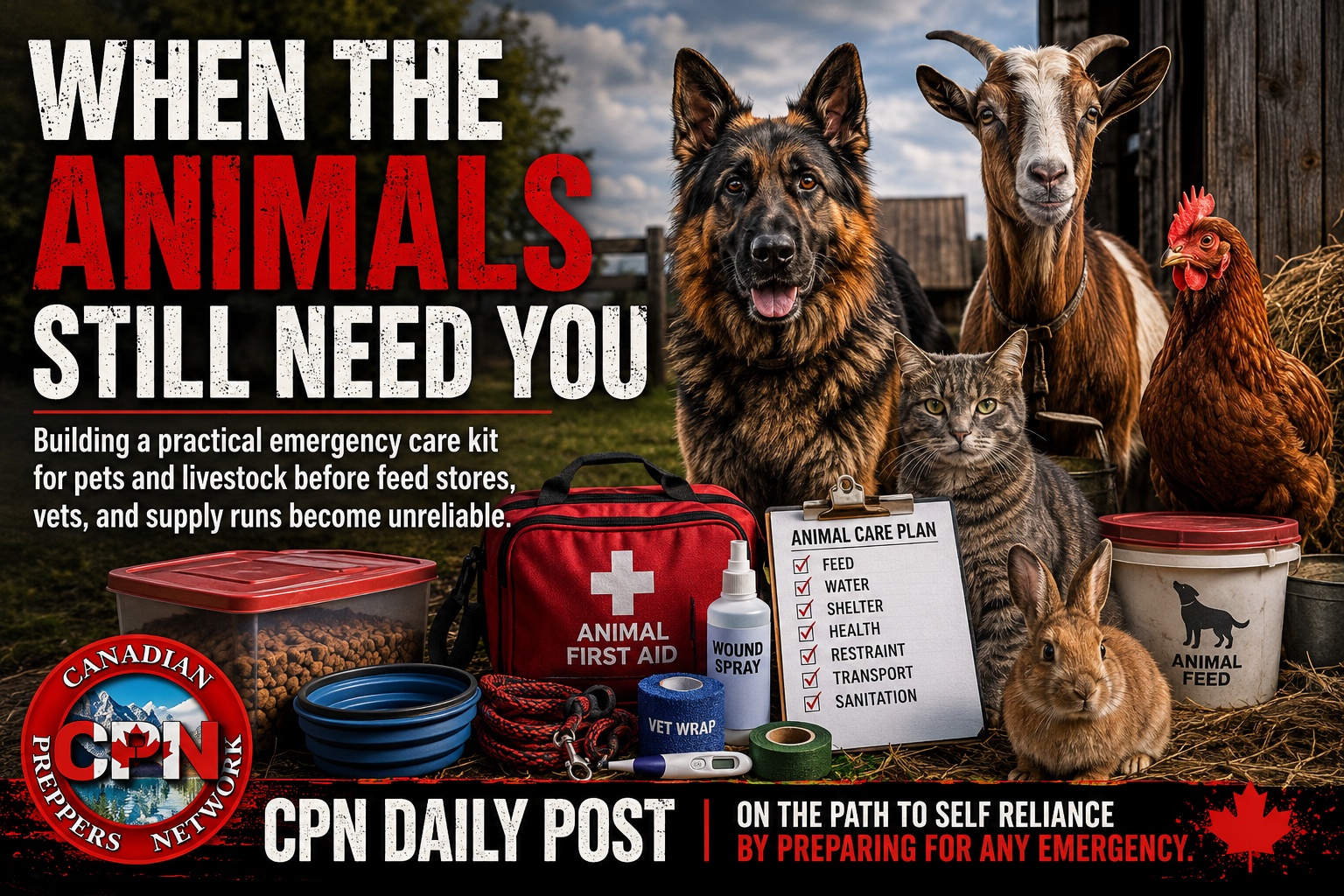
Building a practical emergency care kit for pets and livestock before feed stores, vets, and supply runs become unreliable.
Most preparedness plans start with the people. That makes sense. Food, water, heat, medicine, security, communications, and transportation all come first because if the household fails, everything attached to it fails too.
But many prepared households are not just made up of people.
There are dogs that provide companionship, warning, and sometimes real working value. There are cats that keep rodents out of feed rooms and barns. There are chickens producing eggs, rabbits producing meat and manure, goats clearing brush and providing milk, and larger livestock that may represent years of investment. Even on a small property, animals are not an afterthought. They are part of the household system.
The problem is that animals create their own vulnerabilities. They need feed when roads are closed. They need water when the hose is frozen or the well pump is down. They need restraint when you have to evacuate. They need shelter when heat, cold, smoke, floodwater, predators, or stress change the conditions around them. They may also need basic care at the exact moment when a vet clinic, feed store, or pet supply aisle is no longer available.
That does not mean every prepper needs a barn full of veterinary supplies. It means animals deserve the same kind of practical planning we already apply to people. A working animal care kit is not glamorous, but it can keep a manageable problem from becoming a hard loss.
Animals Are Part of the System
A lot of preparedness talk treats animals as either sentimental extras or food production units. Both views are too narrow.
Pets affect evacuation planning. Livestock affects food security. Working animals affect property safety. Barn cats affect feed protection. Chickens, rabbits, and goats affect how a family might transition from stored food to ongoing production. Anyone serious about homestead resilience already understands that food production is not just about seeds and shelves. It is about maintaining the living systems that keep producing after the stored pantry starts shrinking.
That is why animal preparedness belongs beside the broader Homestead Skills in Canada conversation, not tucked away as an emotional side note. If animals are part of your plan, then keeping them alive, contained, fed, watered, and healthy is part of the plan too.
The simplest way to think about it is this: if the animal matters during normal life, it will matter even more during an emergency.
Start With Feed Before Gear
The first animal care mistake is buying tools before answering the feed question.
How many days of feed do you actually have on hand? Not how much you usually buy. Not what you could pick up tomorrow. Not what the store normally carries. How many days could you feed every animal on the property if the road was closed, the debit machines were down, or the feed store shelves were empty?
For pets, that means extra food stored in a way that protects it from moisture, mice, insects, and spoilage. For chickens and rabbits, it means feed bags stored off the floor and inside sealed containers. For goats or larger livestock, it may mean hay, grain, minerals, and bedding planned around weather and local storage limits. For animals on special diets, the margin should be even wider because substitutions are harder.
This does not mean hoarding feed until it goes stale. It means rotating feed the same way preppers rotate pantry food. Use the oldest first. Keep it dry. Protect it from rodents. Label purchase dates. Pay attention to seasonal needs. Animals often eat more in cold weather, and water demand can spike during heat. A one-month feed cushion on paper may not actually be a one-month cushion in February or July.
The same logic applies to human food storage. A pantry is only useful if it is protected, rotated, and tied to real meals. The Food Procurement & Storage in Canada hub makes that point for households, and the same thinking applies to animals. Food security is not just possession. It is storage, rotation, access, and use.
Water Is the Weak Link
Feed gets most of the attention because it is bulky and expensive, but water is usually the faster failure point.
A dog can become a problem quickly without water. Chickens stop producing and can die in heat. Rabbits are vulnerable when water bottles freeze or fail. Goats and larger livestock need volume, and hauling enough water by hand becomes miserable faster than most people expect. In winter, frozen buckets and lines can turn a normal chore into a crisis. In summer, algae, heat, and contamination become bigger issues.
Every animal plan should answer three questions.
Where does their water come from now? What happens if that system stops working? How will you move water from the backup source to the animal?
A household that stores drinking water for people but has no way to water animals has only solved part of the problem. Buckets, jugs, barrels, hand pumps, sleds, carts, gravity-fed containers, poultry waterers, and simple siphon hoses can matter more than fancy gadgets. The goal is not to build a perfect system. The goal is to make sure there is a boring, repeatable way to keep animals watered when the normal hose or automatic waterer does not work.
This is where general preparedness overlaps again. Water storage, collection, and treatment are already core skills covered in the Water Collection & Purification in Canada hub. Animal water does not always need to be treated to the same standard as drinking water for people, but it still needs to be safe enough, accessible enough, and available in enough volume to prevent losses.
Restraint and Transport Come Before Panic
The worst time to find out your dog crate is broken is during an evacuation. The worst time to discover that your goat will not load is when the smoke is already in the air. The worst time to look for a cat carrier is when the cat is hiding behind the furnace because the house is full of noise, stress, and strangers.
Restraint is not cruelty. In an emergency, restraint is control, safety, and speed.
For pets, that means crates, carriers, leashes, collars, harnesses, ID tags, and current records. For cats, a proper carrier matters far more than wishful thinking. For dogs, a spare leash and collar should be stored where they can be grabbed quickly. For livestock, halters, lead ropes, panels, gates, portable fencing, and loading practice may be the difference between moving the animal and leaving it behind.
Even if you never expect to evacuate with livestock, you may still need to isolate an injured animal, separate an aggressive animal, protect young animals, or keep animals away from damaged fencing. Portable containment is one of those boring categories that never looks exciting until the day it becomes essential.
A prepared household should also think about records. Keep printed copies of vaccination records, ownership papers, registration details, photos, vet contact information, feeding instructions, and any known medical issues. Digital copies are useful, but printed records travel when phones die, apps fail, or someone else has to care for your animals.
Build a Basic Animal Care Shelf
The average household does not need to pretend to be a veterinary clinic. That is a dangerous mindset. What you need is a practical care shelf for minor problems, stabilization, cleaning, restraint, and communication with a vet when possible.
A good animal care shelf may include vet wrap, gauze, saline rinse, clean towels, blunt-tip scissors, nitrile gloves, a digital thermometer, a tick remover, styptic powder for minor nail bleeding, wound spray labelled for animals, tweezers, spare syringes or dosing tools for vet-directed use, and a notebook for recording symptoms, times, and treatments.
The notebook matters. Under stress, memory gets sloppy. If an animal is sick or injured, write down when you noticed the problem, what you observed, what the animal ate or drank, whether it passed manure or urine, and what care was given. If you later speak to a vet, that information is far more useful than vague guesses.
This is also where restraint equipment overlaps with care. Muzzles, towels, crates, halters, gloves, and panels can prevent an injured or frightened animal from hurting itself or someone else. Even gentle animals can react badly when they are in pain.
Do not use an emergency kit as an excuse to improvise medication, guess dosages, or use human drugs on animals without veterinary direction. The goal is to clean, stabilize, document, separate, and seek proper advice when it is available. Preparedness should reduce panic, not encourage cowboy medicine.
Sanitation Keeps Problems From Spreading
Animal emergencies are not always dramatic. Sometimes they are filthy.
A plumbing failure, flood, heat wave, barn leak, power outage, or quarantine situation can turn routine animal care into a sanitation problem. Waste piles up. Bedding gets wet. Flies move in. Rodents find feed. Water gets fouled. Dirty bowls and buckets become normal because everyone is tired.
That is how small problems multiply.
Prepared animal care should include the tools to keep things clean: extra bedding, garbage bags, scrub brushes, dedicated buckets, disinfectant appropriate for animal areas, gloves, shovels, feed scoops, litter, absorbent material, and a way to separate clean supplies from dirty ones. For poultry and rabbits, backup bedding and clean waterers matter. For dogs and cats, waste bags, litter, disposable trays, and washable bedding can keep the house livable during a long disruption.
Sanitation is also part of pest control. Rodent-proof feed storage, sealed bins, swept feed areas, and protected garbage reduce the chance of attracting exactly the pests you do not want around your animals or your stored food.
Shelter Is Species-Specific
Animals do not all need the same emergency shelter.
A dog may need shade, warmth, bedding, or a crate away from chaos. A cat may need a quiet enclosed space where it cannot bolt. Chickens may need ventilation more than insulation. Rabbits may need protection from heat more urgently than protection from cold. Goats may tolerate cold well but still suffer in wet, windy conditions. Young, old, sick, or pregnant animals need more margin than healthy adults.
This is where “just put them in the barn” can fail.
Prepared animal shelter means looking at actual threats. Can the animal get out of wind and rain? Is there shade in a heat wave? Is there ventilation during smoke or summer heat? Is there a way to keep bedding dry? Can predators get in if the power fence is down? Can animals be separated if one becomes aggressive, injured, or sick? Can water be kept from freezing? Can you reach the animals safely in bad weather?
For pets, shelter may also mean planning for evacuation destinations. Not every hotel, shelter, friend, or family member will accept animals. A crate-trained pet with records, food, bowls, leash, and cleanup supplies is much easier to move than an unprepared animal with nothing but good intentions attached.
Small Livestock Need Their Own Backup Plan
Chickens, rabbits, and goats are popular with prepared households because they can fit on smaller properties and provide practical returns. They also fail quickly when basic routines break.
Chickens need feed, water, grit, calcium, shelter, predator protection, and ventilation. Rabbits need shade, clean water, dry housing, feed, and protection from heat. Goats need fencing, minerals, hoof care, shelter, and enough browse or feed to stay healthy. None of these systems has to be complicated, but each one has weak points.
For chickens, backup waterers and feed storage are cheap insurance. For rabbits, heat planning is critical. For goats, fencing repair supplies and hoof tools are not optional luxuries. A downed fence, broken latch, empty waterer, or missing feed scoop can become a real problem when stores are closed or help is unavailable.
Small livestock also connects directly to the larger preparedness goal of producing instead of only consuming. The article You Don’t Own Food Security Until You Can Produce It makes that point clearly. But production animals only remain assets if the household can actually keep them healthy and contained.
Think in Layers, Not One Big Kit
The best animal preparedness setup is layered.
The first layer is daily use: feed bins, waterers, leashes, bowls, bedding, crates, and cleaning tools that are already part of normal life.
The second layer is backup capacity: extra feed, extra water containers, spare collars, spare buckets, backup bedding, printed records, and additional containment options.
The third layer is emergency care: first aid supplies, restraint tools, sanitation gear, isolation space, and transport equipment.
The fourth layer is long disruption planning: feed rotation, alternate water movement, fencing repair, pest control, evacuation options, and trusted people who know how to care for your animals if you are not there.
This layered approach is easier to maintain because it does not require a separate fantasy kit that sits untouched for years. It turns normal animal care into preparedness by adding redundancy.
Buying Box: Emergency Animal Care Supplies
As an Amazon Associate, Canadian Preppers Network may earn from qualifying purchases. Product availability and pricing can change, so use these links as starting points and choose supplies that fit the animals you actually keep.
Feed Storage and Rotation
Airtight pet food storage containers
https://www.amazon.ca/s?k=airtight+pet+food+storage+container&tag=canadianprep-20
Metal feed storage bins
https://www.amazon.ca/s?k=metal+feed+storage+bin&tag=canadianprep-20
Feed scoops and measuring scoops
https://www.amazon.ca/s?k=feed+scoop+animal+feed&tag=canadianprep-20
Water and Feeding Backup
Collapsible buckets
https://www.amazon.ca/s?k=collapsible+bucket&tag=canadianprep-20
Poultry waterers
https://www.amazon.ca/s?k=poultry+waterer&tag=canadianprep-20
Rabbit water bottles and bowls
https://www.amazon.ca/s?k=rabbit+water+bottle+bowl&tag=canadianprep-20
Heavy-duty water jugs
https://www.amazon.ca/s?k=heavy+duty+water+jug&tag=canadianprep-20
Restraint, Transport, and Evacuation
Folding dog crates
https://www.amazon.ca/s?k=folding+dog+crate&tag=canadianprep-20
Cat carriers
https://www.amazon.ca/s?k=cat+carrier&tag=canadianprep-20
Dog leashes and collars
https://www.amazon.ca/s?k=dog+leash+collar&tag=canadianprep-20
Livestock halters and lead ropes
https://www.amazon.ca/s?k=livestock+halter+lead+rope&tag=canadianprep-20
Basic Animal First Aid and Care
Pet first aid kit
https://www.amazon.ca/s?k=pet+first+aid+kit&tag=canadianprep-20
Vet wrap for animals
https://www.amazon.ca/s?k=vet+wrap+animals&tag=canadianprep-20
Animal wound spray
https://www.amazon.ca/s?k=animal+wound+spray&tag=canadianprep-20
Tick remover tool
https://www.amazon.ca/s?k=tick+remover+tool+pet&tag=canadianprep-20
Nitrile gloves
https://www.amazon.ca/s?k=nitrile+gloves&tag=canadianprep-20
Small Livestock and Property Support
Hoof trimmers
https://www.amazon.ca/s?k=goat+hoof+trimmers&tag=canadianprep-20
Fence repair tools
https://www.amazon.ca/s?k=fence+repair+tool&tag=canadianprep-20
Poultry netting
https://www.amazon.ca/s?k=poultry+netting&tag=canadianprep-20
Fly traps for barns and animal areas
https://www.amazon.ca/s?k=fly+trap+barn&tag=canadianprep-20
Final Takeaway
Preparedness is not just about keeping the people alive while everything around them falls apart. It is about keeping the household system functioning.
If your animals are part of that system, then they need more than leftover attention. They need stored feed, backup water, safe shelter, transport options, sanitation supplies, basic care gear, and records that can travel with them. They need a plan that still works when the store is closed, the road is blocked, the power is out, or the normal routine is gone.
The animals still need you during an emergency.
The question is whether you planned for that before the emergency arrived.

One Comment