After a nuclear attack, indoor crops could protect part of your food supply from fallout—but they cannot replace stored calories, clean water or dependable power.
The idea is appealing: fallout settles outdoors, gardens become questionable, grocery deliveries stop, and a protected indoor growing system begins producing clean food from behind closed doors.
There is some truth to it.
An indoor garden could become an important part of surviving the months following a nuclear attack. It could produce fresh greens, herbs, sprouts and other foods without exposing them directly to contaminated dust or soil. It could improve nutrition, provide variety and preserve valuable gardening skills until outdoor production becomes practical again.
What it cannot do is immediately replace the food that normally arrives by truck, train and combine harvester.
A rack of lettuce is not a field of wheat. A tray of microgreens is not a sack of beans. Indoor food production should therefore be understood as a supplement and recovery system, not as the foundation of the household food supply.
The Garden Is Not Your First Priority
Immediately following a nuclear attack, the priority is shelter—not planting.
The building must first be secured against radioactive dust. Windows, doors, vents and other obvious air leaks may need to be closed or controlled. People, animals and equipment arriving from outside must be treated as potential sources of contamination.
This is not the time to open windows because a growing room feels warm or humid. It is not the time to carry bags of outdoor soil through the shelter or retrieve gardening supplies from an exposed shed.
Your first meals must come from food already stored inside the protected area. Indoor gardening becomes relevant only after the shelter is functioning, urgent injuries have been addressed, stored water has been inventoried and the available power supply has been assessed.
The garden is part of the recovery plan. It is not a substitute for having food ready during the initial crisis.
Indoors Does Not Automatically Mean Clean
Bringing a garden indoors protects it from direct fallout only if the growing area remains separated from contaminated material.
Radioactive particles can enter on clothing, footwear, tools, containers, pets and equipment. They can also enter through uncontrolled airflow or through people repeatedly moving between dirty and clean areas.
The growing room should be positioned well away from the entrance used by anyone coming in from outside. It should not share space with contaminated clothing, outdoor gear or waste awaiting removal.
Seeds, growing media, fertilizer, trays and tools should already be indoors or sealed inside containers. Outdoor garden soil, uncovered compost, rain barrels and supplies stored in open sheds should not automatically be brought into the food-production area.
The danger is not that every object from outside will remain unusable forever. The problem is that radioactive contamination cannot be reliably identified by appearance, smell or taste.
A protected garden depends on controlling what enters the room.
What an Indoor Garden Can Actually Produce
The strongest indoor crops are not usually calorie crops. They are fast, compact plants that provide vitamins, minerals, flavour and fresh texture.
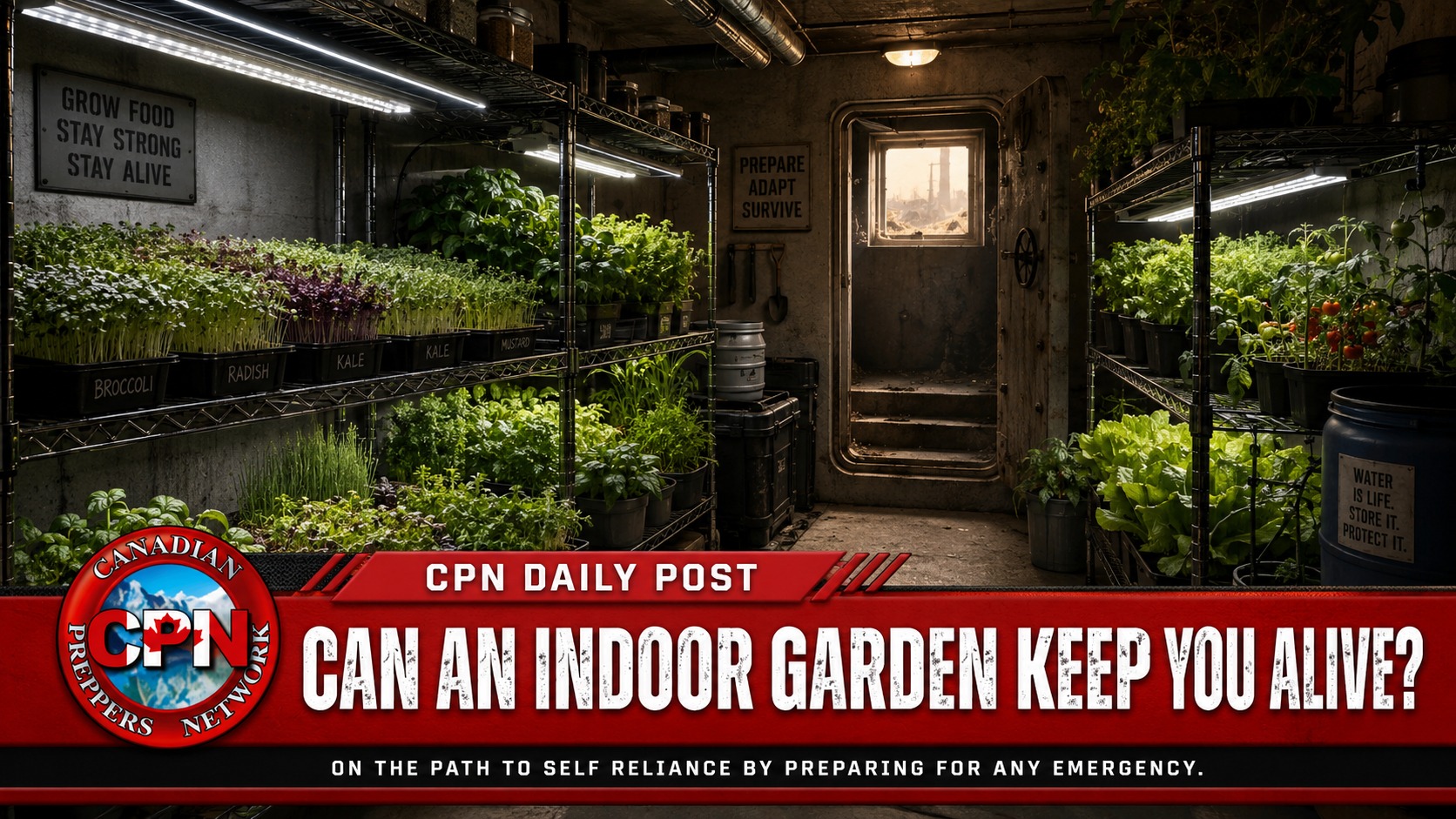
Useful possibilities include sprouts grown from food-grade seed, microgreens, leaf lettuce, green onions, compact herbs, radishes, small Asian greens and dwarf varieties suited to containers.
Sprouts require little or no growing light, making them especially useful when electricity is limited. They still require clean seed, clean containers, safe water and careful handling. Poor sanitation can turn a jar of sprouts into a food-safety problem when medical assistance may already be scarce.
Microgreens and leafy vegetables require more equipment, but they produce edible material relatively quickly and make efficient use of vertical shelving.
Herbs contribute very few calories, but they can make months of rice, beans, pasta, oats and canned food considerably easier to eat.
That matters more than it sounds. A stored-food plan that technically contains enough energy can still become difficult to maintain when meals are repetitive, bland or unappetizing.
Indoor crops help make stored food more tolerable. They do not replace it.
What It Will Not Produce Efficiently
The indoor-garden fantasy usually collapses when calorie requirements are considered.
Potatoes, dry beans, corn, wheat, squash and other substantial crops need significant light, growing space, root volume, fertility and time. They can sometimes be grown indoors, but producing enough to support an entire household would require a much larger electrical and material system than most homes could maintain after a nuclear attack.
Even a productive shelving system filled with greens would provide only a small portion of the calories required by several adults.
This is why a nuclear-preparedness food plan must be layered.
The first layer is stored food: grains, legumes, canned foods, fats, dried ingredients and other dependable calories.
The second layer is protected indoor production for nutrition, variety and seedling development.
The third layer is eventual outdoor food production when local soil, water and working areas can be used with acceptable risk.
The CPN Food Procurement and Storage Hub provides the broader framework for building that stored-food foundation.
Clean Water Is the Limiting Input
Plants consume water, and an indoor garden can use a surprising amount once multiple trays and containers are operating.
During a fallout emergency, water collected from exposed roofs, open barrels, ponds or surface sources cannot automatically be treated as safe simply because it looks clear. Boiling may control biological hazards, but it does not make radioactive particles disappear.
Water used for sprouts, hydroponics or food crops should come from the same protected supply reserved for drinking and food preparation.
That creates a serious trade-off.
Every litre poured onto plants is a litre that cannot be used immediately for drinking, cooking, cleaning or hygiene. Starting a large indoor garden before understanding the household water budget could make the overall situation worse.
Begin with the crops that produce the most value using the least water and space. Sprouts, microgreens and a limited number of leafy plants are more realistic than trying to fill an entire basement with thirsty containers.
The garden should expand only when the household has confirmed that enough water remains available for both people and plants.
Soil, Hydroponics or Something Simpler?
Hydroponics appears ideal because it avoids outdoor soil and can reuse water. However, it also depends on nutrient concentrates, pumps, tubing, containers, monitoring and often continuous electricity.
A pump failure can affect an entire interconnected system. A leak can waste both water and nutrients. A complicated hydroponic setup that has never been operated before the emergency may become more burden than benefit.
Simple container growing is often more forgiving.
Seed-starting mix, coco coir or another sealed growing medium can be stored compactly. Plants can be hand-watered. Individual containers can be isolated if mould, insects or disease appear. The system may not be as technically efficient, but it is easier to understand, repair and operate without electricity.
A strong setup may combine several methods: sprouts for nearly power-free production, shallow trays for microgreens, simple containers for leafy crops and hydroponics only where the system has already been tested.
The best emergency growing method is not necessarily the one that produces the highest yield under perfect conditions. It is the one that continues working after something breaks.
Electricity May Decide Whether the System Works
Artificial light is the largest weakness in most indoor food plans.
Grow lights must operate for substantial periods each day. Larger plants require stronger lighting than seedlings or microgreens. Fans, water pumps, heaters and environmental controls add further demand.
After a nuclear attack, that electricity may also be needed for communications, water pumping, refrigeration, medical equipment, battery charging and general lighting.
Food production must compete with every other electrical priority in the shelter.
An indoor system intended for emergencies should use efficient LED lights, timers, reflective surfaces and the smallest productive growing area possible. Each shelf should serve a defined purpose instead of being filled with plants simply because space is available.
The system should also remain usable without pumps. Hand watering may be less convenient, but it prevents a failed controller, blocked tube or damaged pump from destroying the crop.
CPN has previously examined a solar-powered indoor greenhouse for seed starting and alternative power options for outages. Those systems become particularly relevant when grow lights must operate independently of the electrical grid.
Ventilation Creates a Difficult Trade-Off
Plants need air movement, but the shelter may need to remain isolated from outside dust.
That creates a conflict between contamination control and growing conditions.
During the period when fallout is settling or outdoor dust remains a serious concern, the garden cannot depend on an open window or a fan drawing untreated outside air into the building.
Internal air circulation is different from outside-air exchange. A small fan can move existing indoor air around the plants without intentionally pulling contaminated air inside. Even then, fans should not blow dust from dirty areas toward the growing room.
Humidity must also be watched carefully. Trays, wet growing media and tightly sealed rooms can produce condensation and mould. A garden that damages the shelter or creates respiratory problems is not helping anyone survive.
This is another reason to begin with a modest growing area rather than turning an entire basement into a humid greenhouse.
Build the Garden Before You Need It
An emergency indoor garden should not exist only as unopened equipment in storage.
Grow lights create heat. Containers leak. Some rooms develop mould. Seed varieties behave differently. Nutrient mixtures can be misunderstood. Plants stretch, dry out or fail under weak lighting.
These are manageable problems during normal times. They become much more serious when replacement supplies are unavailable.
Operate at least one shelf of indoor plants now. Learn how much water it uses, how warm the room becomes and whether humidity collects on walls or windows. Determine which varieties perform reliably and which consume space without producing enough food.
Calculate the electrical demand instead of guessing. Test the lights from the same battery, inverter, generator or solar system expected to power them during an outage.
The Homestead Skills Buying Guide provides a starting point for seed-starting and growing equipment, while Garden Planning for Food Security explains why serious food production must eventually extend beyond salad crops.
A Practical Protected-Growing Kit
A basic system does not need to be fully automated. It needs to be durable, understandable and ready to operate from protected supplies.
The core kit should include food-grade sprouting seed, vegetable seed intended for indoor growing, sealed growing medium, shallow growing trays, waterproof lower trays, strong shelving, efficient LED grow lights, timers, hand-watering containers, stored fertilizer, cleaning supplies and spare connectors.
Store more seed than a single planting requires. Poor germination, mould, insects or simple mistakes can destroy a crop. Fertilizer and growing medium are equally important. Seed packets alone do not create food.
Indoor-Growing Supplies
Disclosure: As an Amazon Associate, Canadian Preppers Network may earn from qualifying purchases.
Full-Spectrum LED Grow Lights
Efficient lighting for microgreens, leafy vegetables, seedlings and compact container crops.
Heavy-Duty Adjustable Shelving
Vertical shelving helps produce more food while using less floor space.
Seed-Starting and Microgreen Trays
Shallow trays allow quick crops to be grown in repeatable batches.
Compressed Coco Coir Growing Medium
Compact, clean growing medium that can be stored indoors until needed.
Mechanical or Digital Light Timers
Timers reduce wasted electricity and maintain consistent lighting schedules.
Food-Grade Sprouting Seeds
Sprouts can provide fresh food with little space and minimal lighting.
USB-Powered Circulation Fans
Low-power fans can move indoor air without requiring a full household electrical system.
Waterproof Plant Trays
Protects floors and shelving from leaks, spills and long-term moisture damage.
The Garden Eventually Moves Outside
Indoor production becomes most valuable when it serves as a bridge to larger-scale recovery.
When outdoor conditions become manageable, the same lights, trays and shelving can be used to start transplants for protected beds, containers, greenhouses or rehabilitated garden areas.
Instead of trying to mature full-sized calorie crops under artificial lights, the indoor system can produce seedlings that are later moved into larger growing spaces.
That is where indoor gardening begins to scale.
A shelf cannot feed a family indefinitely. A shelf capable of starting hundreds of healthy plants can help rebuild a meaningful food-production system.
The transition should be gradual. Exposed soil, water sources and equipment may need to be cleaned, replaced or avoided depending on where fallout settled. The household may begin with covered containers, raised beds, imported growing media or a greenhouse before returning to conventional garden plots.
Indoor growing buys time while those decisions are made.
The Honest Answer
Can an indoor garden keep you alive after a nuclear attack?
Not by itself.
It will not replace stored grains, beans, fats, canned meat or other concentrated food. It will not solve a contaminated-water problem. It will not operate indefinitely without energy, growing media and nutrients.
What it can do is protect a small but renewable source of fresh food, improve the nutritional quality of stored meals and preserve the ability to restart larger food production.
The survival value is not found in pretending that a basement shelf can replace Canadian agriculture. It is found in combining stored calories, protected inputs, reliable power and practised growing skills into one system.
After fallout, the pantry keeps you alive first.
The indoor garden helps carry you toward what comes next.
PreppersMeet Updates
Preppers Meet 2026 has officially moved to Primrose Park in Mono, Ontario.
New location:
Primrose Park
635687 Highway 10
Mono, Ontario
L9V 0Z8
Please update your travel plans and GPS destination. The entire event has moved—not only the firearms courses.
Below are answers to the most common questions we have received.
Has the entire Preppers Meet event moved?
Yes. All Preppers Meet activities, presentations and registered courses will now take place at Primrose Park.
What is the new location like?
Preppers Meet has been given a large section toward the back of the campground with plenty of camping space.
The campground owners have been extremely welcoming and accommodating. Best of all, the campground has flushing toilets and showers.
Please note that the showers are coin operated.
Will there be signs when we arrive?
Yes. There is a gate at the campground entrance.
Someone will be available to welcome arriving attendees and direct them toward the Preppers Meet camping and event area. Additional signs will be placed throughout the campground.
Is camping still included with my ticket?
Yes. Camping remains included with regular event admission.
The only activities requiring additional registration fees are the Firearms Training Course and the Remote First Aid Course.
There are no new campground charges being added to your existing Preppers Meet ticket, although the showers are coin operated.
Can we bring trailers and RVs?
Yes. There is room for trailers, including trailers approximately 28 feet long.
Depending on the size and layout of your unit, you may need to disconnect the trailer from your towing vehicle after setting up.
Are there places to hang hammocks?
Yes. There are plenty of suitable hammock camping locations within the Preppers Meet area.
Hammock campers may still want to bring a backup tent in case their preferred location is unavailable or weather conditions change.
Do the campsites have electricity?
Electrical service at individual campsites is not available.
Please do not assume that your camping area will have an electrical hookup. Anyone who requires electricity for medical equipment or another essential reason should contact the organizers before arriving.
Will food be available for sale at the campground?
There will not be regular prepared food service available on-site, so attendees should plan to bring their own meals, snacks and drinks.
There are several nearby food options, including Subway and local burger restaurants approximately five minutes away.
Shelburne is about ten minutes away and has two major grocery retailers where attendees can purchase additional supplies.
Should we bring cash?
Yes.
You may need coins for the showers, and some vendors may prefer or require cash. Bringing cash also makes it easier to support the vendors, raffles and other activities taking place during the weekend.
Will presentations be indoors or outdoors?
Both.
Presentations requiring technology, such as a large television or other audiovisual equipment, will generally be held in an indoor classroom.
Other presentations will take place in an outdoor classroom beneath a large event tent. This will provide protection from sun and rain.
Bringing a folding camp chair is recommended for outdoor presentations and courses.
Where will the Remote First Aid Course be held?
The Remote First Aid Course begins on Wednesday, July 8 and is currently planned for the outdoor classroom beneath the event tent.
Participants should bring a folding chair.
Those registered for the course may arrive and set up their campsite the day before the course begins.
Will the campground’s July 11 foam party interfere with Preppers Meet?
No. The campground’s foam party will not interfere with Preppers Meet activities.
Attendees are welcome to participate in the foam party if they choose.
Are dogs still permitted?
Yes. Well-behaved dogs are welcome.
Dogs must remain on a leash, be kept under control and be cleaned up after at all times.
What address should we enter into our GPS?
Use the complete street address rather than relying on a social-media map:
Primrose Park
635687 Highway 10
Mono, Ontario
L9V 0Z8
The campground is located on Highway 10 near Highway 89, south of the Petro-Canada and Subway area.
Will registered attendees receive an email about the move?
Yes. We are contacting registered attendees directly to make sure everyone receives the new location and arrival information.
Please share this update with anyone travelling or camping with you.
Where can we find updated venue information?
Current venue information is available at: https://preppersmeet.com/venue/
We are excited about the move. Primrose Park provides considerably more camping space, proper washroom and shower facilities, indoor and covered outdoor presentation areas, and a welcoming environment for the entire Preppers Meet community.
We look forward to seeing everyone at Primrose Park!