Why lakes, rivers, wells, rain barrels, and snow are not automatically safe after a disaster
Canada gives people a false sense of security about water.
We look at the map, see lakes everywhere, know there is snow for half the year in much of the country, and assume water will be the easy part of an emergency. That assumption gets people into trouble. Water nearby is not the same as water you can safely drink. Water stored in a barrel is not automatically potable. Water from a clear stream is not automatically clean. Water from a private well is not automatically usable when the pump has no power, the casing is compromised, or floodwater has moved through the area.
In a short power outage, bottled water may be enough. In a longer emergency, water becomes a system. You need stored water, collection options, treatment methods, containers, fuel, sanitation planning, and a realistic understanding of what each water source can and cannot provide.
The dangerous myth is simple: “We’ll just get water from the lake, river, rain barrel, snowbank, or well.”
Maybe you will. But only if you planned for the problems before the tap stopped.
Abundant Water Does Not Mean Safe Water
The Canadian Preppers Network water hub makes the point clearly: Canada may have abundant freshwater, but abundance is not the same thing as household access. Water can be contaminated, frozen, inaccessible, chemically affected, or difficult to move and treat safely. That is why water preparedness cannot be reduced to a few cases of bottled water in the basement. It needs to be treated as a household system.
Health Canada’s emergency guidance lists water as a core emergency kit item and recommends keeping water for drinking, with additional water for cooking and cleaning. It also notes that households may need extra water for pets, infants, and other special needs. You can review that guidance here: Health Canada emergency food and drinking water safety.
That is the starting point, not the finish line.
Stored water buys time. It keeps you from making bad decisions during the first hours of an emergency. It lets you cook, drink, wash hands, mix formula, care for animals, clean minor wounds, and avoid rushing outside with a bucket and a filter before you understand what has happened.
But once stored water runs low, everything depends on your backup sources and treatment plan.
Lakes and Rivers Are Not Ready-to-Drink Sources
A lake may look clean and still carry biological contamination. A river may look fast-moving and still be affected by upstream agriculture, septic failure, storm runoff, fuel spills, dead animals, industrial sites, or flood debris. After a storm or infrastructure failure, surface water can change quickly.
The more people in an area are improvising sanitation, the more dangerous nearby water sources become.
In a true long emergency, the problem compounds. If toilets stop working, sewage systems back up, livestock escape containment, garbage collection stops, and people begin dumping waste, then the creek that looked useful on day one may become a serious health risk by day ten.
The practical lesson is not to avoid surface water entirely. The practical lesson is to stop treating it as automatically safe.
Surface water should be considered questionable until it has been settled, pre-filtered, properly filtered, and disinfected according to reliable guidance. Even then, you need to understand that some treatment methods address biological risks but do not solve chemical contamination.
Rain Barrels Are Useful, But They Are Not Magic
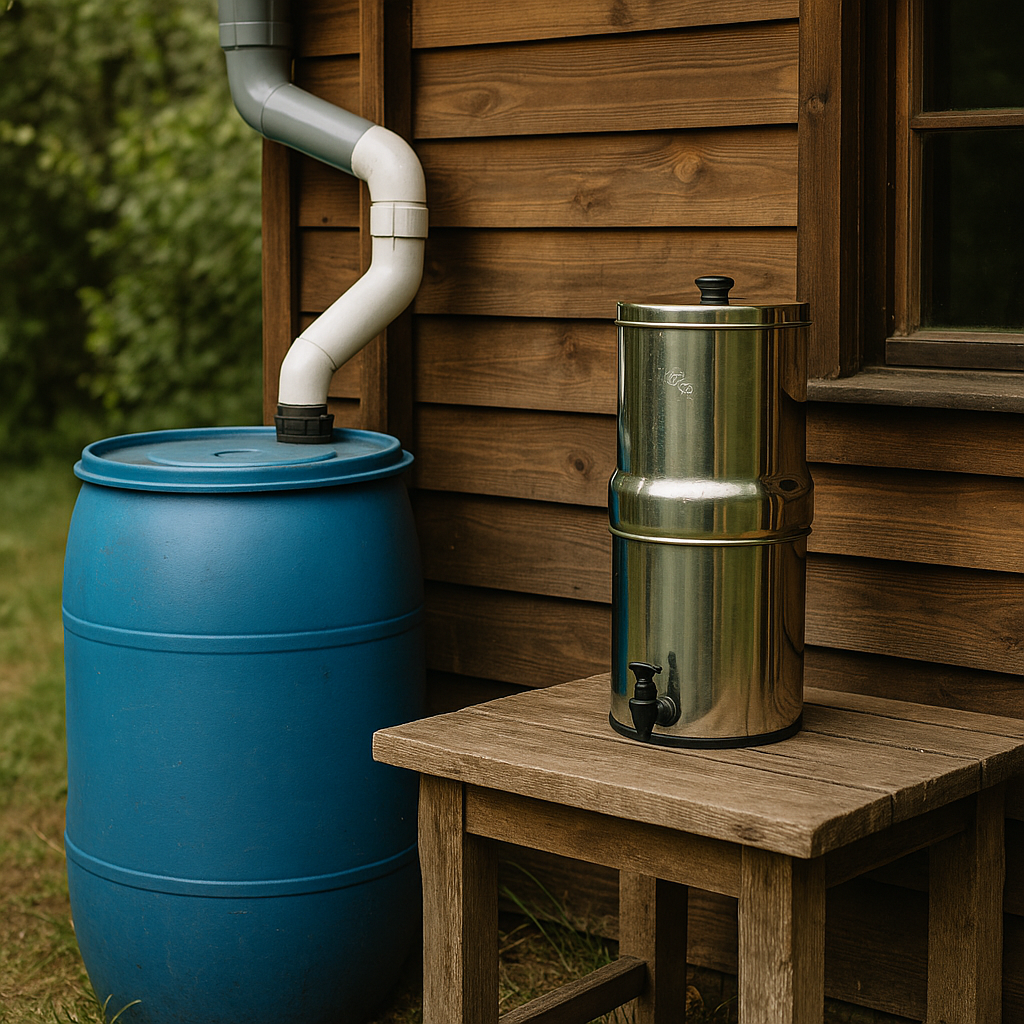
Rain barrels are excellent for gardens, cleaning, flushing toilets, livestock support, and reducing dependence on treated municipal water. They are also one of the easiest collection systems for a homeowner to set up.
But roof runoff is not automatically drinking water.
Rainwater can pick up bird droppings, asphalt residue, roofing chemicals, pollen, dust, insects, leaves, and whatever else has settled on your roof and gutters. A barrel that sits warm in summer can become a biological soup. A barrel with a loose lid becomes a mosquito nursery. A barrel near floodwater or animal activity can be contaminated from outside.
That does not make rain barrels useless. It means they need to be assigned the right job.
For most households, rain barrels should first be thought of as utility water: gardens, washing, cooling, cleaning tools, flushing, and livestock where appropriate. Turning that water into drinking water takes a separate treatment plan.
A serious rainwater setup should include screened inlets, sealed lids, overflow control, a way to drain sediment, and ideally a first-flush approach that keeps the dirtiest roof runoff out of the main storage.
Wells Can Fail Without Running Dry
Rural Canadians often assume a private well solves the water problem. In normal times, it might. In a grid-down situation, a well is only useful if you can actually access the water.
Electric well pumps are an obvious weak point. Without power, a deep drilled well may be full of water you cannot reach. A generator can solve that temporarily, but generators require fuel, maintenance, noise discipline, and spare parts. Solar backup can help, but only if designed before the emergency.
There is also the contamination problem. Flooding can affect wells. Surface runoff can enter damaged well caps or poorly sealed casings. Septic issues can become water issues. If a property has been flooded, a private well should not simply be trusted because it worked before.
A better rural plan includes more than “we have a well.”
It should include stored water, backup power for the pump if practical, a manual or alternative access method where possible, water testing after contamination events, and secondary water sources that do not rely on one powered system.
Snow Is Not a Free Water Supply
In much of Canada, snow looks like a backup water source. It can be, but it is inefficient and often misunderstood.
Snow takes fuel to melt. A large pot of snow produces far less water than many people expect. In a winter power outage, fuel is already needed for heat, cooking, and safety. Burning extra fuel to melt snow can become expensive fast.
Snow can also be contaminated by smoke, vehicle exhaust, road salt, animal activity, roof runoff, and debris. Snow from near roads, driveways, buildings, or high-traffic areas should be treated with suspicion.
If snow is part of the plan, it should be a fallback, not the foundation. Store water indoors before winter storms. Keep containers where they will not freeze solid. Know how much fuel you can spare. Plan for water before the temperature drops, not after the pipes freeze.
Boiling Is Powerful, But It Is Not a Complete Plan
Boiling is one of the most reliable emergency water treatment methods for biological contamination. The CDC advises bringing clear water to a rolling boil for one minute, and longer at high elevation. It also advises filtering cloudy water through a clean cloth, paper towel, or coffee filter first, or letting sediment settle before boiling. You can review that guidance here: CDC emergency water guidance.
That said, boiling has limits.
It requires fuel. It takes time. It does not remove chemical contamination. It does not remove heavy metals, fuel residues, pesticides, or other industrial pollutants. In some cases, boiling contaminated water can concentrate certain non-biological contaminants rather than solve the problem.
That is why “I’ll just boil it” is not enough.
A better approach is layered: choose the safest source available, settle and pre-filter dirty water, use a proper filter where needed, then disinfect or boil depending on the situation and guidance. HealthLink BC specifically warns that boiling or adding bleach does not make heavily chemically contaminated water safe and that an alternate potable source is needed in that case. You can review that guidance here: HealthLink BC disinfecting drinking water.
That point matters. A roadside ditch, flooded basement, industrial runoff area, or fuel-contaminated stream is not a drinking water source just because you own a filter and a pot.
Filters Are Not All the Same
Many preppers talk about “a water filter” as if the term means one thing. It does not.
Some filters are designed mainly to improve taste. Some reduce sediment. Some reduce bacteria and protozoa. Some are designed for backpacking. Some are better suited to a family basecamp. Some require replacement cartridges. Some clog quickly in turbid water. Some do not address viruses unless paired with chemical treatment or boiling.
This is why the CPN article Water Storage and Filtration for Canadian Households makes an important distinction: storage handles the short term, while filtration handles everything beyond that. Once stored water runs low, filtration becomes the backup plan that expands your options.
A good household plan should include sediment control before fine filtration, a gravity-fed system for the home, portable filters for evacuation or field use, chemical treatment tablets as a backup, clean containers for treated water, and a way to avoid mixing dirty and clean water equipment.
The last point is often overlooked. If you scoop dirty water with the same container you use to store treated water, you can contaminate your own clean supply.
The Real Water Plan Is Separation
A serious household water plan separates water by use.
Drinking and cooking water should be the cleanest and most protected. Handwashing and dishwashing water still needs care because poor sanitation spreads illness quickly. Garden water can be lower quality. Toilet flushing water can be lower still. Livestock water has its own risks and requirements.
Not all water needs to be drinkable. But drinkable water must be protected.
That means labelling containers, keeping treated water covered, storing it away from fuel and chemicals, using dedicated clean containers, and teaching everyone in the household which water is safe for which purpose.
During a stressful emergency, confusion becomes dangerous. A clear label can prevent a bad mistake.
Water Failure Is Often Infrastructure Failure
Many boil water advisories are not caused by some dramatic poison in the water. They are caused by normal systems breaking down. Environment and Climate Change Canada notes that boil water advisories are issued to protect against disease-causing bacteria, viruses, or parasites, and that many advisories are tied to equipment and process problems such as broken water mains, maintenance, power failures, or equipment issues. You can review that reporting here: Environment and Climate Change Canada boil water advisories indicator.
That is exactly the kind of failure preppers should pay attention to.
Water systems depend on power, pumps, pressure, treatment chemicals, trained operators, pipes, sensors, roads, and communication. A household may see water come from the tap every day and forget how much has to work behind the scenes for that to happen.
When those systems fail, the household that has already stored water, planned collection, and practised treatment is in a far better position than the household staring at a nearby river and hoping for the best.
Build the System Before You Need It
The goal is not paranoia. The goal is removing assumptions.
A real emergency water system should answer these questions before the crisis:
- Where is our first three days of clean water?
- Where is our next two weeks of water?
- What water can we collect without electricity?
- What water can we move without a vehicle?
- What water can we treat without guessing?
- What water is only suitable for cleaning, flushing, or gardening?
- How do we keep dirty water away from clean containers?
- How do we handle water in winter?
- How do we protect water during flooding?
- What happens if our primary filter fails?
The answer does not have to be expensive. It does have to be thought through.
A few stored containers, a gravity filter, portable backup filters, water purification tablets, clean buckets, rain collection, coffee filters or cloth for sediment, a dedicated pot for boiling, and labelled containers can dramatically improve a household’s position.
What does not work is pretending that a lake, river, well, rain barrel, or snowbank is the same thing as safe water.
It is not.
In a long emergency, water is not a single item. It is a chain. Source, collection, transport, storage, treatment, sanitation, and discipline all have to hold together. Break one link, and abundance does not matter.
You can be surrounded by water and still have nothing safe to drink.
Related CPN Reading
- Water Collection & Purification in Canada
- Water Storage and Filtration for Canadian Households
- CD3WD Survival Manual Deep Dive: Water Purification, Storage, and Long-Term Use in a Grid-Down World
Practical Water Preparedness Gear
As an Amazon Associate, Canadian Preppers Network may earn from qualifying purchases.
A water plan should not depend on one gadget. The goal is layered capability: storage, collection, sediment control, filtration, disinfection backup, and clean handling.
- Water storage containers
- Gravity water filter systems
- Portable water filters
- Water purification tablets
- Food-grade buckets with lids
- Rain barrel screen and diverter kits
- Drinking water test strips
- Collapsible water containers
Bottom line: buy the gear that supports a system, not the gear that lets you avoid planning.
Final Thought
The most dangerous water mistake is assuming nature has already solved the problem for you.
Canada has water. That does not mean your household has safe water. Lakes freeze, wells need pumps, rivers carry upstream problems, rain barrels collect roof contamination, and snow costs fuel to turn into liquid.
Preparedness begins when you stop saying, “There’s water nearby,” and start asking, “Can we collect it, move it, treat it, store it, and keep it clean?”