Animal power is not nostalgia. In a long collapse, it may be the difference between a working homestead and a dead one.
When modern people think about energy production, they almost always think about electricity.
Solar panels. Batteries. Generators. Inverters. Charge controllers. Extension cords. Fuel storage. Maybe wind or micro-hydro if they are thinking a little further ahead.
That makes sense in normal preparedness planning. Electricity runs radios, lights, pumps, tools, freezers, battery chargers, medical devices, cameras, and communications equipment. It deserves attention.
But in a long-term collapse, electricity is not the only form of energy that matters. It may not even be the most important one.
At some point, the question changes.
It is no longer, “How do I power my house?”
It becomes, “How do I move weight, turn soil, haul water, drag firewood, grind grain, pull equipment, and keep food production alive when fuel is gone and batteries are dying?”
That is where animal power comes back into the conversation.
Not as a romantic pioneer fantasy. Not as a hobby farm decoration. Not as a cute retreat accessory.
As an engine.
A horse, mule, ox, donkey, or properly trained working dog is a biological power unit. It converts feed, water, training, and care into useful work. It can pull. It can carry. It can drag. It can walk into places machines cannot. It can reproduce. It produces manure. It can work in silence compared to an engine. It does not need gasoline, diesel, propane, lithium cells, imported electronics, or functioning supply chains.
That does not make animal power easy.
It makes it worth understanding.
For more conventional backup systems, see the CPN Energy Production hub.
But today we are looking past panels and fuel cans.
We are looking at the forgotten engine.
Work Comes Before Watts
One of the biggest mistakes in energy preparedness is assuming that every problem needs electricity.
It does not.
A post-collapse homestead does not need to electrify every task. It needs to keep essential work happening. Those are very different goals.
If you need drinking water moved from a spring, well, creek, or storage tank, the answer may not be a battery-powered pump. It may be a cart, sled, barrel, animal team, and a disciplined hauling schedule.
If you need firewood moved from the bush to the house, the answer may not be a chainsaw, ATV, trailer, and fuel stash. It may be a crosscut saw, hand tools, horse, ox, sled, and a cleared winter route.
If you need grain cracked, roots chopped, manure moved, garden rows cultivated, or fencing material hauled, the answer may not be another generator. It may be a trained animal and the right mechanical setup.
That shift matters.
Electricity is precious. In a real grid-down situation, electrical power should be reserved for the tasks that truly need it: communications, lighting, medical support, small electronics, security monitoring, and critical charging. Every job moved out of the electrical category extends the life of your battery bank and reduces dependence on fragile gear.
Animal power is part of that energy triage.
It does not replace solar. It does not replace batteries. It does not replace hand tools.
It fills the gap between human labour and machine labour.
That gap is enormous.
Pulling Is the First Power System
The most realistic use of animal power is not generating electricity.
It is pulling.
That may sound simple, but pulling is one of the most valuable forms of work after a collapse. A household can move small items by hand. A fit adult can carry a pack. A wheelbarrow can do a lot on level ground. But once you start dealing with water barrels, firewood, feed sacks, manure, logs, fencing rolls, garden produce, stones, salvaged lumber, or winter loads, human backs run out fast.
That is where a working animal changes the math.
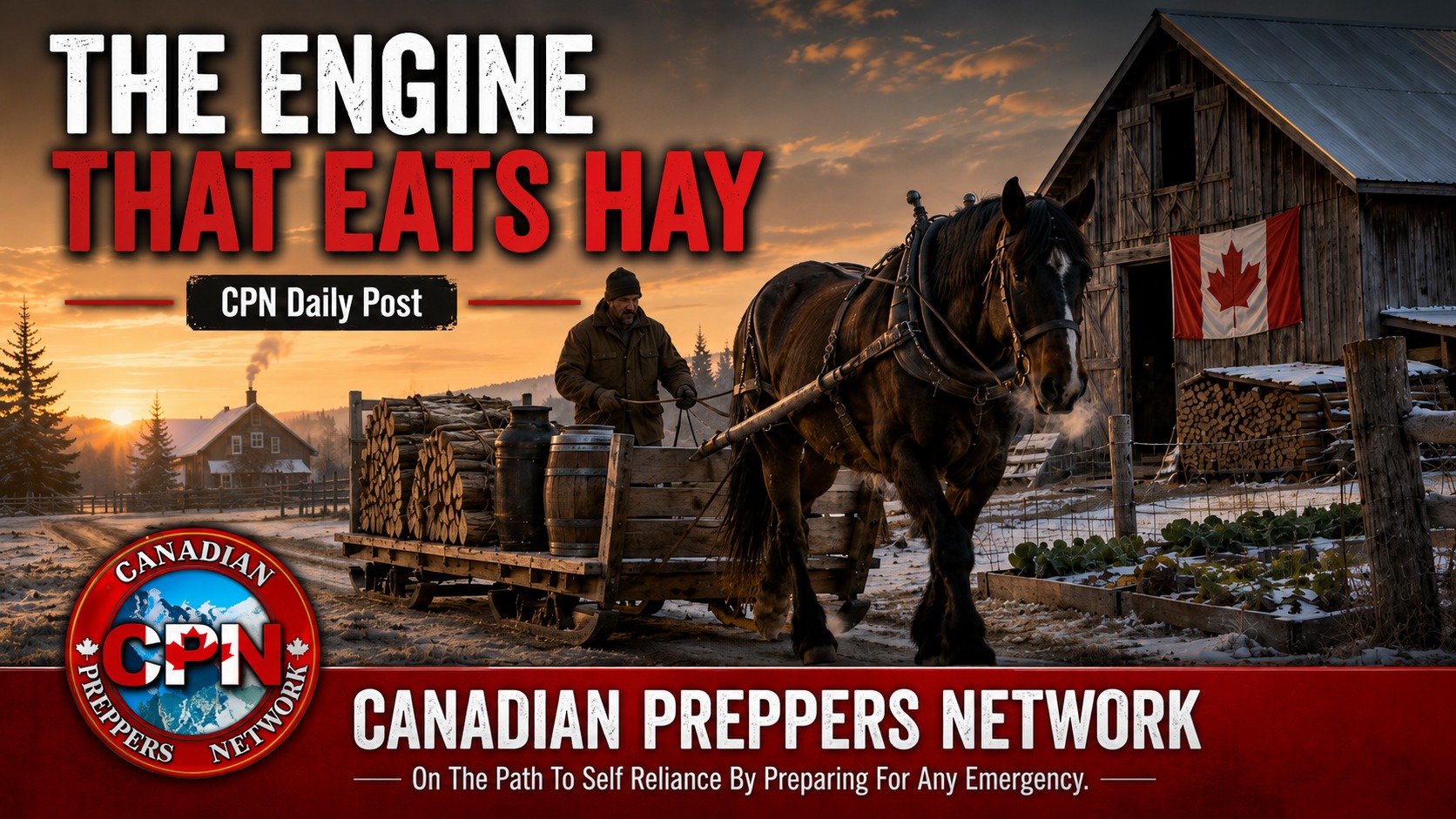
A horse or mule with a cart can move supplies between buildings, gardens, woodlots, neighbours, and retreat sites. Oxen can pull heavy loads steadily and patiently. Donkeys can carry packs or pull smaller carts. A good sled behind a properly trained animal can make winter hauling practical in a way that wheeled carts cannot.
Even large working dogs have a place, though their role is limited. A dog cart or sled can move light loads, firewood kindling, small water containers, trapline supplies, or communication gear. That does not make a dog a substitute for a draft animal, but in a small household every useful system counts.
The key point is this: after collapse, transport becomes local again.
Fuel scarcity shrinks the world. Roads may exist, but reliable vehicles may not. Bridges may fail. Gas stations will be useless. Snow clearing may stop. Abandoned vehicles and debris may block normal routes. Long-distance logistics will become rare and risky.
Animal power brings local logistics back.
A group that can move weight without fuel can do things other groups cannot.
Field Work Without Tractors
Food production is where animal power becomes even more serious.
A shovel garden can feed people, but scaling up is hard. Expanding food production means breaking soil, hauling compost, moving mulch, carrying water, cultivating rows, collecting manure, and transporting harvests. Human labour can do all of that, but slowly and painfully.
A trained draft animal can plough, harrow, cultivate, haul manure, move hay, and pull small implements. That matters in a post-collapse setting because food production will not be a weekend hobby. It will be survival infrastructure.
This does not mean every prepper should run out and buy a horse.
Most should not.
A poorly trained animal in the hands of an inexperienced owner is not an asset. It is a liability with hooves. It eats every day, whether it works or not. It needs water, shelter, fencing, hoof care, veterinary knowledge, and competent handling. It can injure people, damage equipment, break fences, or become useless through neglect.
Still, the principle stands.
In a serious long-term disruption, a community with trained animal power has a major advantage over a community with dead tractors and empty fuel cans.
This is where homestead skills matter. Animal power belongs beside gardening, composting, food preservation, tool maintenance, and no-power repair skills — not in a separate fantasy category.
See the CPN Homestead Skills hub for more on the broader skill base that supports this kind of long-term planning.
Rotary Power: The Forgotten Mechanical Layer
Pulling and hauling are obvious. Rotary power is less obvious, but it may be just as important.
Before small engines became common, animal power was often used to turn equipment. A horse, ox, mule, or donkey could walk in a circle around a sweep, capstan, treadmill, or similar system. That movement could be converted into rotating mechanical power.
This type of setup could drive certain low-speed mechanical tasks: grain milling, root chopping, threshing, water pumping, feed processing, or other farm operations designed for animal traction.
The key phrase is “designed for animal traction.”
This is not a place for reckless improvisation. High-speed machinery, exposed shafts, homemade belt systems, and mismatched equipment can maim people and animals. If a group is serious about animal-powered mechanical work, it needs proper equipment, guards, spacing, training, and someone who understands the system before anyone steps near it.
Still, the concept deserves attention.
In a post-collapse setting, the smartest energy system may not be electric at all. It may be mechanical.
A rotating shaft can do useful work without converting motion into electricity, storing it in batteries, and converting it back again. Every conversion wastes energy and adds failure points. If the job is grinding grain, pumping water, or chopping feed, sometimes direct mechanical power is the better answer.
That is the kind of thinking preppers need more of.
Do not ask, “How do I generate more electricity?”
Ask, “Does this job need electricity in the first place?”
Choosing the Right Animal
Different animals suit different work.
Horses are fast, versatile, and historically common for transport, field work, and hauling. They are also feed-intensive and require steady handling.
Mules are often tougher, careful-footed, and durable, with many of the advantages of horses and donkeys. They can be excellent pack and draft animals in rough terrain, but training and temperament matter.
Oxen are powerful, steady, and historically important for heavy pulling. They are slower than horses, but for ploughing, logging, and heavy hauling, slow is not necessarily a disadvantage. In a collapse, a calm animal that pulls steadily may be more valuable than a fast one that burns energy and nerves.
Donkeys can be useful for packing, small carts, guarding livestock in some settings, and working in rough areas. They are not just small horses. They think differently, respond differently, and need handlers who understand them.
Large working dogs can support very small-scale hauling or sled work, but they are not farm engines. Their role is limited and should be treated accordingly.
The best animal is not the biggest one.
The best animal is the one matched to the work, the land, the feed supply, the handler, and the equipment.
A massive draft horse with no trained handler, poor fencing, inadequate hay, and no farrier support is not preparedness. It is a problem waiting to happen.
A modest, well-trained animal with proper harness, good feed planning, and a handler who knows what he is doing is a different story.
The Feed Problem
Animal power does not run on hope.
It runs on feed.
That is the part people skip when they romanticize horse-drawn collapse living. A working animal needs reliable food, clean water, minerals, shelter, and care. In Canadian conditions, winter feed is not optional. Hay must be grown, purchased, stored, protected from weather, and rationed.
That means animal power is not separate from land planning.
If a retreat or homestead cannot produce or store enough feed, it may not be able to support working animals long term. If pasture is poor, fencing weak, hay storage inadequate, or winter planning unrealistic, the animal becomes a drain instead of an asset.
This is why animal-powered preparedness has to be treated as a system.
The animal is only one part.
The system includes pasture, hay, water, fencing, barns, feed storage, harness, carts, implements, hoof care, veterinary supplies, manure handling, breeding decisions, and trained people.
It also includes security. Feed becomes valuable when supply chains fail. Hay fields, barns, tack rooms, and working animals themselves become assets that need protection.
That connects directly to long-term livestock thinking. For more on the food side of keeping animals after collapse, see The Post-Collapse Protein Problem.
Harness, Tack, and Equipment Matter
A good animal with bad equipment is still a failure point.
Harness must fit. Collars must match the animal. Rubbing, poor weight distribution, weak stitching, cheap hardware, and improvised gear can injure the animal and make work impossible. Carts and wagons need maintenance. Wheels, bearings, tongues, shafts, brakes, singletrees, doubletrees, and traces all matter.
This is not an area where “close enough” is good enough.
A prepper who wants animal power should spend time around people who actually use working animals. Watch. Learn. Ask questions. Handle equipment. See how harness is fitted. See how animals are hitched and unhitched. See how commands are given. See how calm handlers move.
Books help. Videos help. Old manuals help.
They do not replace hands-on experience.
A retreat group may not need every member to be a teamster, but it should have at least one or two people who know the animals, equipment, routines, and warning signs. Just as a group needs a radio person, a medical person, a food-preservation person, and a repair person, it may also need an animal-power person.
That skill set cannot be downloaded after collapse.
Hooves, Health, and Hard Reality
Animal power comes with chores that never stop.
Hooves need care. Water troughs need cleaning. Fences need checking. Bedding needs changing. Feed needs moving. Manure needs handling. Animals need observation. Injuries, parasites, dental problems, lameness, heat stress, cold stress, and digestive problems can all turn a valuable working animal into a crisis.
This is where inexperienced preppers get humbled.
A generator can be shut off and ignored for a while.
An animal cannot.
It needs care on good days, bad days, storm days, sick days, and dangerous days. It needs care when the handler is tired. It needs care when everyone else wants to focus on something more exciting.
That is not a reason to dismiss animal power.
It is a reason to be honest about it.
Animal power rewards routine, discipline, and competence. It punishes neglect.
Winter Changes Everything
In Canada, any serious animal-power plan has to include winter.
Winter can make animal power more valuable and more difficult at the same time.
Snow can turn sled hauling into a major advantage. Firewood, water, hay, and supplies may move more easily over packed snow than over mud. A good winter route between house, barn, woodpile, water source, and neighbours could become part of the homestead’s energy infrastructure.
But winter also increases demands.
Water freezes. Feed requirements can rise. Footing becomes dangerous. Ice can injure animals and handlers. Shelter matters more. Hay storage becomes critical. Equipment must be maintained in cold conditions. Working animals need to be cooled down, dried off, and cared for properly after labour.
A collapse plan that imagines animal power only in warm weather is incomplete.
The real test is February.
Where Animal Power Fits in a Modern Prepper Plan
For most households, animal power is not the first step.
The first steps are still reducing electrical demand, building layered backup power, storing critical supplies, learning hand skills, and developing realistic food and water systems.
But for rural preppers, retreat groups, homesteaders, and anyone planning beyond short-term disruption, animal power deserves a place on the long-term map.
Not necessarily as something to own immediately.
At minimum, it should be something to understand.
Who in your area still uses horses, oxen, mules, donkeys, or sled dogs for real work?
Who repairs harness?
Who knows farrier skills?
Who has horse-drawn equipment sitting in a barn?
Who has pasture?
Who has hay?
Who has the temperament to train and handle animals safely?
Who in your group could learn now, before the lights go out?
Those are preparedness questions.
They are just not the kind that come with a charge controller manual.
The Practical Starting Point
The average prepper should not start by buying a draft animal.
Start smaller and smarter.
Learn the basics of animal handling. Visit farms that use working animals. Attend demonstrations. Talk to teamsters. Study harness systems. Learn the difference between riding animals, pack animals, and draft animals. Understand feed requirements. Learn what proper fencing looks like. Learn basic hoof care concepts. Learn how much hay a large animal actually consumes through a Canadian winter.
Then look at your own property.
Could an animal move safely there?
Is there pasture?
Is there water?
Is there shelter?
Is there enough land to produce or store feed?
Is there safe access to woodlots, fields, lanes, and work areas?
Are there people nearby with knowledge?
Would animal power make sense for your situation, or would it become another mouth to feed?
Preparedness is not about collecting impressive assets. It is about building systems that can be maintained under pressure.
Animal power is no different.
Buying Box: Animal-Power Preparedness Support Gear
Disclosure: As an Amazon Associate, Canadian Preppers Network may earn from qualifying purchases.
Animal power itself should not be an impulse purchase. Harness, tack, carts, and working animals need local expertise and proper fitting. The items below are support tools and learning aids that can help build the knowledge and infrastructure around a serious animal-powered homestead plan.
Draft Horse and Animal Traction Books
Good for understanding the history, equipment, commands, and workload behind real animal traction.
Horse Care and Hoof Care References
A starting point for learning the daily maintenance side that many people underestimate.
Hoof Pick and Basic Grooming Tools
Simple tools for routine care, inspection, and keeping working animals healthy.
Lead Ropes and Halters
Basic handling gear that belongs in any livestock or large-animal setup.
Fencing Repair Tools
Because animal power is only useful if the animals stay where they are supposed to be.
Livestock Water Troughs and Buckets
Water handling becomes part of the energy system when animals are doing the work.
Manual Grain Mills
A useful fallback for processing grain when electrical options are limited or reserved for higher-priority jobs.
Garden Carts and Utility Wagons
Human-scale hauling tools still matter and pair well with a broader low-energy homestead plan.
For broader homestead tools and manual backups, see the CPN Homestead Skills Buying Guide.
For conventional blackout and off-grid electrical gear, see the Energy Production Blackout Power Buying Guide.
Final Thought
Animal power is not for everyone.
It is expensive in time, feed, training, land, and responsibility. It requires daily care and real skill. It cannot be stored in a box, charged once a month, or ignored until the next emergency.
But in a true long-term collapse, that may be exactly why it matters.
Fuel runs out. Batteries age. Electronics fail. Generators break. Solar panels help, but they do not haul logs, pull carts, plough fields, or move manure.
A working animal can.
The future may not belong to the household with the biggest battery bank.
It may belong to the group that still knows how to turn grass, hay, muscle, leather, wood, and discipline into work.