
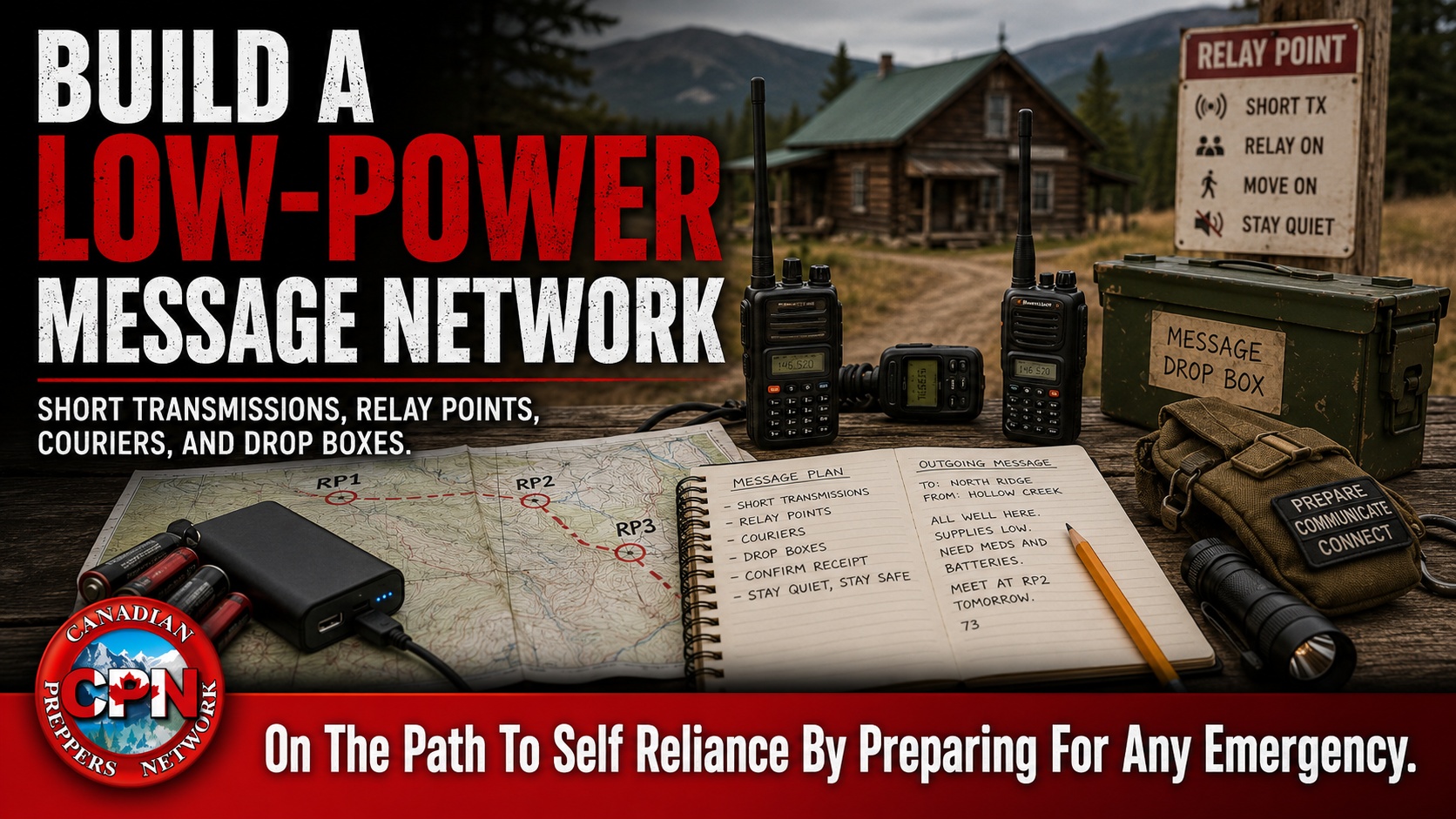
How short transmissions, relay points, couriers, drop boxes, and disciplined schedules can keep a group connected when normal communications are gone
Most prepper communication plans are too fragile because they depend on one thing working.
A cell phone. A repeater. A handheld radio. A group chat. A Starlink terminal. A single person with a ham licence and a better antenna than everyone else.
That may be fine during a storm, a short outage, or a normal emergency where infrastructure is bruised but not broken. It is not enough for a long-term grid-down situation, a regional disaster, or a slow collapse where fuel, power, movement, and trust all become scarce.
Real communication planning is not about buying the strongest radio you can afford. It is about building a system that can still move information when power is limited, people are tired, batteries are low, and nobody wants to transmit more than necessary.
That is where a low-power message network comes in.
A low-power message network is not one device. It is a method. It uses short radio transmissions, fixed check-in times, written messages, relay points, trusted couriers, and dead-drop locations to move information without constantly broadcasting your position, burning through batteries, or depending on a single piece of infrastructure.
If you are just starting to build your household or group communications plan, the CPN Communications hub is a good foundation. But once the basics are covered, the next step is discipline.
You do not need to talk all day.
You need to know what to say, when to say it, who needs to hear it, and what happens if nobody answers.
The Problem With Constant Contact
Modern life has trained people to expect instant replies. Send a text. Wait for the bubble. Call again. Refresh the app. Check the map. Ping the group.
That habit becomes dangerous when communications become scarce.
In a serious emergency, every transmission costs something. It costs battery power. It costs attention. It may reveal activity. It may create confusion. It may draw responses from people who do not need to be involved. It may also tempt untrained people to fill the air with speculation, panic, complaints, or unnecessary updates.
A radio net that turns into casual chatter is not a survival tool. It is noise.
The goal is not constant contact. The goal is reliable contact.
That means short messages. Set times. Known procedures. Clear priorities. Everyone in the group should understand that silence does not automatically mean failure. Silence may mean people are conserving power, staying concealed, working, resting, or waiting for the next scheduled window.
This is why your network needs structure before trouble starts.
Start With Message Windows
The simplest way to reduce power use and confusion is to stop leaving radios on all day.
Instead, create message windows.
A message window is a prearranged time when everyone who needs to communicate turns on their radio, listens first, and transmits only if needed. For example, a household, retreat group, or neighbourhood network might establish check-ins at 0700, 1200, 1800, and 2200. The exact times do not matter as much as consistency.
The first few minutes should be listening time. Nobody talks. Everyone listens for traffic, interference, or signs that the channel is already busy.
After that, one control station or designated lead station checks in with each person or location in order. The structure can be simple:
“Base to North Post. Status?”
“North Post to Base. All quiet. Two vehicles passed eastbound. No contact. Battery good.”
That is enough.
There is no need for long speeches. No need for stories. No need to repeat every rumour. A good message window should feel almost boring. That is a feature, not a flaw.
For a deeper look at practical radio limits, especially in Canadian terrain, see How Far Can Your Radio Really Reach?
Build Around Short Messages
The best emergency messages are short because short messages are harder to misunderstand.
Every group should practise using a basic written format before they ever need it. A message does not need to be military-grade. It just needs to answer the same questions every time:
Who is sending it? Who is it for? When was it written? What happened? Where did it happen? What action is needed?
A simple example:
From: Creek Team
To: Base
Time: 1430
Location: West trail crossing
Message: Bridge damaged. Foot traffic possible. Cart or vehicle movement blocked. Recommend alternate route south.
Action needed: Confirm if supply route should shift.
That message can be spoken by radio, carried by hand, copied into a notebook, or left in a drop box. The format stays the same no matter how the message moves.
That matters because tired people make mistakes. Cold people make mistakes. Stressed people forget details. A standard message format reduces the chance that important information gets lost.
Use Relay Points Instead of More Power
A common mistake in prepper communications is trying to solve every range problem with more power.
Sometimes more power helps. Often, it does not.
Terrain, buildings, forest, hills, valleys, weather, and antenna placement can matter more than output power. A handheld radio at ground level in thick bush may perform poorly even if the battery is full. A lower-powered radio from a better position may do far more.
Instead of assuming every person must reach every other person directly, build relay points into the network.
A relay point is a person or location that can hear two sides that cannot hear each other. That could be a hilltop, a second-storey window, a barn loft, a ridge, a vehicle parked in the right place, or a trusted neighbour between two properties.
The relay operator does not need to interpret the message. In fact, they should not. Their job is to pass the message exactly as received.
If Base cannot reach South Farm directly, but Hill Post can hear both, the procedure becomes simple. Base sends to Hill Post. Hill Post repeats to South Farm. South Farm replies to Hill Post. Hill Post repeats back to Base.
This allows a network to expand without everyone transmitting at maximum power or trying to talk over one another.
For longer regional communication, especially when VHF/UHF handhelds are not enough, NVIS can become an important layer for licensed amateur operators. The CPN article HF NVIS: The Missing Layer In Most Prepper Comms Plans is a useful starting point.
Normal licensing and legal use still matter during ordinary times. The point is to train now, understand the limits now, and build lawful competence before the day you need it.
Do Not Ignore Couriers
Radio is useful, but it is not always the best answer.
Sometimes the safest and most reliable way to move a message is to physically carry it.
A courier can move written information without transmitting at all. That may be slower, but it can also be quieter, clearer, and less dependent on batteries. A bicycle, ATV, snowmobile, canoe, or a person on foot may become part of the communications network.
This is especially true when messages are detailed. Radio is good for short updates. It is not ideal for passing long lists, maps, names, inventory numbers, medical notes, or detailed route instructions.
A good rule is simple:
Use radio for brief status and urgency. Use couriers for detail. Use scheduled check-ins to confirm movement.
For example, a radio message might say:
“Courier leaving Base for East Farm at 0900. Written message in sealed envelope. Expected arrival before 1030.”
That tells the receiver what to expect without broadcasting the full content.
Dead Drops and Message Boxes
A dead drop sounds dramatic, but the idea is simple. It is a prearranged place where written messages can be left for trusted people to collect later.
For preparedness purposes, think of it less like spycraft and more like rural practicality.
A waterproof container under a specific fence rail. A marked jar inside an old shed. A small lockbox at a trail junction. A sealed envelope inside a known mailbox or cache point. The point is not secrecy for its own sake. The point is reliable message transfer when two parties cannot safely or conveniently meet at the same time.
Message boxes are especially useful for retreat groups, nearby homesteads, or family members spread across a rural area. They allow information to move even when radios are off, batteries are dead, or people are away from their listening post.
Every drop location needs rules.
Who may use it? How often is it checked? How is a new message marked? How is an old message removed? What happens if the box is missing or disturbed?
Do not make the system complicated. Complicated systems fail under stress. One container, one notebook, one pencil, one simple marker system, and one clear schedule may be enough.
The CPN article Signaling Your MAG Group To Assemble After A Disaster fits naturally into this larger message-network approach.
Power Is the Hidden Weakness
Most communications plans quietly assume batteries will be available.
That is a dangerous assumption.
A low-power network should be built around rechargeable AA and AAA batteries, USB charging, small solar options, power banks, and radios that can operate for long periods without constant charging. Devices that require oddball proprietary batteries may still be useful, but they should not be the backbone of the plan unless you have spares and a way to recharge them.
Every station should know how long its equipment lasts in real use. Not advertised runtime. Actual runtime.
How long does the radio last while monitoring? How long does it last with regular transmitting? How many full charges can the power bank provide? Can the AA charger run from USB? Can the household solar setup recharge radio batteries before sunset? Can the group keep one radio alive for a week?
Small-scale manual and off-grid charging options are not glamorous, but they matter because communications collapse quickly when batteries become rare. For more on that, see Very Small Scale Manual Power Generation For Charging Essential Devices.
The best radio in the world is just a brick when the battery is dead.
Listening Is Part of the Network
A message network is not only about sending information. It is also about receiving it.
Someone should be responsible for listening. That may include AM/FM broadcast, shortwave, amateur radio nets, local two-way traffic where appropriate, and direct group channels. The listening station should keep a log of what was heard, when it was heard, and whether it was confirmed.
This is where discipline matters again.
Not every report is true. Not every voice is trustworthy. Not every emergency update is current. A message network should separate confirmed information from rumours.
A simple log can use three labels:
Confirmed. Unconfirmed. Needs follow-up.
That one habit can prevent a group from making bad decisions based on panic.
The Emergency Communications Buying Guide is a useful companion piece for households building out the practical equipment side of a communications plan.
Buying Box: Low-Power Message Network Gear
As an Amazon Associate, Canadian Preppers Network may earn from qualifying purchases.
A low-power message network does not require exotic gear. Start with items that help you receive information, send short messages, write things down, protect paper from weather, and keep batteries charged.
Compact AM/FM Shortwave Emergency Radios
Useful for receiving broadcast information when internet and cellular service are down. Look for USB charging, replaceable batteries where possible, and simple controls.
Shop compact AM/FM shortwave emergency radios on Amazon.ca
FRS/GMRS Handheld Radio Sets
Useful for short-range household, property, convoy, and neighbourhood communication. Train with them before you need them and understand realistic range limits.
Shop FRS/GMRS radio sets on Amazon.ca
USB AA/AAA Battery Chargers
A good choice for off-grid systems because they can run from power banks, solar panels, vehicle USB ports, and small backup power stations.
Shop USB AA/AAA battery chargers on Amazon.ca
Rechargeable AA and AAA Batteries
Standard batteries make it easier to support radios, flashlights, headlamps, and small devices without chasing specialty battery packs.
Shop rechargeable AA and AAA batteries on Amazon.ca
Waterproof Notebooks and Pencils
Critical for written messages, logs, drop boxes, courier notes, patrol reports, and message windows.
Shop waterproof notebooks and pencils on Amazon.ca
Map Cases and Document Pouches
Protect route notes, message forms, contact plans, frequency sheets, and printed maps from rain, snow, mud, and rough handling.
Shop waterproof map cases and document pouches on Amazon.ca
USB Power Banks
Useful for keeping small communication devices charged without running a generator for every minor need.
Practise Before It Matters
A message network cannot remain theoretical.
Run a test.
Pick a Saturday morning. Turn off cell phones for two hours. Set one radio check-in window. Send one written courier message. Leave one message in a drop box. Have one person relay a radio message from a better location. Log everything.
Then ask the uncomfortable questions.
Who missed the window? Who talked too long? Who forgot the format? Which radio died first? Which location had poor reception? Which message was unclear? Which person did not know what to do?
That test is more valuable than another online shopping cart full of gear.
Equipment gives you options. Practice gives you competence.
Final Thought
A low-power message network is not about pretending you can rebuild the internet after the grid goes down.
It is about moving the right information to the right people with the least amount of energy, exposure, confusion, and waste.
Short transmissions. Known schedules. Written messages. Relay points. Couriers. Drop boxes. Battery discipline.
That is how communication survives when convenience disappears.
The group that can still pass a clear message after the phones die is already ahead of most people.



One Comment