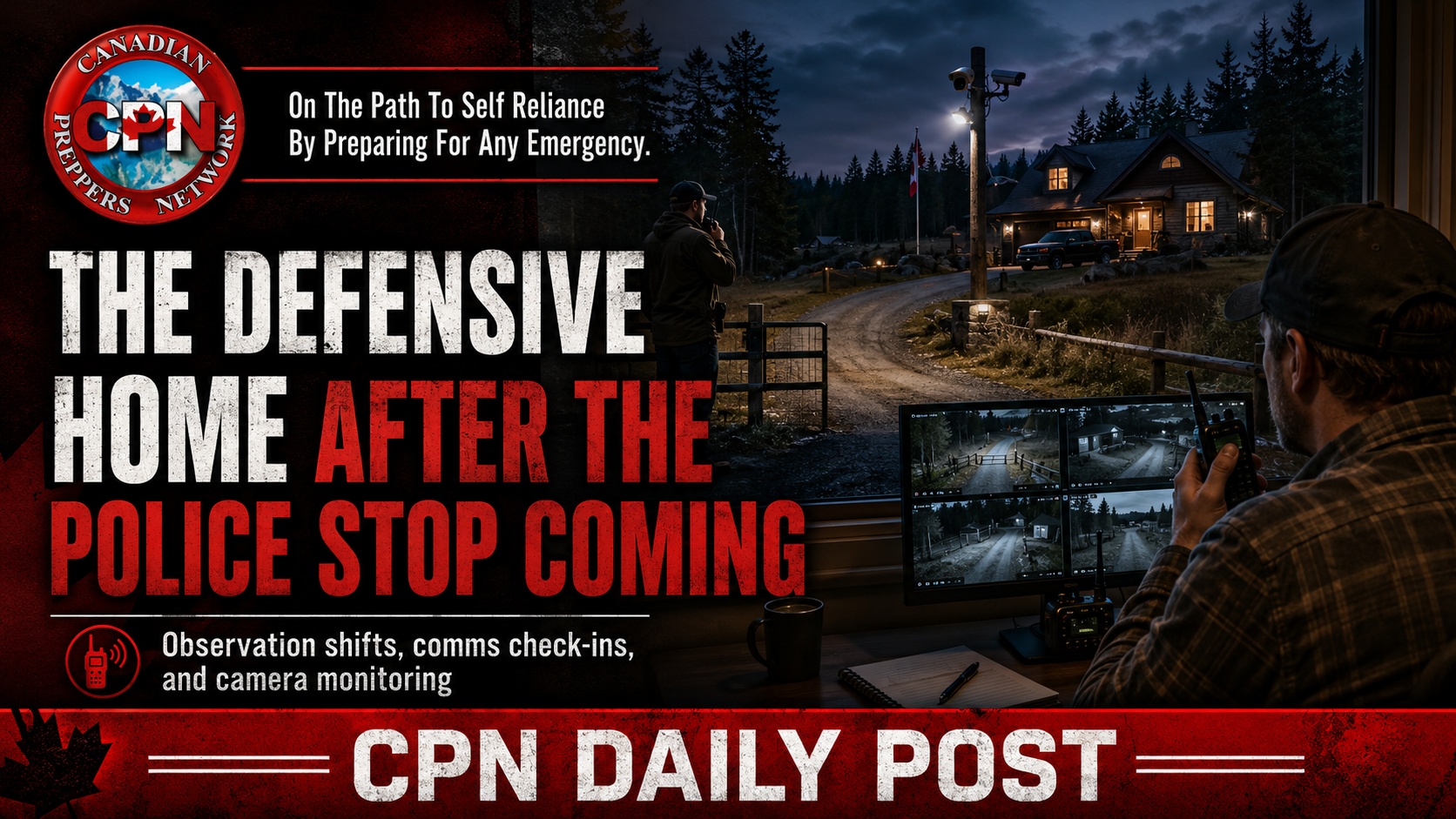
When official response is delayed or absent, home defense becomes a routine of observation, communication, early warning, and disciplined decision-making.
There is a comforting lie buried in most modern home security advice.
Install a camera. Lock the door. Call 911. Wait for help.
That works when the power is on, the roads are open, the phones are working, and emergency services are functioning normally. But serious preparedness has never been about normal. It is about the moment when normal systems slow down, become overwhelmed, or stop answering entirely.

In a long blackout, civil disorder, evacuation breakdown, fuel shortage, ice storm, wildfire displacement, economic collapse, or deep rural emergency, the police may not be coming quickly. They may be dealing with larger threats. They may be blocked by weather, road damage, manpower shortages, communications failures, or simple distance.
In that environment, a defensive home cannot be treated like a passive building with locks on the doors. It has to function like a watched location.
That does not mean playing soldier. It means having awake eyes, working radios, charged batteries, monitored cameras, controlled access, and a routine that does not collapse the moment people get tired.
A defensive home after the police stop coming is not defended by one dramatic act. It is defended by boring, repeated discipline.
Someone is watching.
Someone is listening.
Someone knows who is supposed to check in.
Someone notices when a vehicle slows down twice at the end of the lane.
Someone checks the camera feed before opening the door.
Someone logs the stranger who walked past the shed at dusk.
Someone knows when the next radio check is due.
That is real defense.
Defense Starts With Observation
Most home security plans fail because they begin too late. They begin when someone knocks, when glass breaks, when the dog explodes at the door, or when a family member sees movement outside after dark.
By then, the household is already reacting.
A serious defensive home needs a watch routine. Not a fantasy patrol. Not people wandering around tired in the dark. A watch routine means assigned observation periods, known responsibilities, radio check-ins, camera monitoring, and a clear understanding of what counts as unusual.
In normal times, you can afford to ignore a strange vehicle at the end of the road. In a collapse, that vehicle may be nothing — or it may be someone studying houses, checking who has power, listening for generators, watching smoke from chimneys, or looking for an easy target.
The observer’s job is not to confront. It is to notice early.
That single distinction matters. Observation buys time. Time allows the household to wake people, secure doors, move children or elderly family members, bring animals in, shut off unnecessary lights, stop noisy equipment, check cameras, call neighbours, or prepare for a controlled conversation at the gate.
Without observation, everything becomes a surprise.
The Watch Shift Becomes the First Defensive Layer
In a prolonged emergency, especially after dark, the household should not drift into sleep with no one assigned to awareness. That does not mean everyone stays awake all night until they are useless. It means the group creates a sustainable watch schedule.
A watch shift can be simple. One person awake. One person designated as backup. A radio within reach. A flashlight available but not constantly waving around. Cameras or sensors checked at set intervals. A written log nearby. A clear rule for when to wake others.
The watcher is not there to be heroic. The watcher is there to preserve reaction time.
That person should know the property well enough to recognize what belongs and what does not. Which lights are normal? Which animals make noise at night? Which neighbour’s vehicle passes late? Which trail camera usually gives false alerts? Which side of the house catches headlights from the road? Which dog bark means wildlife, and which one means human movement?
This kind of local knowledge is worth more than most gadgets.
A prepared home should also avoid vague instructions like “keep an eye out.” That means nothing under stress. A watcher needs specific responsibilities.
Watch the driveway. Check the camera feed. Listen for dogs, engines, voices, breaking branches, gate noise, or outbuilding doors. Confirm the radios are on. Log unusual activity. Do not open the door. Wake the backup if something feels wrong.
That is much better than everyone assuming someone else is paying attention.
Camera Monitoring Is Not the Same as Having Cameras
Many preppers buy cameras and then treat the purchase as the solution. It is not.
A camera that no one checks is just a recorder. A camera without backup power may be dead when needed most. A camera tied entirely to home internet may be useless during an outage. A camera pointed at the wrong approach may give a beautiful view of nothing while someone walks up from the side yard.
Camera monitoring needs to be part of the routine.
During normal life, cameras are often used after the fact. Someone steals a package, breaks into a shed, or walks around the property, and the owner checks footage later. That is evidence gathering. It may help police later, but it does not help much during an active emergency.
In a collapse scenario, cameras become early warning tools only if someone is checking them.
A practical setup should cover the most likely approach routes: driveway, gate, front door, rear entrance, garage, outbuildings, fuel storage, livestock areas, and blind corners. Rural properties may also need eyes on laneways, trails, ATV access points, and secondary approaches from bush or field edges.
The camera monitor does not need to stare at screens every second. That burns people out. Instead, cameras should be checked on a schedule, checked after alerts, and checked before anyone opens a door or walks outside.
A simple camera routine might include a morning check to confirm cameras are working, lenses are clear, batteries or power supplies are good, and overnight alerts have been reviewed. A daytime check should happen when dogs alert, vehicles slow down, someone approaches, or work crews are outside. An evening check should review vulnerable areas before dark, confirm gates and outbuildings are secure, and make sure camera views are not blocked. A night watch check should review feeds at set intervals, especially the driveway, gate, rear approach, and outbuildings.
That is not complicated. It is discipline.
The camera system should also have a low-tech backup. If the internet is down, can the cameras still record locally? If power is out, are they battery, solar, or backed up? If the monitor is dead, can someone physically observe the same area from a safe interior position? If cameras fail entirely, does the watch routine still work?
Technology is useful, but it should never be the only layer.
Radio Check-Ins Prevent Confusion
Communications are often treated as a separate preparedness topic, but in a defensive home they are part of the security system.
If someone is in the barn, workshop, garden, woodlot, gate area, or neighbouring property, they need a way to check in. If someone inside sees trouble on camera, they need a way to warn the person outside. If the night observer hears something near the shed, they need a way to wake or alert others without shouting through the house.
Radios solve a simple problem: they keep people connected when phones are dead, overloaded, or impractical.
But owning radios is not enough. The household needs radio discipline.
Everyone should know the primary channel. Everyone should know the backup channel. Everyone should know when check-ins happen. Everyone should know what to say and what not to say. Loose chatter wastes batteries, creates confusion, and may reveal information to anyone listening.
A check-in does not need to be dramatic. It can be plain and boring.
“House to workshop, status check.”
“Workshop good.”
“Next check in thirty.”
That is enough.
During a serious disruption, scheduled check-ins should become routine. A person working outside checks in at agreed times. The observer confirms the check-in. A missed check-in triggers a follow-up. A second missed check-in wakes the backup or sends another trusted person to observe from a safe position.
The key is deciding the rule before emotions are involved.
If you make it up under stress, people will argue. If the rule already exists, people act.
For a multi-family retreat, farm, or larger rural property, this becomes even more important. The kitchen, sleeping area, gate, workshop, animal area, garden, water point, and woodlot may all be separate zones. Without radios, people become isolated pockets. With radios and scheduled checks, the property becomes one connected system.
The Logbook Is More Important Than It Sounds
A defensive home should keep a simple security log during serious disruptions.
That may sound excessive until you have three tired people trying to remember whether the same truck passed twice, which neighbour came by asking about fuel, what time the dog barked near the barn, or whether the camera alert was before or after the power flickered.
Memory fails under stress. Logs do not.
The log does not need to be fancy. A notebook, pencil, time, event, location, and initials are enough.
Examples might include a vehicle slowing near the driveway, a dog alert toward the rear shed, a radio check with the barn, a motion light triggered near the woodpile, or an unknown person walking the road with a flashlight.
Over time, the log shows patterns. Repeated vehicle passes. Recurring movement near one weak point. A neighbour who always arrives after dark. A camera that gives false alerts when wind moves a branch. A gate that gets left open by the same person.
Patterns matter.
Without a log, each event feels isolated. With a log, the household starts to understand its own security environment.
Shift Changes Need Structure
The weakest moment in any watch system is the handoff.
One person is tired. Another person is half-awake. Information gets forgotten. A camera alert is dismissed. A radio battery is almost dead. A flashlight was moved. The gate was never checked. The next observer assumes everything is normal.
This is how routines fail.
Every shift change should include a short handover. Nothing formal or theatrical. Just enough to transfer awareness.
What happened during the last shift? Were there any camera alerts? Are all radios charged? Was the gate checked? Are all household members accounted for? Are animals calm? Are there any noises, vehicles, lights, or movement to keep watching? What is the next scheduled check-in?
The outgoing observer should not disappear until the incoming observer understands the situation. In a household under stress, this kind of structure prevents dangerous gaps.
The same applies in the morning. The person who slept through the night should know if anything happened. If a strange vehicle passed three times at 2 a.m., that matters before someone walks down the driveway at sunrise.
The Door Should Never Be the First Warning
A knock at the door should not be the first sign that someone is on the property.
By the time someone reaches the door, the household should already know they are there. The camera should have seen them. The dog may have alerted. The observer should have noticed movement. A driveway alarm may have sounded. Someone should already be awake, aware, and thinking.
This changes the entire interaction.
A prepared household does not stumble to the door, open it halfway, and try to figure out what is happening while standing exposed. The household checks the camera, confirms who is outside, keeps the door closed, and speaks from a protected position if necessary.
During a breakdown, the door is not a social space. It is a boundary.
Children do not answer. Guests do not answer. Elderly family members are not left to handle unknown visitors alone. The person who speaks at the door should already be chosen by the household. That person should know the rules.
Unknown people do not come inside. Supplies are not discussed. Storage areas are not visible. The door does not open just because someone is emotional, demanding, or desperate. Help, if offered, is controlled. The household does not reveal how many people are home, who is sick, who is alone, what equipment is available, or what supplies are stored.
This is not cruelty. It is boundary control.
Neighbour Communication Can Extend the Defensive Perimeter
A single household can only see so much. Trusted neighbours can extend awareness without making anything obvious.
In a rural area, a neighbour may see a vehicle before it reaches your lane. In a small town, someone may notice strangers checking sheds, fuel cans, parked vehicles, or back doors. In a retreat group, another family may hear rumours, see smoke, spot roadblocks, or notice unusual traffic.
This is where communication becomes defense.
A small, trusted radio net or phone tree can provide early warning long before trouble reaches the door. It does not need to be dramatic. It can be as simple as three households agreeing to report unusual road activity, suspicious visits, fire, medical emergencies, or requests for supplies.
The key word is trusted.
Not every neighbour needs to know your setup. Not every person gets invited into the information circle. Loose networks become gossip. Tight networks become useful.
A good neighbour check-in might include road conditions, unusual visitors, medical concerns, fuel availability, weather changes, and local tension. It should not include supply counts, defensive details, or anything that would make your household a target if repeated.
In a long emergency, information is security.
Fatigue Is the Enemy
The hardest part of a watch routine is not the first night. It is the fifth night. The tenth night. The third week.
People get tired. They get sloppy. They skip check-ins. They stop writing things down. They assume the camera alert is another branch. They leave radios uncharged. They forget gates. They open the door too quickly because they are irritated instead of alert.
Fatigue ruins good plans.
That is why the routine has to be sustainable. Do not create a watch schedule that destroys the household in two days. Do not put the same person on the worst shift every night. Do not expect one strong personality to carry the whole security burden. Do not confuse exhaustion with dedication.
A tired observer misses things.
Rotate shifts. Shorten watches if needed. Pair inexperienced people with experienced people when possible. Keep caffeine, water, warm clothing, notebooks, charged lights, and spare radio batteries available. Make the watch station comfortable enough that someone can stay alert, but not so comfortable that they fall asleep.
A defensive home is only as strong as its routine under fatigue.
Children, Guests, and Non-Watch Members Still Need Rules
Not everyone in the home will stand watch. That is fine. But everyone still needs to understand the household rules.
Children need to know not to answer the door. Guests need to know not to mention supplies. Elderly family members need to know who to call inside the house if someone approaches. Teenagers need to know that posting generator noise, food stores, or “we still have power” online is not harmless. Visitors need to understand that the household does not discuss storage, fuel, tools, radios, or defensive routines with outsiders.
Most security leaks are not malicious. They are casual.
Someone says too much at the wrong time. Someone complains about how much food is stored. Someone mentions that the family has solar power, medicine, fuel, radios, or a warm house. Someone posts a photo with recognizable supplies in the background.
The watch routine protects the property. Information discipline protects the household.
Both matter.
Gear Should Support the Routine
Gear should support the defensive routine, not replace it.
A pile of gadgets does not create security. A household with no observation schedule, no check-ins, no camera monitoring, no logbook, and no door policy is still weak, even if it owns cameras and radios.
The right gear helps people follow the plan.
A driveway alarm gives the watcher a cue. A trail camera watches the back approach. A rechargeable flashlight keeps the observer functional. A radio connects the barn to the house. A notebook preserves patterns. A solar motion light exposes movement. A door reinforcement kit buys time. A lockable storage box keeps useful tools from being turned against the property.
The equipment matters, but only when attached to a routine.
Related CPN Reading
Exterior Barriers That Restrict Access
Emergency Communications Buying Guide
What Actually Stops a Home Invasion When the Grid Is Down
Prepared Home Defense Buying Box
Disclosure: As an Amazon Associate, Canadian Preppers Network may earn from qualifying purchases.
This article is not about buying random security gear. It is about building a defensive routine around observation, communication, early warning, and delay.
Driveway Alarm Sensors
Driveway Alarm Sensors
Trail Cameras
Trail Cameras
Battery-Powered Motion Alarms
Battery-Powered Motion Alarms
Solar Motion Security Lights
Solar Motion Security Lights
FRS/GMRS Handheld Radios
FRS/GMRS Handheld Radios
Rechargeable Flashlights
Rechargeable Flashlights
USB Battery Chargers
USB Battery Chargers
Weatherproof Notebooks
Weatherproof Notebooks
Door Reinforcement Hardware
Door Reinforcement Hardware
Lockable Storage Boxes
Lockable Storage Boxes
Bottom line: Gear does not replace discipline. The useful equipment is the equipment that supports observation, communication, logging, early warning, and delay.
Final Thought
A home is not defended only by locks, cameras, or strong doors.
It is defended by awake people following a serious routine.
The household that survives a long emergency may not be the one with the most expensive security system. It may be the one that keeps a watch schedule, checks in by radio, monitors cameras, logs unusual activity, controls the door, and notices trouble before trouble reaches the porch.
When official response is delayed or absent, the defensive home becomes its own early warning network.
That is the shift.
Not paranoia.
Not fantasy.
Just disciplined observation, reliable communication, and enough warning to act before the situation is already inside the house.